


How a Magnetic Flip Box Actually Closes
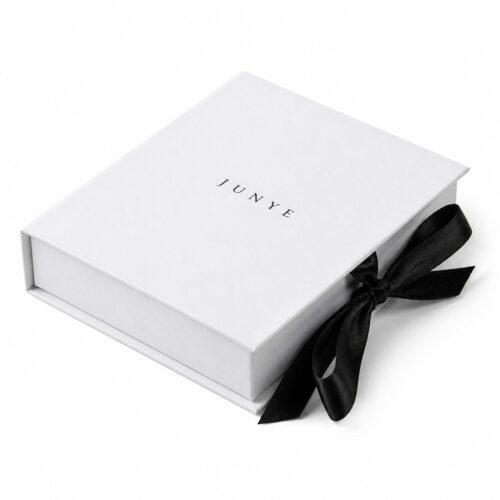
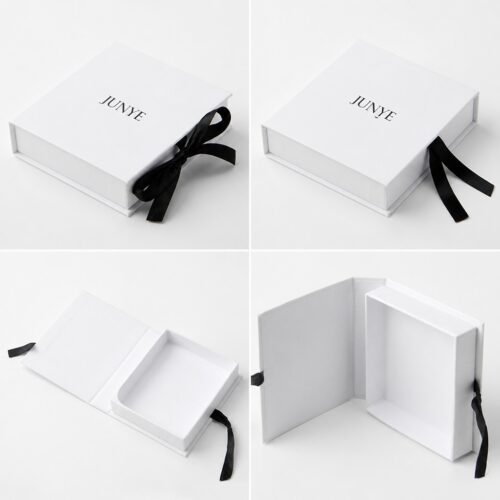
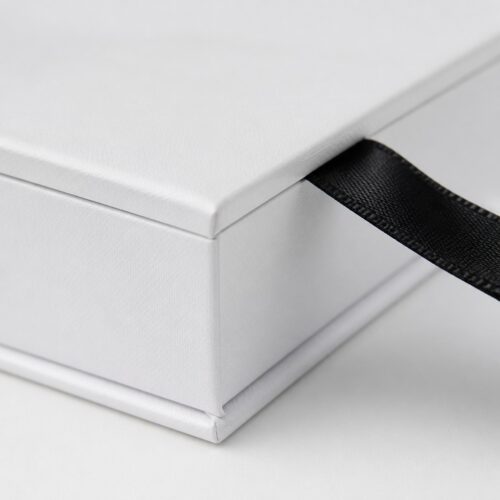
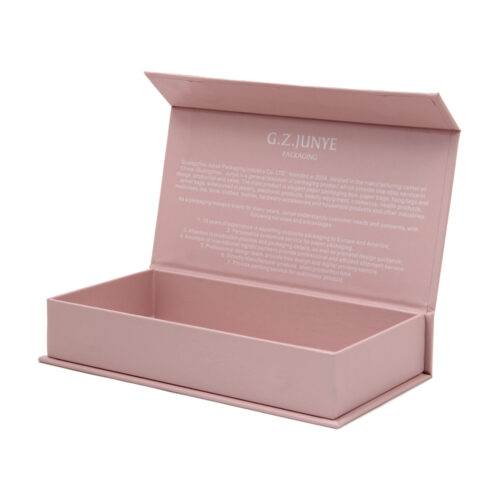
One piece of board carries the base and the lid together. A crease joins them along a single edge, so the lid is
never taken off the box: it swings up on that crease and comes back down. There is no tray to pull out, no sleeve to
slide, and no second lid to put down while the customer looks inside.
What keeps it shut is a pair of magnets set into the front edge. Lower the lid and it pulls itself flat against the
base; the ribbons hang loose until someone decides to tie them. That is the practical difference between a box that has
to be fastened and one that simply closes.
| Structure | Rigid flip box — base and lid cut from one piece, joined along one edge |
| Opening | Lid swings up on the edge crease, then drops back down |
| Closure | Magnet in the front edge — holds closed with or without ribbon |
| Parts count | One — nothing to assemble, nothing to lose |
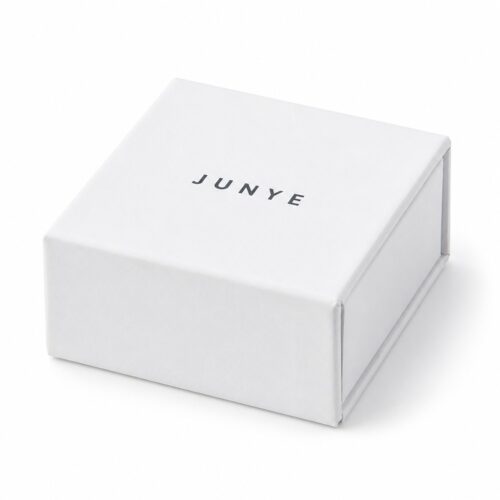
| Size | 9 x 9 x 2.5 cm |
| Outer | Matte white specialty paper over rigid gray board |
| Lining | White paper |
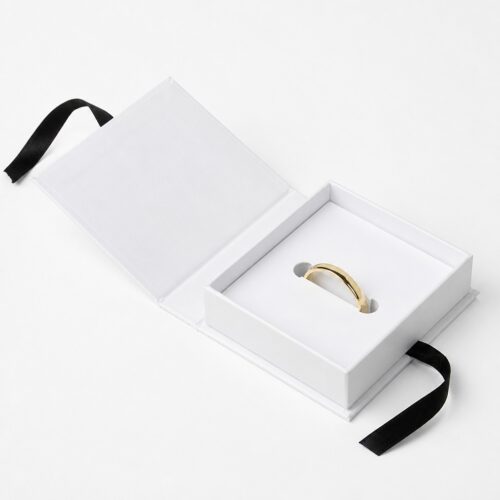
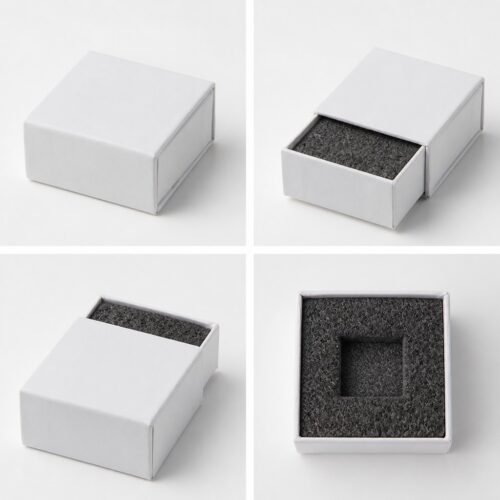
| Tray (choose one) | EVA tray / sponge pad / velvet lined pad, cut to your outline |
| MOQ | 300 pcs |
The Magnet at the Front Edge: What It Changes
Ribbon boxes raise one question at the counter: what holds it shut once the bow comes loose? On this box the answer
is not the bow.
| Bow tied | Lid held by the magnet, ribbon purely decorative |
| Bow loosened or untied | Lid still sits flat and stays shut |
| In a bag | Nothing catches or snags; the box cannot fall open |
| In a mailer | Closed lid protects the piece before it is opened |
| Re-opened | Lid releases by hand, no tearing, no tape |
The magnet sits behind the wrapped surface, so nothing is visible when the box is closed. This is the one structural
point that separates it from a plain flip top box with a tuck flap.
Two Satin Ribbons, One Job
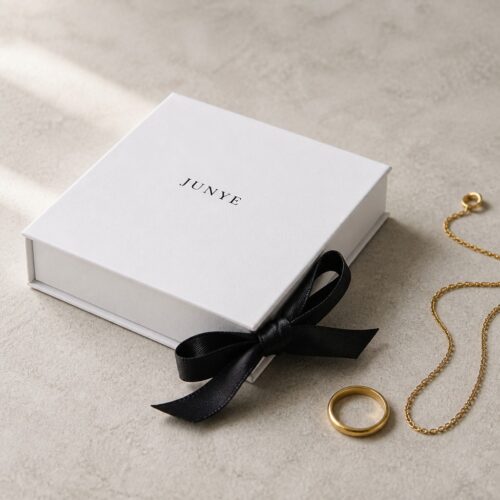
Each ribbon is anchored on its own part — one on the lid, one on the base — so they meet near the middle
when the box is shut.
| Count | Two black satin ribbons |
| Anchored | One to the lid, one to the base |
| Function | Decorative — the bow is not what holds the box |
| Can be left loose | Yes; the box still closes and stays closed |
| Custom | Ribbon colour and width made to your brand |
A bow reads as a gift detail on a counter, in a photograph or on a dispatch note. Because the closure does not depend
on it, a shop can also display the same box with the ribbons flat and the lid shut.
The Square 9 x 9 x 2.5 cm Format
Depth is what decides whether a small box looks like packaging or like a jewellery case. At 2.5 cm this one stays
low and square, so the piece lies in a single plane and nothing is tucked away underneath.
| Bracelet | Laid flat across the tray |
| Necklace | Chain run in one row, or curled into the velvet pad |
| Ring, earrings | In a cut slot or a pair of slots |
| Small set | Two or three pieces side by side |
| On a shelf | Low enough to stack or stand in a display row |
A square footprint also means the same box works for a bracelet box run and a
earring box run, with only the tray outline changing.
The White Wrap and How a Logo Sits on It
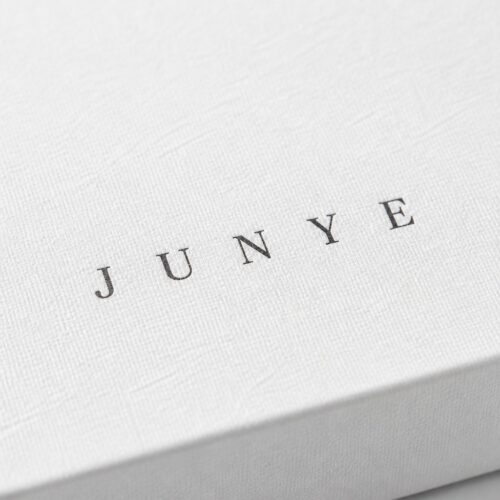
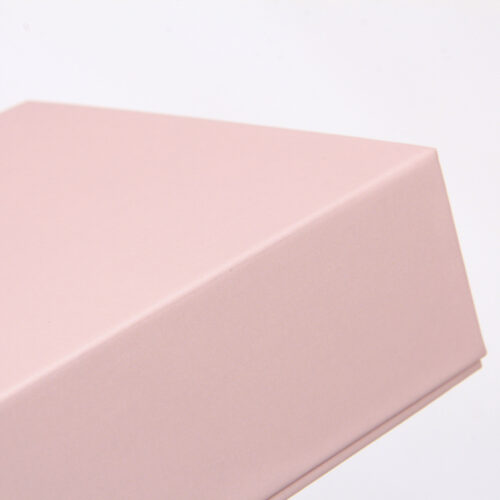
White shows marks, so the surface has to be chosen with that in mind. The wrap is a matte specialty paper with a fine
grain, and the lid interior is lined in white so the two surfaces match when the box is open.
| Core | Rigid gray board, wrapped, keeps the corners square |
| Wrap | Matte white specialty paper with a fine grain |
| Lining | White paper, matched to the wrap |
| Why matte | No glare under shop lights or in product photos; hides fingerprints |
| Paper sourcing | FSC-compliant paper (sourced from FSC-certified suppliers) on request |
Paper tone is the one thing to settle on a physical sample: a white foil box under warm shop lighting reads warmer
than the same box photographed on a white sweep.
Logo Finishes That Hold Their Edge on White
On a white surface, contrast comes from the mark itself rather than from the background.
| Foil stamping | Gold, silver or a matched brand colour; the usual choice for contrast |
| Screen printing | Flat ink, clean on solid marks and one or two colours |
| Embossing | Raised relief, uncoloured, read by light rather than by contrast |
| Debossing | Recessed mark, quietest of the four on white |
| UV spot | Gloss varnish over matte white, a sheen change rather than a colour |
Send artwork or a photo of the mark and you get a die cut drawing back to approve before any foil goes down.
Choosing the Tray: EVA, Sponge or Velvet Pad
The tray decides which pieces the box can carry, and one shell covers a whole line.
| EVA tray | Firm, cut precisely; best for rings and heavier pieces |
| Sponge pad | Soft with cut slots; holds a shape without pressing on it |
| Velvet lined pad | Softest surface under a chain or a stone; a presentation finish |
All three sit in the same 9 x 9 cm base, so the choice can change between SKUs without touching the box artwork,
the wrap or the ribbon.
Cutting the Tray to Your Jewelry Outline
A tray works when four things are known before the die is made.
| 1. Outline | A tracing, a photo on graph paper, or the piece itself |
| 2. Sitting height | The piece must clear the rim of the base, not press the lid shut |
| 3. Clearance | Clasps, links and curved sections must not catch on the tray edge |
| 4. Range | The other pieces that should share the same tray footprint |
The tray drawing and the box die cut are approved together, and both are checked on the physical sample.
A Box That Travels as Its Own Mailer
A 2.5 cm profile changes where the box can go. It fits a padded envelope, a courier satchel or a drawer slot, which
means the packaging does not need a second carton around it for a single-piece shipment.
| Single shipment | Goes out in a padded envelope without extra wrapping |
| Retail storage | Low enough to stand in a display row or stack flat |
| Counter use | Ribbons can be tied for display, or left flat for stacking |
| If you need a presentation tray | That is a different build — see our lid and base box and two-way drawer box, where the piece is lifted out or drawn out instead of hinged open |
Sampling: Five to Seven Days
A flip box is signed off as a physical object, not as a drawing, and the piece that settles it is the magnet
position and the lid gap.
| Artwork and die cut proof | 1-3 days, before sampling starts |
| Sampling | 5-7 days |
| What the sample settles | Paper tone, lid-to-base gap, magnet strength, tray cut |
| MOQ | 300 pcs |
Order a trial piece from the free sample page and it is made on the line the bulk order
will run on.
Production: 18-25 Days After the Sample Is Signed Off
Bulk timing starts from the approved sample and the deposit.
| Standard run | 18-25 days |
| Small batch | 10-15 days |
| New die or peak season | 25-30 days |
A first-time cutting die and a seasonal queue are the two factors that move the date; both are flagged when the
quotation is issued, so the schedule is agreed before the run begins.
What Gets Checked on Every Unit
For a flip box, the closure is the part that decides whether the box works in the customer’s hand.
| 1. Magnet pull | Lid closes and stays closed without help from the ribbon |
| 2. Lid alignment | Edges meet evenly on all three sides when shut |
| 3. Crease | Lid opens freely on the hinge crease, without cracking the wrap |
| 4. Ribbon fixing | Both ribbons firmly anchored, even in length and colour |
| 5. Print | Logo position and finish against the approved sample |
| 6. Tray | Cut matches the drawing; the piece sits below the rim |
| 7. Surface | No scuffs on the matte white wrap, no glue showing at the edges |
Boxes are checked after assembly, and the paper, board and magnet specification is filed so a repeat order matches.
Where This Box Is Made
Guangzhou Junye Packaging Industry Co., Ltd. builds this flip box at its own site in Baiyun District, Guangzhou —
a 5,000 sqm factory with more than 50 skilled workers, serving buyers since 2004.
| Printing | Offset printing, laminating and die cutting in house |
| Assembly | Board wrapping, magnet setting, ribbon fixing, tray cutting |
| Checking | Incoming board and paper inspection, finished-goods inspection |
Having laminating and die cutting in the same building is what keeps the white wrap and the logo registration
consistent from the approved sample through to a repeat order. Background is on our about us page.
Paperwork That Comes With the Order
Documents we can supply for this box:
| ISO9001:2015 | Certificate No. ZYC24Q00141R1S, valid until 28 Nov 2027, covering paper packaging boxes and paper bags |
| RoHS | Test report for the paper box build |
| EPR Germany | LUCID registration DE2463045771631 |
| EPR France | CITEO registration FR292146_01UOMY |
| EU GPSR | Responsible person details issued with the order |
| Paper | FSC-compliant paper (sourced from FSC-certified suppliers) available |
The certificate scope excludes food-contact inner packaging; this is a rigid presentation box rather than a
food-contact pack.
Export Packing, Delivery and How to Start
Boxes are protected individually and cased for export, then sent to your agent or delivered door to door.
| Unit protection | PP anti-scratch bag per box |
| Export carton | Corrugated carton; pieces per carton agreed with you |
| Pallet | 120 x 100 cm pallet on request |
| Terms | EXW, FOB or DDP door delivery |
| Reply time | Within 4 hours on working days |
Send the piece you need to present — a sketch with measurements is usually enough — and you get the cutting
drawing and a trial of the jewelry packaging box itself. Structure questions are
collected on our FAQ page.




Reviews
There are no reviews yet.