


A 26 cm Box Built for a Set, Not a Single Piece
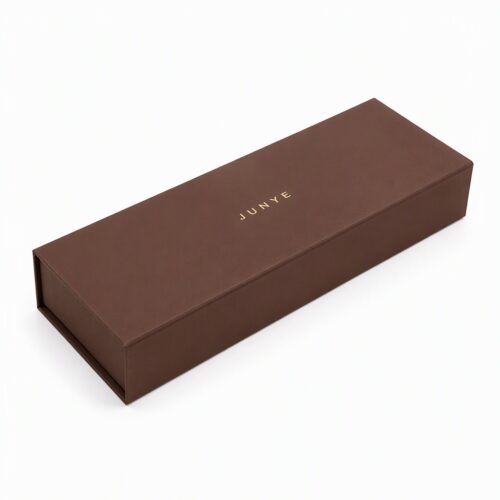
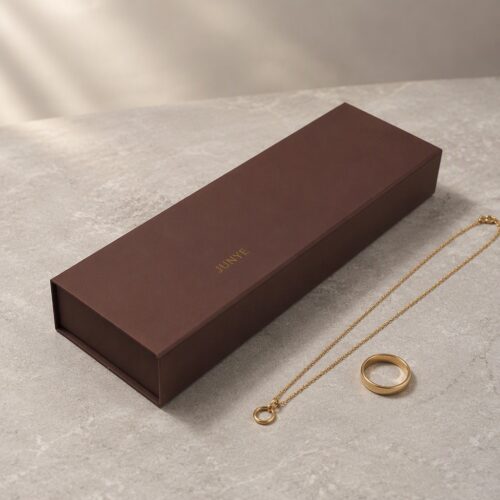
Most jewellery boxes are sized around one piece. This one is sized around a group: 26 cm long, 9 cm wide and 4 cm
deep, a shallow tray format that reads as a presentation case rather than a small gift box.
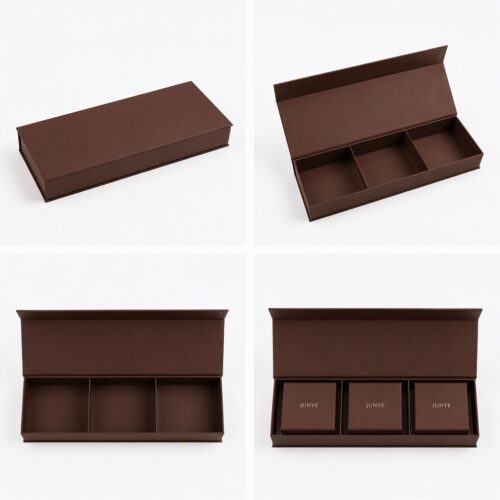
The lid and the base come from the same piece of board, joined along one long edge. It opens upward on that edge and
returns the same way — there is no separate lid resting on the table while your customer looks inside, and nothing
to reassemble afterwards.
| Format | Long rectangular flip box, 26 x 9 x 4 cm |
| Lid | Joined to the base along one long edge; opens like a book cover |
| Closure | Two magnets at the opening edge — no ribbon, no bow, no tuck flap |
| Inside | Two fixed dividers forming three equal compartments |
| Outer | Brown specialty paper wrapped over rigid gray board |
| Lining | Matching brown paper |
| MOQ | 300 pcs |
Closing Without Ribbon: What the Magnets Do
This box has no ribbon at all. The lid is held by two magnets set into the opening edge, and that single decision
changes how the box behaves in use.
| On a shelf | Stays shut with nothing tied around it |
| Handed to a customer | Opens by hand, closes by itself |
| In a shopping bag | Cannot fall open; no loose ribbon to catch |
| In a courier outer | Closed lid protects the set before it is opened |
| Repeat openings | No bow to retie, so the box looks the same after every sale |
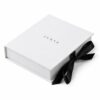
If you would rather have the ribbon look, that belongs on a different build — our
white flip box carries two satin ribbons, and this one stays clean.
Two Dividers, Three Equal Compartments
Inside, two fixed dividers split the base into three compartments of the same size. They are part of the box
construction rather than a loose insert, so they stay square through handling and travel.
| Divider count | Two fixed dividers |
| Result | Three equal compartments across the length |
| Depth | 4 cm outer height; compartments sit under the lid line |
| Effect | Pieces stay apart; chains do not cross, stones do not touch |
Even compartments matter commercially: the same box then takes a single set, three small boxes, or a mixed
arrangement, without a new die for each scenario.
Use One: A Die Cut Insert for a Whole Set
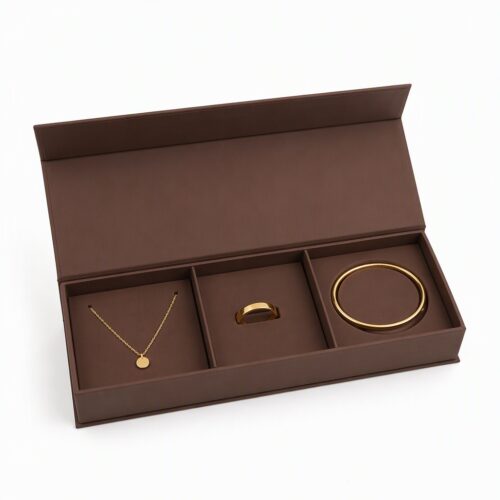
The first way to fill the box is to keep the dividers and drop in a cut insert that turns the three compartments into
fixed positions for a whole set.
| Necklace | Chain run in one compartment, pendant resting on the insert |
| Bracelet or bangle | Laid flat in its own compartment |
| Ring and earrings | Cut slots in the third compartment, side by side |
| Material | EVA, sponge or velvet lined pad |
This is the configuration for a bridal set, a first-order gift or any product where the pieces are meant to be seen
together in a fixed arrangement. For single-piece versions of the same idea, the
necklace box and ring box pages cover the smaller formats.
Use Two: Three of Your Own Jewelry Boxes Inside
The second way needs no insert at all. Keep the three compartments empty and place three of your small jewellery
boxes straight into the tray — one per compartment.
| What goes in | Three of your own small boxes, one per compartment |
| Compartment fit | Agreed against your box dimensions before the run |
| Advantage | One outer case presents three separate items or three price points |
| Retail use | The set can be taken apart and each box sold or given on its own |
The dividers are what make this work: small boxes cannot shift into each other’s space. Send us the dimensions of
the inner boxes and the divider spacing is set to suit them.
Brown Specialty Paper over Gray Board
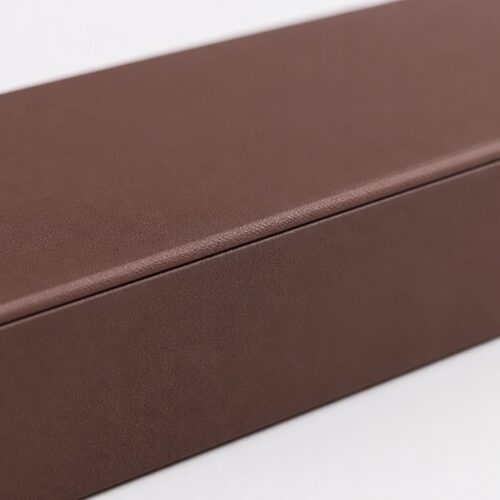
The wrap is a brown specialty paper with a fine grain over a rigid gray board core, and the lining is matched to the
same brown so the inside and outside belong to one object.
| Core | Rigid gray board; holds the long edges straight at 26 cm |
| Wrap | Brown specialty paper with a fine grain, matte finish |
| Lining | Matching brown paper |
| Why brown | Reads warmer than black in photographs and less formal than white for a set |
| Paper sourcing | FSC-compliant paper (sourced from FSC-certified suppliers) available |
On a long box, board stiffness is the detail that matters most: a lighter core shows a curve along a 26 cm edge. Worth
settling on the physical sample rather than on a screen.
Logo Finishes on a Brown Wrap
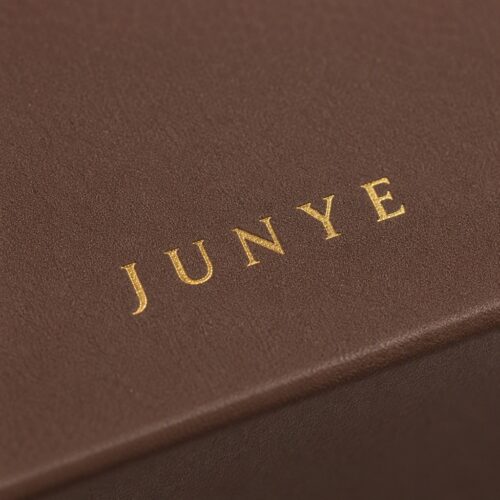
A mid-tone brown takes foil and relief differently from white or black, so the finish is chosen against the paper
rather than from a colour chart.
| Foil stamping | Gold reads warm against brown; silver stays cooler |
| Embossing | Raised relief, uncoloured, caught by side light |
| Debossing | Recessed mark; quietest option on a grained paper |
| Screen printing | Flat ink for one or two colours |
| UV spot | Gloss varnish over matte paper, a sheen change only |
Send artwork or a photograph of the mark and a die cut drawing comes back for approval before anything is stamped.
Three Insert Materials and How They Differ
Where a cut insert is used, the material decides how the piece sits and how the set photographs.
| EVA | Firm and precisely cut; the practical choice for rings and heavier pieces |
| Sponge | Soft and forgiving; holds a shape without pressing on it |
| Velvet lined pad | The softest surface under a chain or a stone; a presentation finish |
All three are cut to the same drawing, so switching between them does not change the box, the dividers or the
artwork — only what sits inside.
What We Need to Cut the Insert
Four details fix the drawing. They are simple, but each one changes the cutting die, so they are settled before the
sample is made rather than after.
| 1. Tracing | The outline of each piece, or the pieces themselves |
| 2. Compartment assignment | Which piece sits in which of the three compartments |
| 3. Sitting height | How high each piece finishes, so nothing presses the lid |
| 4. Range | The other pieces the same insert should accept |
Where the box will also be sold with three inner boxes, send those dimensions too: divider spacing and insert cut are
agreed in the same drawing.
Sampling a Set Box: Five to Seven Days
A set box is approved as a physical object. On this build the parts that decide it are the divider spacing, the magnet
pull along a 26 cm edge, and the fit of the insert.
| Die cut drawing | 1-3 days from your artwork or reference |
| Sample | 5-7 days after the drawing is approved |
| MOQ | 300 pcs |
| Trial piece | Made on the same line as the bulk order |
Ask for a trial through the free sample page and test the closure with your own set loaded.
Bulk Production After Approval
Timing starts once the sample is signed off and the deposit is in.
| Standard production | 18-25 days |
| Small batch | 10-15 days |
| New die or peak season | 25-30 days |
Dividers and insert share one die set, so a change to the compartment layout after approval means a new die and a new
date. Fixing the layout at sampling keeps the schedule.
Quality Checks Before Packing
On a long flip box the closure and the long edges are where faults show, so they are checked piece by piece after
assembly.
| 1. Lid pull | Lid closes on magnet force alone along the whole length |
| 2. Edge line | No bow or curve along the 26 cm sides |
| 3. Divider set | Two dividers square, three compartments equal |
| 4. Insert fit | Cut matches the drawing; pieces finish below the lid line |
| 5. Surface | Brown wrap free of scuffs; no glue at the edges |
| 6. Print | Mark position and finish against the approved sample |
Paper, board and magnet specifications are filed with the order, so a repeat run matches the first.
Made in Our Guangzhou Factory
The box is produced by Guangzhou Junye Packaging Industry Co., Ltd. at its own site in Baiyun District, Guangzhou: a
5,000 sqm factory with more than 50 skilled workers, serving overseas buyers since 2004.
| Printing | Offset printing, laminating and die cutting in house |
| Making up | Board wrapping, magnet setting, divider assembly, insert cutting |
| Checking | Incoming material inspection and finished-goods inspection |
Wrapping and die cutting under one roof is what keeps a 26 cm wrapped edge straight from sample to repeat order.
Company background is on our about us page.
Compliance Documents Available for This Box
| ISO9001:2015 | Certificate No. ZYC24Q00141R1S, valid to 28 Nov 2027 (paper packaging boxes and paper bags) |
| RoHS | Test report for the paper box build |
| EPR Germany | LUCID registration DE2463045771631 |
| EPR France | CITEO registration FR292146_01UOMY |
| EU GPSR | Responsible person details issued with the order |
| Paper | FSC-compliant paper (sourced from FSC-certified suppliers) available |
The certificate scope excludes food-contact inner packaging. This is a presentation box for jewellery, not a
food-contact pack.
How the Set Box Ships
Each box is bagged, cased and palletised for export, then sent to your forwarder or delivered door to door.
| Unit protection | PP anti-scratch bag per box |
| Export carton | Corrugated carton; pieces per carton agreed with you |
| Pallet | 120 x 100 cm pallet on request |
| Terms | EXW, FOB or DDP door delivery |
| Reply time | Within 4 hours on working days |
Send the set you want to present, plus the dimensions of any inner boxes if you plan to use the three-compartment
option, and the box drawing comes back for approval. Structure questions are collected on our FAQ page,
and the shell itself is covered under jewelry packaging box.




Reviews
There are no reviews yet.