


A Sleeve and a Drawer, Nothing Else
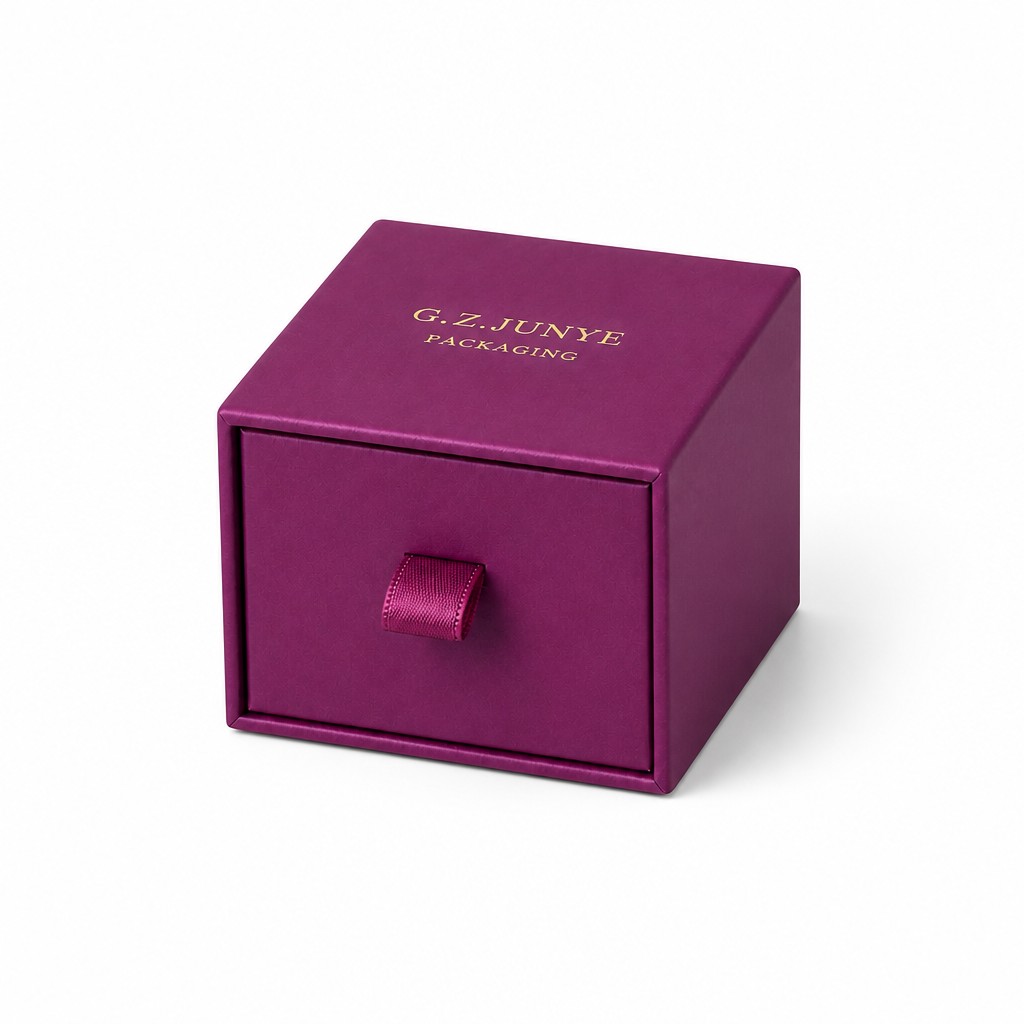
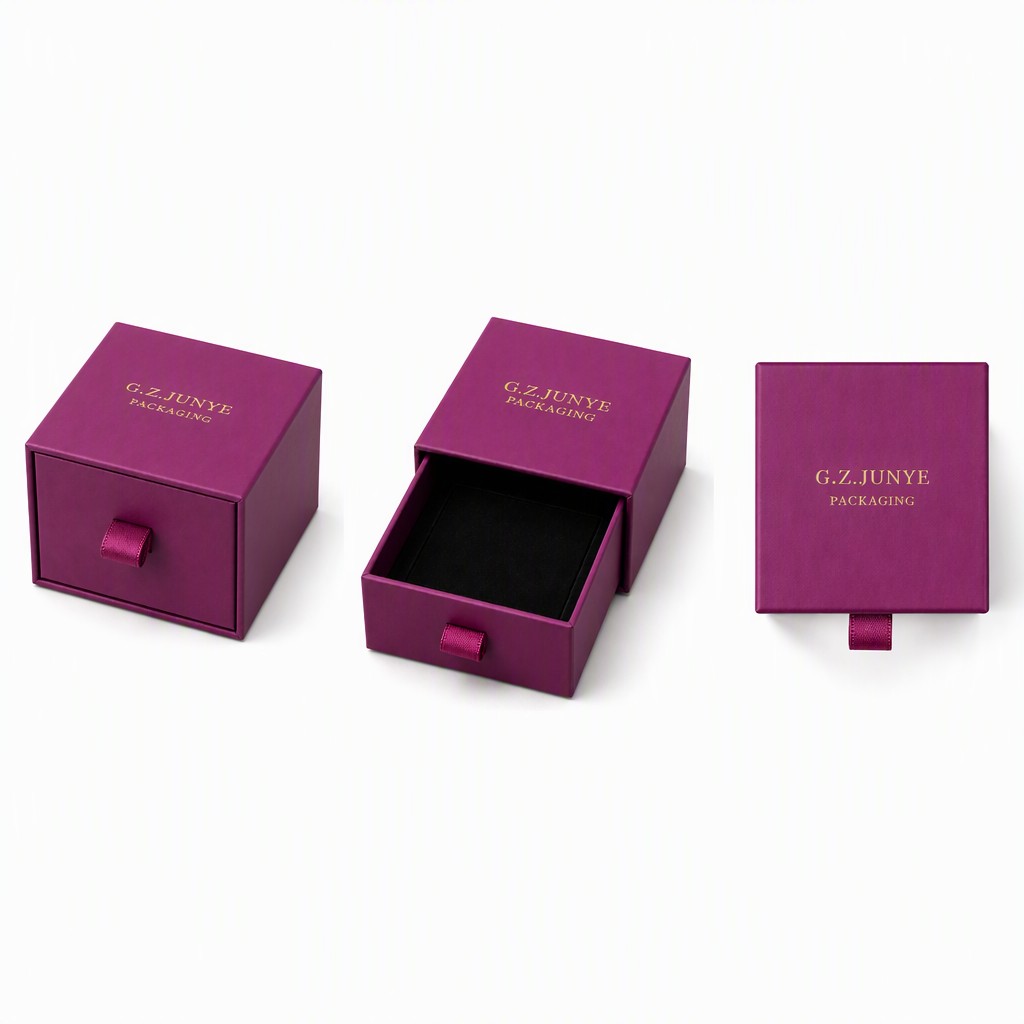
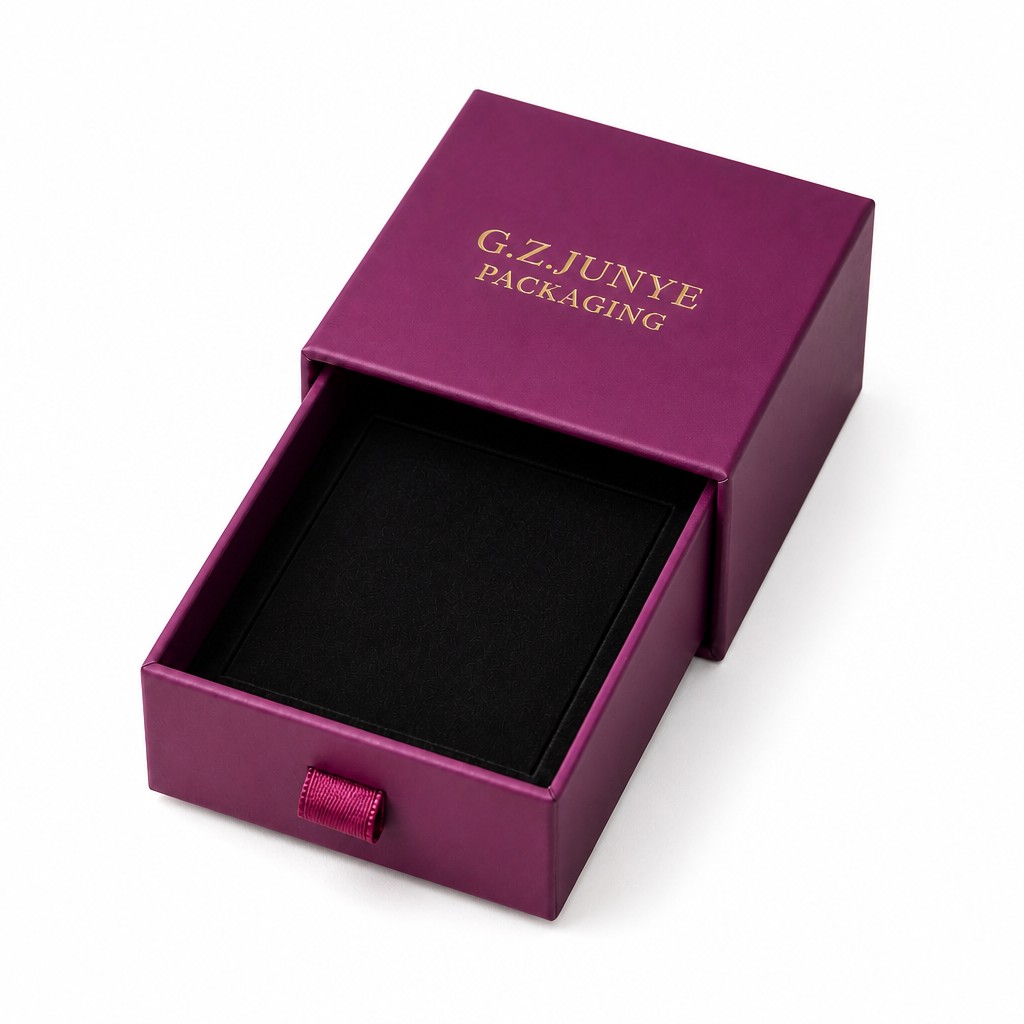
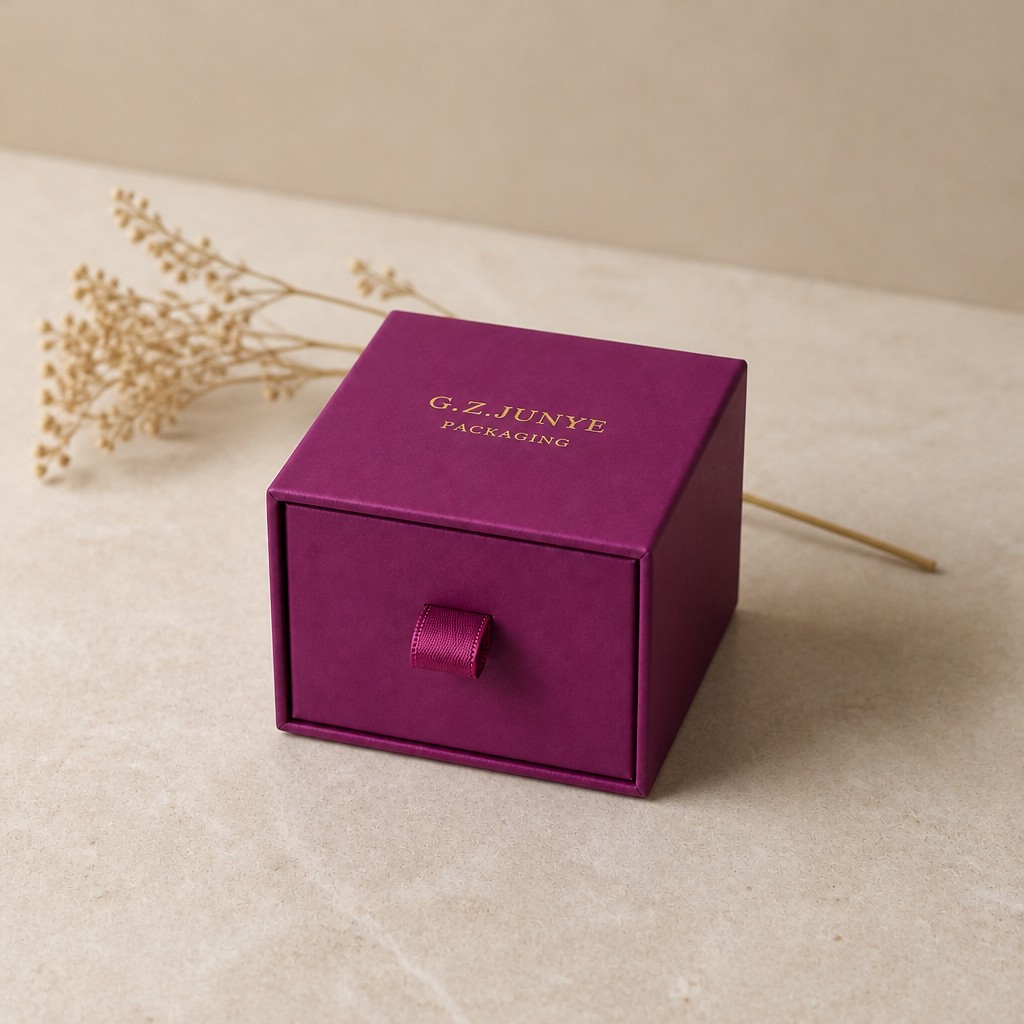
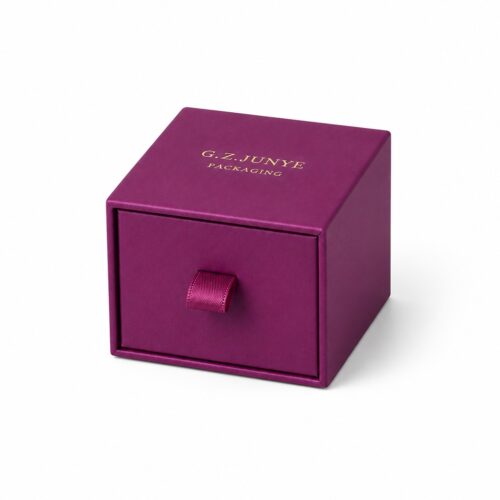
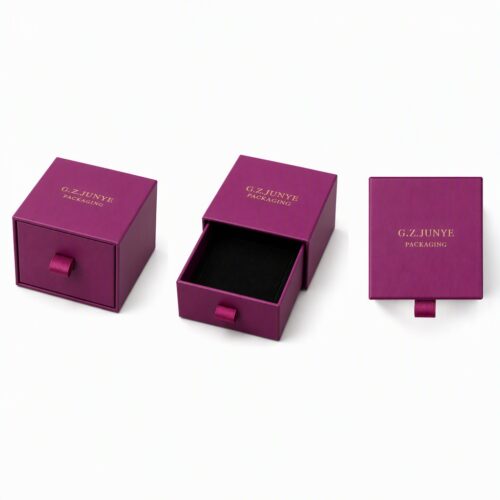
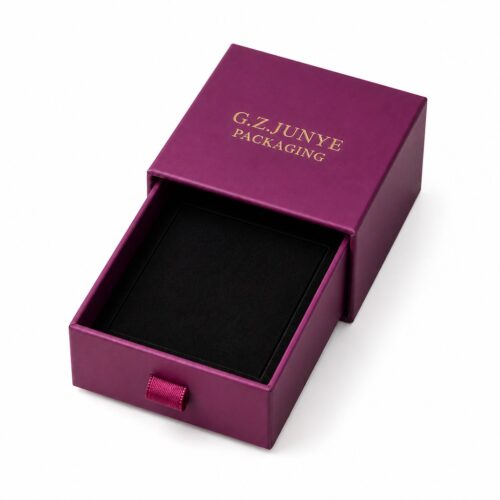
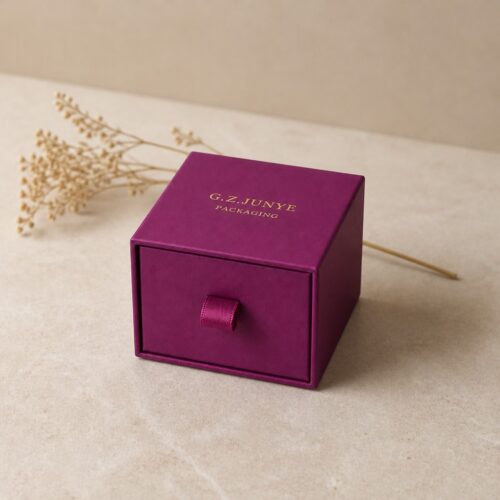
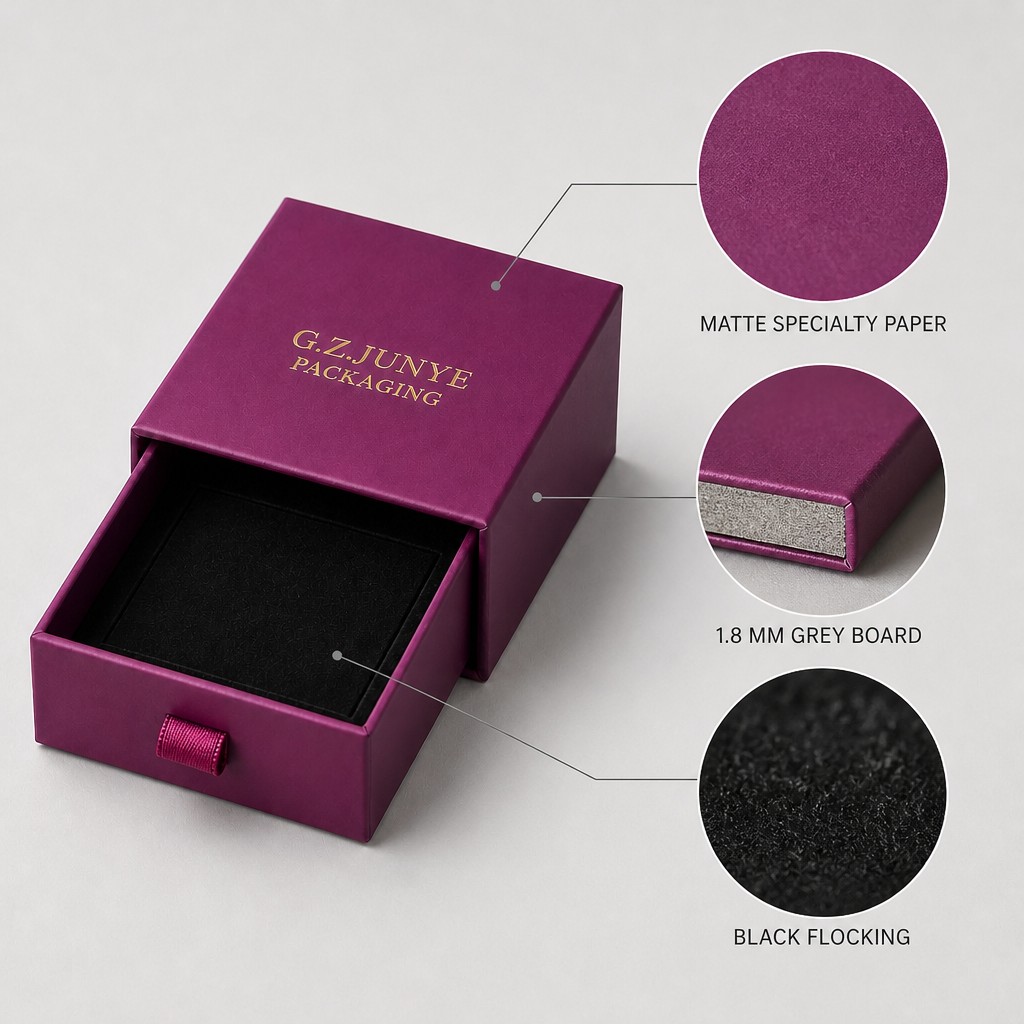
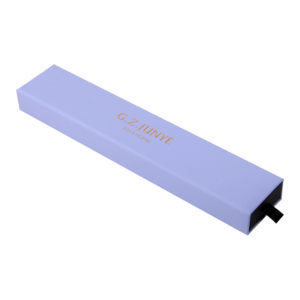
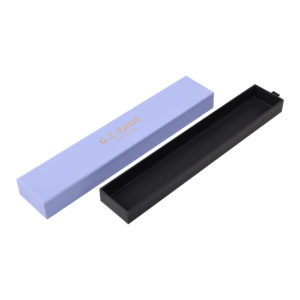
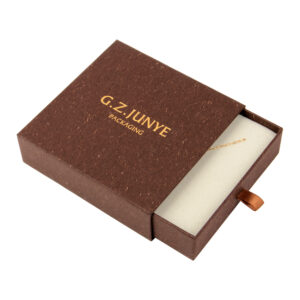
Two pieces make the whole box, as in our drawer box range and our bracelet drawer box. The sleeve is a tube, open at both ends. The tray inside it is a five-sided panel that slides straight out along the long edge. There is no lid to lift, no hinge, no magnet and no second tray — when the tray is out, the sleeve is empty.
| Structure | Sleeve plus sliding tray — no other moving part |
| Opening | Horizontal pull along the long edge |
| Size | 8 x 7 x 7 cm, near cube |
| Outer | Magenta specialty paper over 1.8 mm rigid grey board |
| Liner | Black flocking, plain and flat as standard |
| MOQ | 300 pcs — request a quote for your liner and print |
The Ribbon Tab Sits at the Centre of the Drawer Face
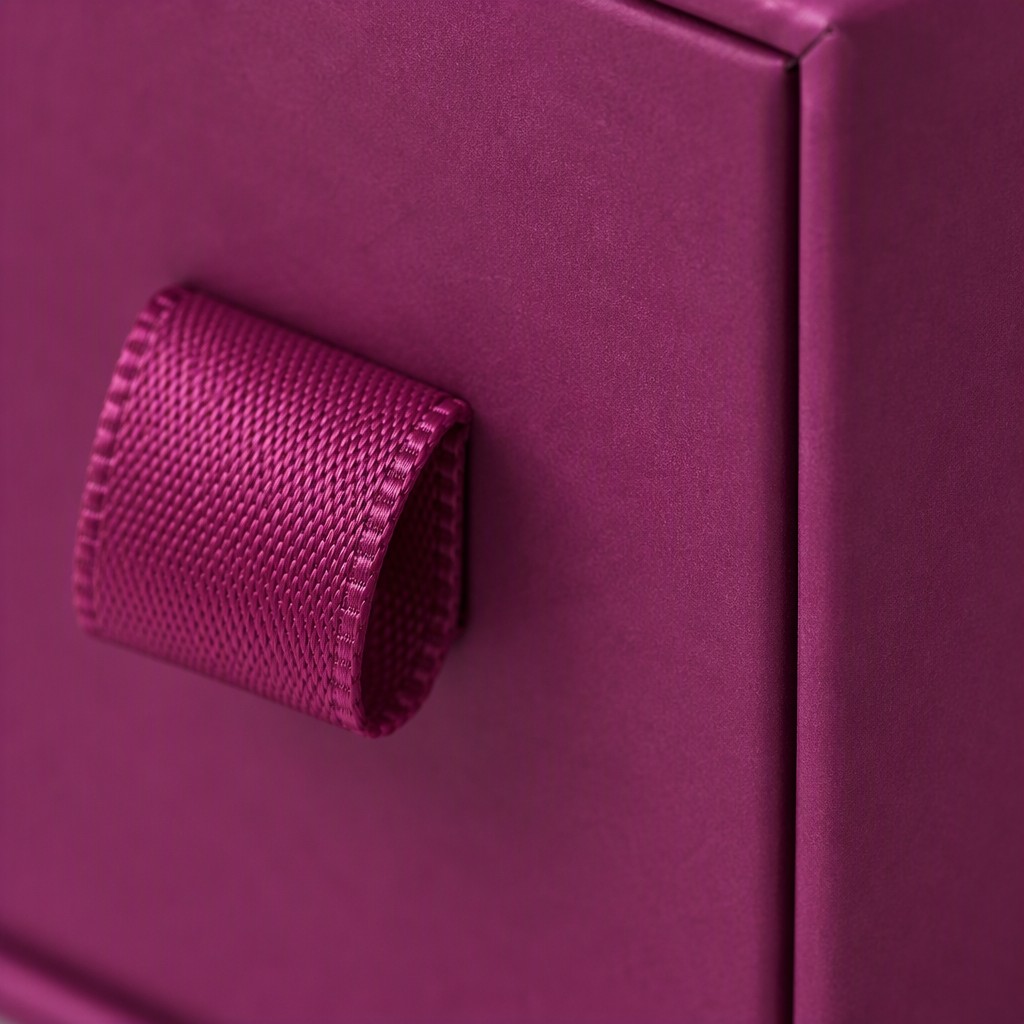
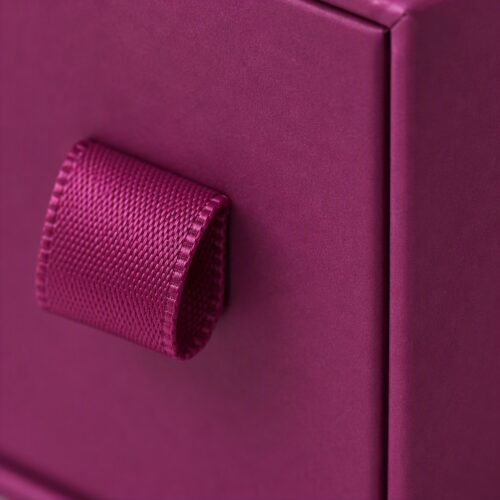
The pull is a single short ribbon tab folded into a loop and fixed at the middle of the tray face. When the box is shut the tab reaches past the sleeve mouth, so the tray can be opened without a nail hold or a notch.
It is a handle, not a fastener: nothing is tied, knotted or bowed. The same ribbon is used on our ribbon jewelry box. Ribbon colour and width match the print, and the tab can be left off if your display calls for a bare face.
| Tab position | Centre of the tray face |
| Function | Pull only — the tray is held closed by friction in the sleeve |
| Ribbon | Colour and width to order |
Black Flocking, Laid Flat as Standard
The liner as shipped is a plain flocked pad, laid flat, with no compartments. Rings and earrings sit on it and stay put because flocking grips; a light border line runs around the pad as a registration mark for anything we print later.
It is deliberately empty. A plain pad lets one order cover a run of different pieces, and it leaves the choice of layout until you know what is going in the box.
| As shipped | Flat flocked pad, no compartments |
| Border | Light recessed line around the pad |
| Colour | Black flocking over the liner board |
Flat, Necklace, Earring: One Liner, Three Cuts
The same liner board takes three cuts, and the outer box never changes.
| Flat pad | Standard — rings, earrings, brooches, anything that sits on a surface |
| Necklace recess | A shallow recess cut to the chain outline, so a chain lies level |
| Earring recess | Wider shallow pairing for a set of studs or drops |
Send the piece or its outline — the way we cut a necklace box — and we cut the liner to it. Because only the liner changes, a single 8 x 7 x 7 cm size can carry a ring line and a pendant line at the same time.
What Changes When You Swap the Liner
Swapping the liner is not a redesign. The sleeve, the tray, the tab and the print stay exactly as approved; the flocked board is re-cut.
| Unchanged | Sleeve, tray, ribbon tab, logo position, outer colour |
| Changed | The liner cut only |
| Sampling | A new liner wants its own sample — 5 to 7 days |
In practice that means one packaging purchase can cover a line that keeps adding pieces, instead of a new box for every jewellery type.
Why the 8 x 7 x 7 cm Format Suits a Set
Seven centimetres of depth is the reason this box is not a flat tray. A chain laid in a recess needs length; an earring pair wants a wide slot in a earring box; a ring wants to sit level in a ring box. A near cube gives all three the room, and it keeps the footprint small on a counter or in a drawer.
| Footprint | 8 x 7 cm, close to square |
| Depth | 7 cm — deep enough for a recessed chain |
| Carton size | 10 x 9 x 9 cm each, 0.5 kg gross |
Magenta Specialty Paper over 1.8 mm Grey Board
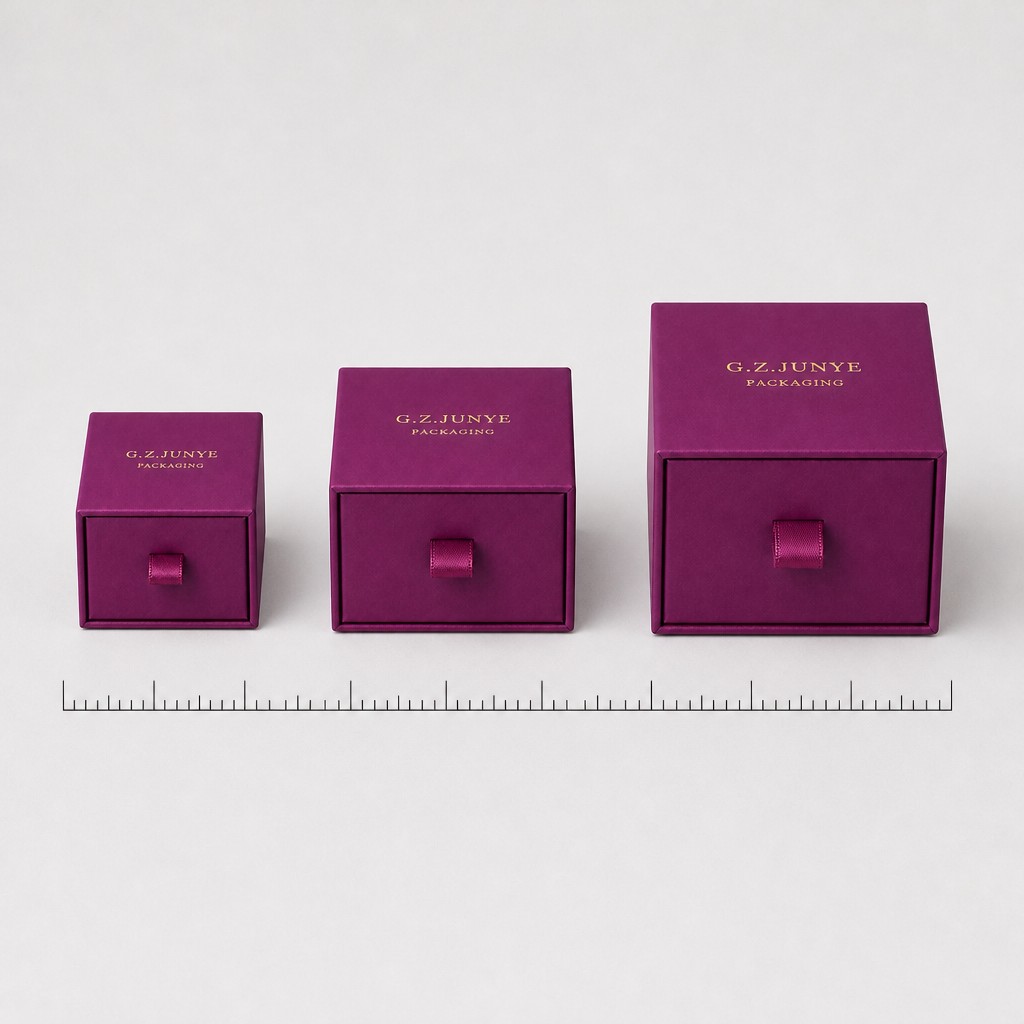
The outer is magenta specialty paper with a matte finish, wrapped over 1.8 mm rigid grey board. Colour is matched to a swatch or to a Pantone reference you send; alternative colours are made to order.
| Standard colour | Magenta, matte specialty paper |
| Board | 1.8 mm rigid grey board |
| Other colours | To order — swatch or Pantone reference |
The Structural Panel Joint, and Why the Drawer Runs Smooth
Inside the tray a structural panel joint holds the walls square. That is what keeps the run smooth over a long production batch: a tray that is a fraction out of square drags on one side and will eventually be felt by a customer.
The same joint is why the tray can be cut with a recess without the liner breaking the wall line.
Printing a Logo on a Wrapped Sleeve
Logo work sits on the sleeve faces and, if you want, on the tray face beside the tab. Foil, deboss, emboss and screen print are all possible; on a dark magenta sheet, foil and screen print read hardest.
| Methods | Foil stamp, deboss, emboss, screen print |
| Placement | Sleeve face, tray face, liner print |
| Artwork | Artwork proofing is free |
A Note on the Insert Border Line
The recessed line around the pad is a registration mark, not a compartment. It tells the cutting die where the usable area ends, and it is what keeps a hand-cut recess centred from unit to unit.
If you would rather have the pad unmarked, say so at the drawing stage — it is the same board and the same cut.
Sampling the Liner: Five to Seven Days
A sample request covers the print and the liner together, because they have to be judged in the hand: foil against dark magenta, and a recess against the piece that will sit in it.
| Sample lead time | 5 to 7 days |
| What is judged | Print, colour, tray run, liner cut and depth |
| After approval | Bulk runs are scheduled |
Bulk Windows After the Sample Is Signed Off
Standard turnarounds below; a new die, a recess cut or a peak season slot moves the date — the usual questions are on our FAQ — and we say so before you order rather than after.
| Standard | 18 to 25 days |
| Small batch | 10 to 15 days |
| New tooling or peak | 25 to 30 days |
What We Check Before the Drawer Goes Back In
Every tray is fitted back into its sleeve before packing, and the checks below are the ones that decide whether a unit ships.
| Fit | Tray slides in and out with even resistance, no wobble at the mouth |
| Pull | Tab fixed at the panel centre, reaching past the sleeve mouth |
| Liner | Flocking clean, recess centred, no lifting at the edges |
| Registration and colour against the approved sample | |
| Squareness | Walls true, corners closed, no panel gap visible |
Certificates, EPR Numbers and Where the Paper Comes From
Wrapped board rather than moulded plastic (see our workshop profile) means the box can go into a paper stream. FSC-compliant paper is available, sourced from FSC-certified suppliers, and the finished box does not carry the FSC mark.
| Quality system | ISO9001:2015, certificate ZYC24Q00141R1S, valid to 2027-11-28 |
| Substance | RoHS report AZT032202170002C-010 |
| EPR | Germany LUCID DE2463045771631, France CITEO FR292146_01UOMY |
| EU rules | GPSR responsible person on file |
How the Near-Cube Box Travels
Each box is bagged, cartoned and palletised; terms are FOB Nansha, EXW or DDP.
| Unit | Polybag, then export carton |
| Carton size | 10 x 9 x 9 cm per box, 0.5 kg gross |
| Terms | EXW / FOB Nansha / DDP |
| Lead time to door | Air 7 to 12 days, sea 30 to 40 days, to be confirmed |




Reviews
There are no reviews yet.