


Two Pieces, No Hinge: How a Rimmed Lid Meets Its Base
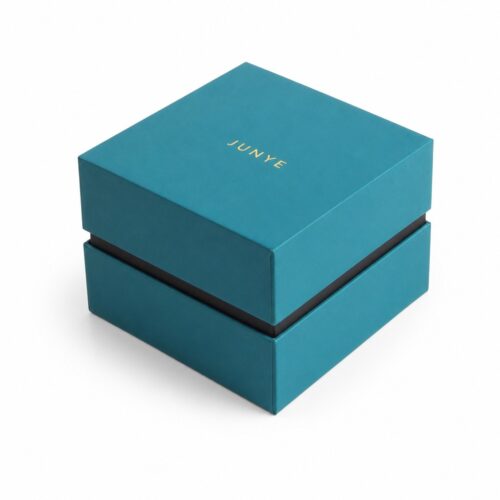
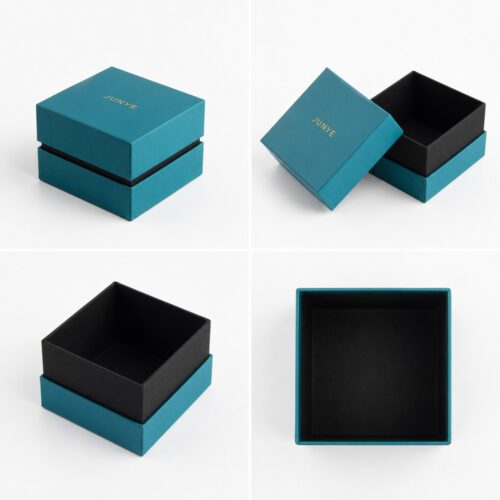
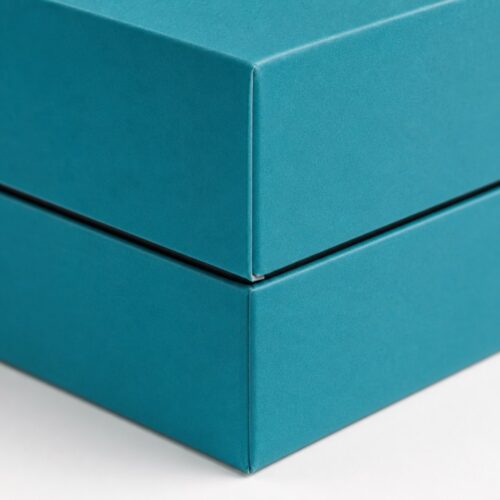
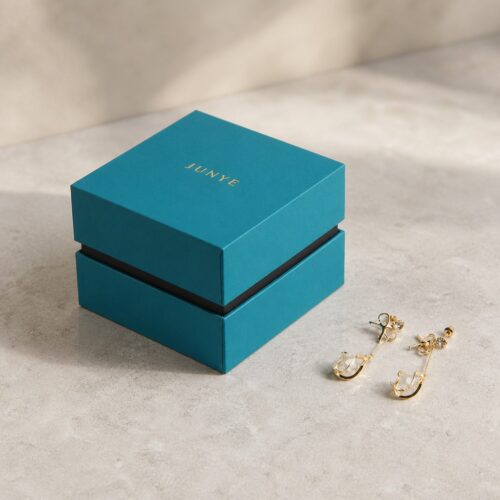
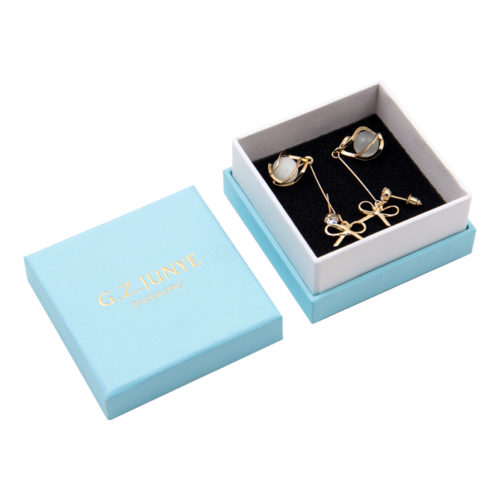
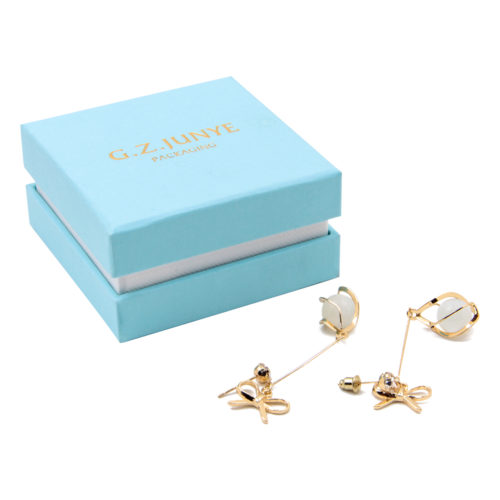
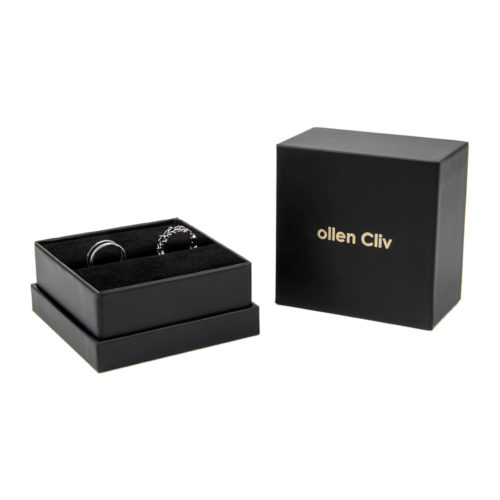
This box is two moulded parts. The lid is a deep shell: its side walls, or skirt, drop several centimetres down the outside of the box. The base is an open tray. Nothing is screwed, glued or hinged between them.
To open it you lift the lid straight up. To close it you lower the lid back over the tray and let the skirt take up the load. Because the skirt overlaps the tray on all four sides, the closed box behaves like one solid block rather than two boxes resting on each other.
| Format | Rimmed lid and base, two pieces |
| Lid type | Deep skirted lid, no hinge, no magnet |
| Opening | Lid lifted vertically clear of the base |
| Closing | Lid lowered back over the tray, friction fit |
| Outer size | 7 x 7 x 6 cm |
| Base depth | 6 cm of usable interior height |
What a 6 cm Deep Base Actually Holds
Six centimetres is deep for a box this small, and that is deliberate. A shallow box forces you to choose between the piece and its presentation — a chain has nowhere to go once it is coiled.
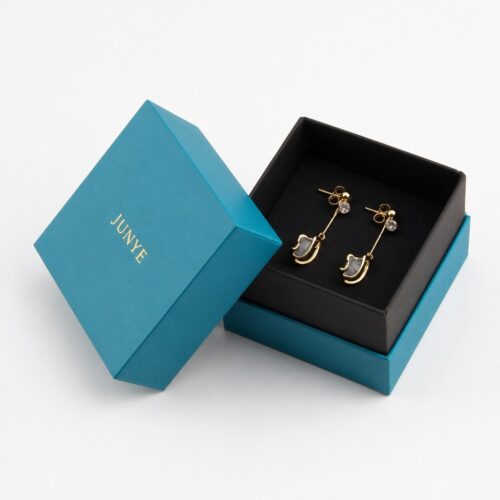
At 7 x 7 cm with 6 cm of depth, a pendant on a chain, a pair of drop earrings or a ring with a domed crown sit inside without pressing against the lid. The piece rests on the bottom, not against the top.
| Drop earrings | Two pieces side by side, upright |
| Stud earrings | Flat, with room for a pair of rings |
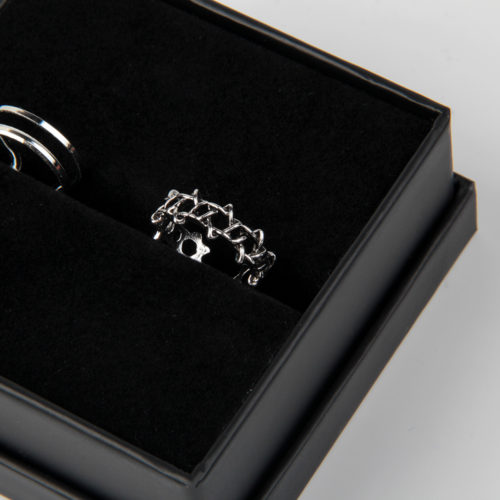
| Ring | Seated in a cut pad, crown clear of the lid |
| Single pendant | Pendant plus its chain, both inside |
| Small set | A pendant and a pair of earrings together |
The Black Interior and Why Contrast Matters
The outer surfaces are wrapped in teal specialty paper; the inside of the base is lined in matte black. The choice is not decoration. A black floor gives gold, silver and coloured stones a clean edge the moment the lid comes off, where a pale interior tends to wash a small piece out.
The lining also hides handling. Fine scratches and finger marks disappear against matte black in a way they never do on a light surface, which matters for a box that gets opened at a counter.
| Outer wrap | Teal specialty paper, matte |
| Core | Rigid grey board, wrapped by hand |
| Base interior | Matte black lining |
| Why black | Contrast for gold and silver; hides finger marks |
A 7 x 7 cm Footprint for Earrings, Rings and Pendants
Square, small and deep — that combination is what makes this a jewellery box rather than a general gift box. It occupies a hand’s width, so it fits a retail counter, a display riser or a shallow drawer in a stockroom.
If your line runs to bracelets or bangles, a wider format suits a bangle better than a deep square, and we make a bracelet box box for that. If the piece travels by post on its own, the flat flip box format with a magnet is the easier fit through a letterbox.
Teal Specialty Paper Wrapped by Hand over Grey Board
The body is rigid grey board, not folded carton. Each panel is cut, then wrapped in teal specialty paper with a fine grain that sits flat under the thumb. Corners are turned by hand, which is where a wrapped box either looks sharp or does not.
Rigid construction is also what keeps the skirt true. A thin lid wall warps and the lid starts to catch when it is set back down; a board wall holds its line through a season of openings.
| Board | Rigid grey board core |
| Wrap | Teal specialty paper, matte grain |
| Corners | Wrapped and turned by hand |
| Interior | Matte black lining |
| Paper sourcing | FSC compliant paper from certified suppliers |
Placing a Logo on the Lid: Foil, Screen Print or Emboss
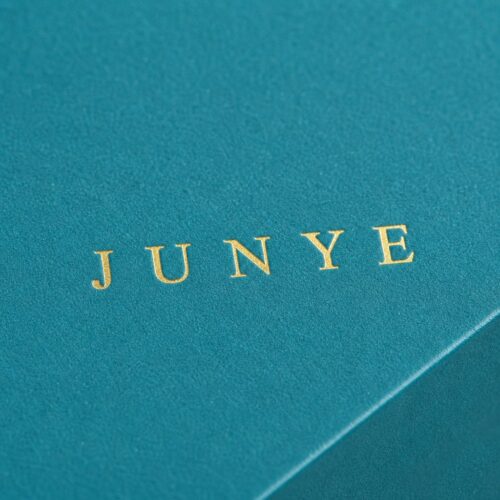
The lid is the only large flat surface, so it carries the logo. On a matte teal wrap the finish decides how the mark reads from a step away.
| Foil stamping | Metallic mark, strongest read on teal |
| Screen printing | Flat colour, good for fine type |
| Emboss or deboss | Tone-on-tone, felt rather than seen |
| Spot UV | Gloss over matte, visible at an angle |
| Artwork | Free mockup, normally within one to three days |
Die Cut Paper Card, EVA or Velvet: Choosing the Insert
The box is quoted without a fixed insert, so you can keep the whole 7 x 7 cm base or divide it. Three materials cover most orders.
| Die cut paper card | Lightest option; a printed platform with a cut slot |
| EVA foam | Firm slot that grips a ring or an earring post |
| Velvet pad | Softest surface under a chain or a stone |
All three drop into the same tray, so the insert can change between SKUs without touching the wrap, the lid or the box size.
Measuring the Piece Before the Cut Is Drawn
A cut that is one millimetre tight will not release the piece. Before we draw anything we ask for four things.
| Outline | A tracing or a photo of the piece on squared paper |
| Thickness | The highest point, so the lid still clears it |
| Range | The smallest and largest piece in the same box size |
| Handling | Whether the piece is lifted by hand or tipped out |
If the range is wide, one slot will not serve every SKU. In that case we either widen the cut to the largest piece or quote two insert variants.
Sample First: Five to Seven Days, Drawn in One to Three
Every order starts with a sample, and the drawing comes before the sample. Artwork, a 3D mockup and the die cut drawing are free of charge and are normally ready in one to three days, with revisions until the shape is right.
The physical sample then takes five to seven days. You hold the real board, the real wrap and the real insert, which is the only way to judge whether the teal reads the way you want it to on a shelf.
| Drawing and mockup | Free, one to three days, unlimited revisions |
| Physical sample | Five to seven days |
| Sample cost | Quoted per piece; asked about on the free sample page page |
| What ships with it | Box, chosen insert and one printed logo option |
From Approval to Cartons: 18 to 25 Days
Once the sample is signed off the run is scheduled. Standard work takes 18 to 25 days from approval, counted from the day the deposit and the approved artwork are both in hand.
Two things move that number: a new die, which adds drawing and cutting time, and the pre-holiday window, when both our line and the paper supply are busier.
| Small run | 10 to 15 days |
| Standard run | 18 to 25 days |
| New die or peak season | 25 to 30 days |
| Minimum order | 300 pcs, see the note below |
The Checks That Happen Before Boxing
Each batch is inspected before it is packed, against the sample you approved rather than against a description.
| Colour | Wrap matched to the approved teal, batch by batch |
| Fit | Lid lowered onto the tray by hand; skirt clears on all four sides |
| Lining | Matte black inner surface checked for bubbles and lifting |
| Logo position, size and edge sharpness | |
| Insert | Cut checked with your piece where a piece is supplied |
Inside Our Own Workshop in Baiyun, Guangzhou
The box is made in our own workshop in the Baiyun district of Guangzhou, about 5,000 sqm with more than 50 people on the floor. We have been producing paper packaging since 2004.
Wrapping, die cutting and finishing run in house, so a change to the wrap or the insert is handled at the machine rather than sent out and scheduled again.
EPR Numbers, RoHS Reports and the Quality Certificate
Buyers in the EU and the US usually ask for paperwork before they ask for a price. The documents we hold for this box are listed below; anything else you need, ask and we will say whether we have it.
| Quality system | ISO9001:2015, certificate ZYC24Q00141R1S, valid to 28 November 2027 |
| Germany EPR | LUCID registration DE2463045771631 |
| France EPR | CITEO registration FR292146_01UOMY |
| Materials | RoHS test reports for the box build |
| Paper | FSC compliant paper from certified suppliers |
| EU market | GPSR responsible person details issued with the order |
Packing a Skirted Lid So It Arrives Flat
A skirted lid is the part most likely to arrive damaged, because the skirt is a thin wall standing proud of the base. Packing is built around that.
| Unit | PP anti-scratch bag around each closed box |
| Carton | Corrugated export carton with a divider or layered fill |
| Pallet | 120 x 100 cm pallet on request |
| Terms | EXW, FOB Nansha or DDP door delivery |
| Reply time | Within four working hours on weekdays |
Two Ways to Start: A Sample or a Written Quote
Send the piece and the quantity and we will come back with a quote for the box, the insert and the print. If you would rather hold it first, the sample route starts on the free sample page page and the drawing is free either way.
Minimum order is 300 pcs. Custom sizes and new die work are quoted from 500 pcs, and a printed logo from 1,000 pcs; on this 7 x 7 x 6 cm format the standard box covers most small jewellery lines without a new die at all.
Questions about lead times, paperwork or packing are collected on the FAQ page, and the workshop itself is described on the about page page. The full range of jewellery boxes sits under jewelry packaging boxes, with the lid and base family under lid and base boxes.




Reviews
There are no reviews yet.