
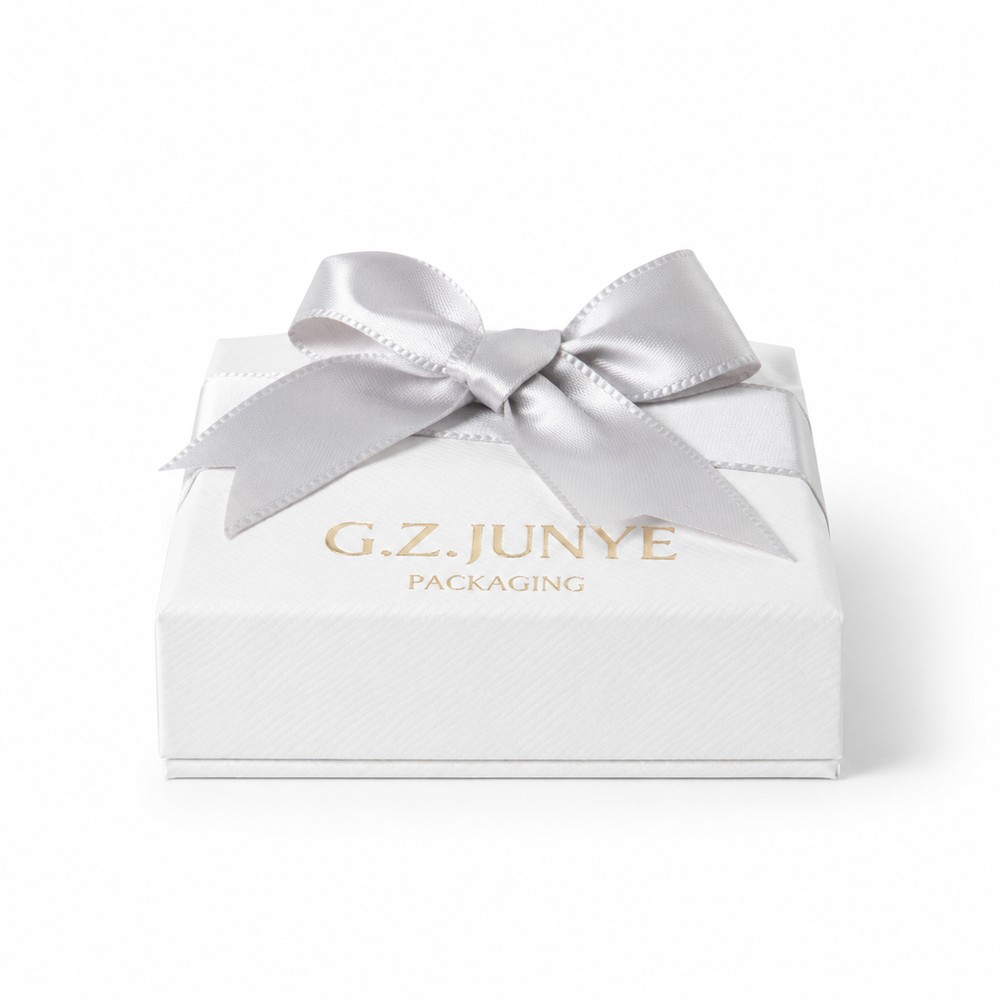
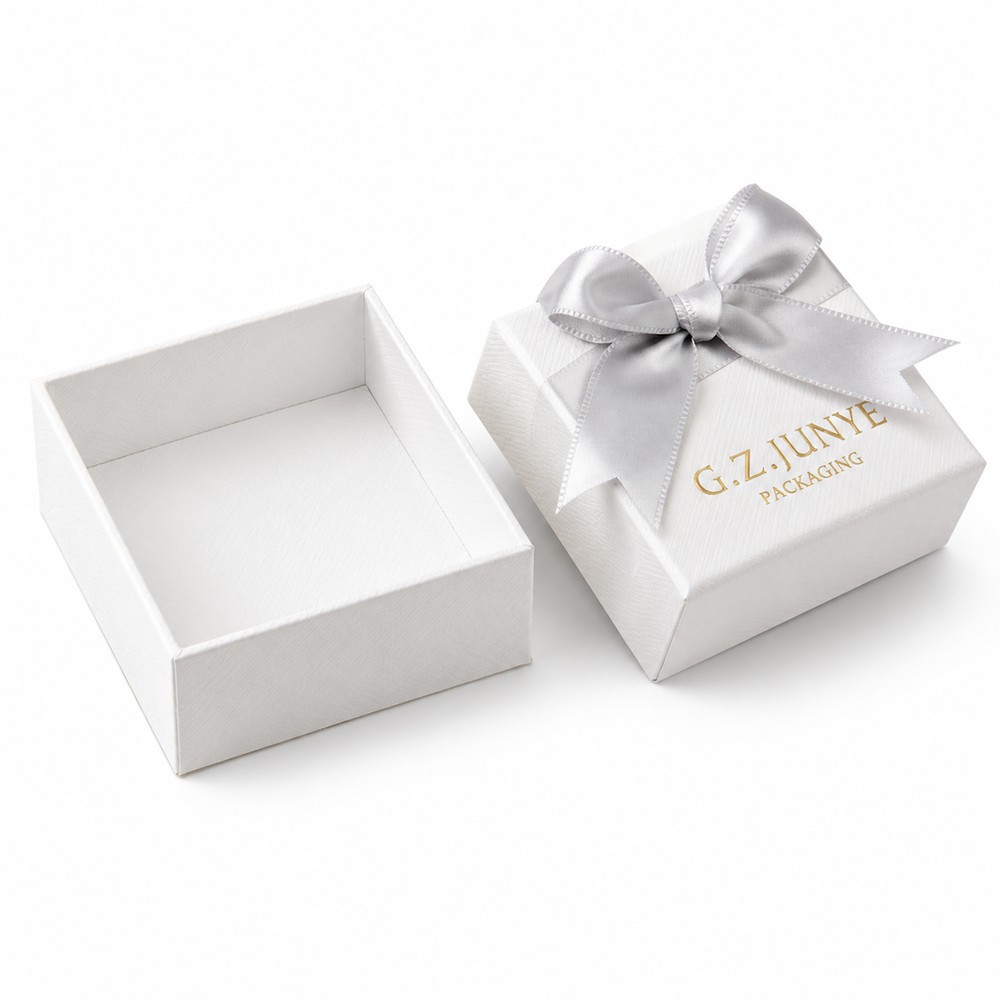
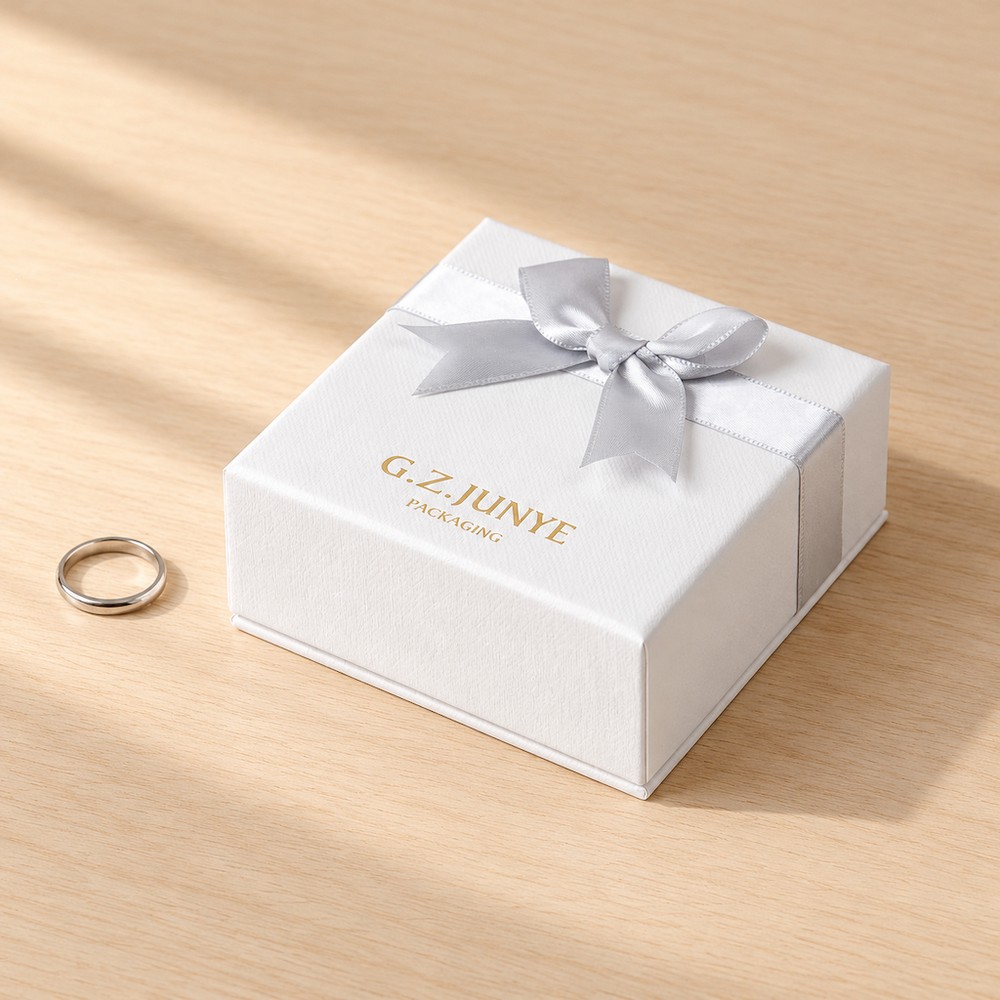
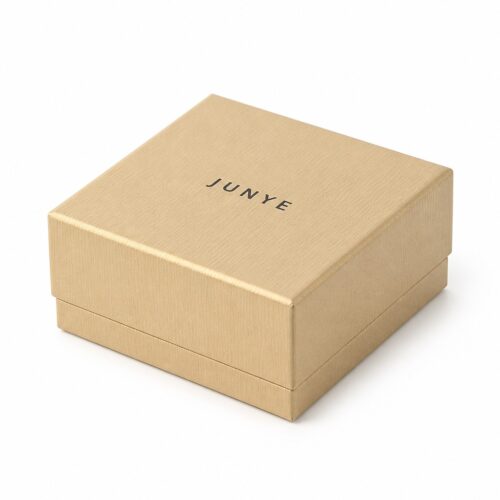
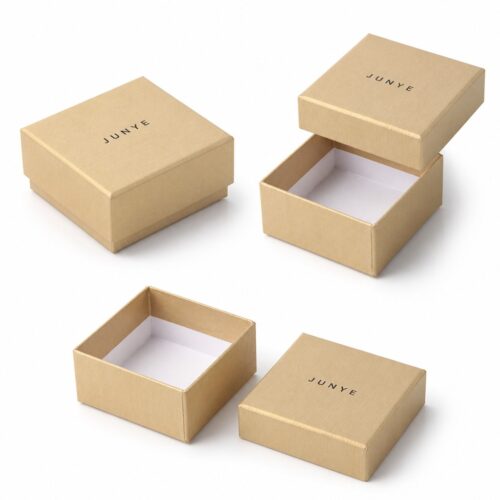
This is a square jewelry box built from three pieces instead of the usual tray-and-lid pair: a flat board base, a rim strip that becomes the body, and a deep-cover lid. The lid drops all the way down and hides the rim completely, so the only thing you see at the bottom edge is the board itself. The board and the lid are cut to the same footprint, which is why the closed box reads as one straight line on all four sides.
Three Pieces, Not Two
A conventional two-piece box folds the base into a tray: four walls, four corner folds, and a fold allowance that has to go somewhere inside. This box does not do that. The base is a single flat sheet of rigid board with no folded walls at all. The body is a separate strip of paperboard folded into a square ring and glued down onto that board. Its outer face is the outside of the box; its inner face is the wall of the cavity.
What that buys you is a floor with nothing on it. No corner seams, no fold lines, no allowance tucked into the corners where a ring or a pendant would sit. The cavity is a clean square with a flat bottom.
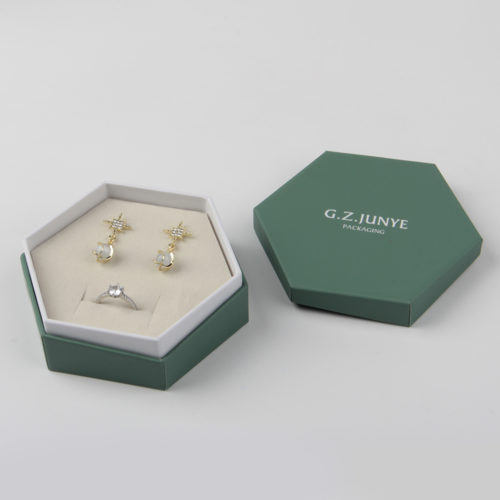
The same lid logic, carried onto a much deeper base, is what makes our rimmed lid and base jewelry box in teal read the same way in profile.
What The Closed Box Looks Like
The closed profile is three bands, and all three should be readable at once:
- the lid face, top
- the lid skirt, which covers the entire rim
- a thin band of the base board at the bottom, about 3 mm
On a 3 cm tall box, that bottom band is roughly a tenth of the height. It has to be even on all four sides. A base edge that is wide on one side and narrow on the other is the single most common way this box goes wrong, because the board sits under the rim rather than around it, and any misalignment shows up as an uneven bottom line instead of a hidden seam. The base does not overhang the lid — same footprint, so there is no brim and no step.
The Bow Is Already Tied
The satin bow on the lid is a finished component. It is tied and glued in our factory before the box is packed, so nothing arrives as a loose ribbon for you or your customer to tie.
That changes what happens on your packing line. A loose ribbon has to be tied by hand, at the right tension, facing the right way, on every unit, by someone who knows how. A glued bow is the same bow every time, in the same position, at the same angle, and it cannot slide off in the carton. For retail, the box comes out of the shipper ready to go on a counter or into a gift bag. The checks that decide whether a bow survives cartons and couriers are set out in our guide to a jewelry box with a ribbon bow.
The ribbon is a satin weave with a directional sheen and slanted cut tails. Because it is a real three-dimensional bow rather than a printed motif, it casts its own small shadow across the lid face — one of the quickest ways to tell a glued bow from a printed one in a photograph.
Gold Foil On The Lid
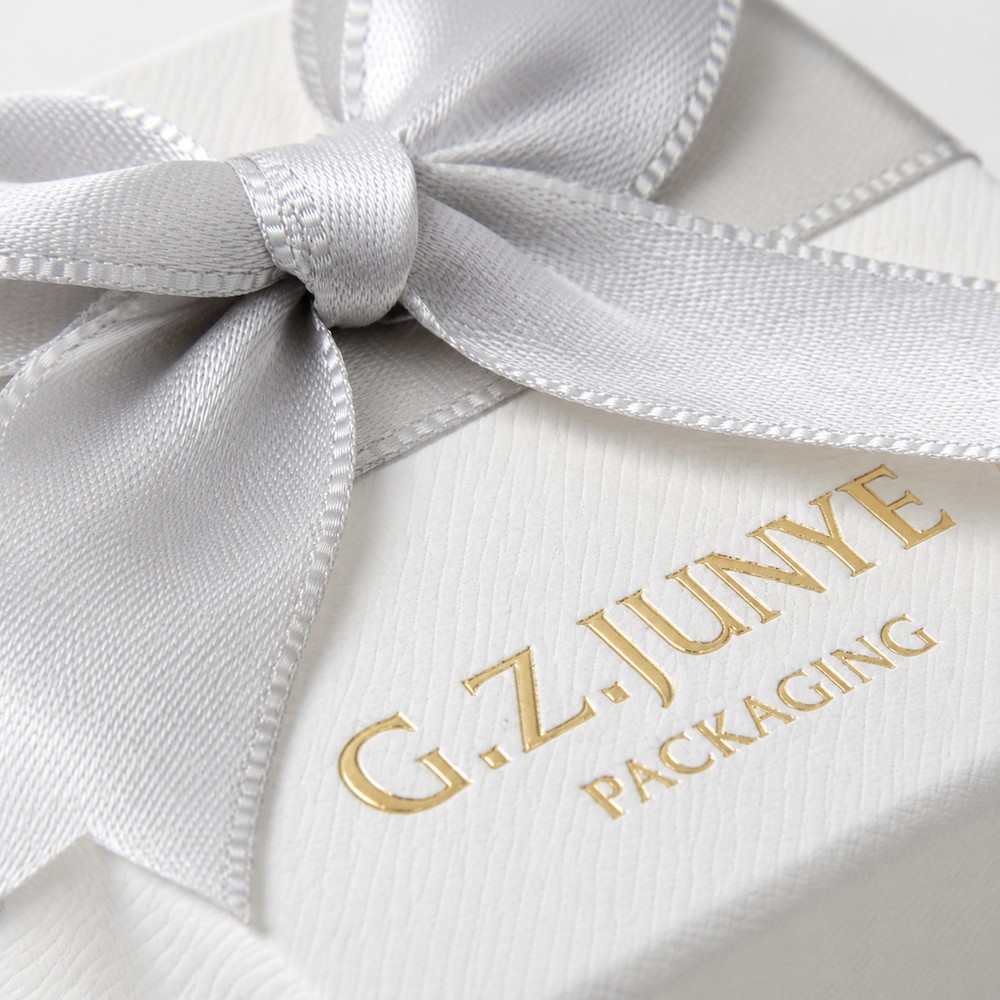
The logo on the lid face is hot foil stamped: metal foil pressed into the paper under heat, which leaves a crisp edge and a slight impression you can feel with a fingernail. It is not printed, not a sticker, and not screen print. Gold is the default on this white paper; silver foil and blind emboss are also available, and the same die can be run in either.
The bow and the logo share the lid face, so the two have to be laid out together. If your logo sits close to the bow, tell us before the die is cut rather than after — moving a stamping die is a new die.
The Paper, And What The Wrap Leaves
The box is wrapped in a white matte textured paper with a fine vertical grain and very little sheen. Corners are sharp right angles rather than rounded. Because the paper is wrapped around the rim and folded into the lip, there is a narrow wrap line just inside the opening. That is a trace of the folding process, not a defect, and it is present on every unit. The paper is the variable that decides how the wrap behaves, and we set out what a paper jewelry box is actually made of in a separate note.
Inside: Plain White, No Insert
As standard the cavity is plain white paper. The four walls are the inner face of the rim strip and the floor is the top face of the base board; both are the same white, with no flocking, no EVA, no sponge and no compartment tray.
If your piece needs to be held in place, an insert is a separate decision rather than a default: flocked card, EVA, sponge or a compartmented paper tray can all be fitted on request, and each one changes the clear height available for the product.
What It Holds
The 8 x 8 cm square suits a single piece or a small set placed centrally: rings, earrings and studs, pendants, bracelets, brooches and cufflinks. The 3 cm height holds a ring or a pair of studs without the lid pressing on them, and a pendant lies flat rather than hanging.
The same format works outside jewelry: perfume samples and solid perfume, watch parts, commemorative coins, and corporate gifts where the box is part of the presentation rather than just protection.
Custom Sizes And Formats
Every dimension can be changed without changing the structure: the footprint, the rim height, and the depth of the lid skirt. The construction stays the same, so a larger box behaves exactly like this one.
For jewelry sets we build larger squares and rectangles and add a compartmented insert, along the lines of our custom jewelry set gift box. For necklaces and bangles the footprint usually goes rectangular, because a long piece wants length rather than depth. Shapes beyond square and rectangle need a new cutting die.
Finishing runs from hot foil in gold or silver, blind emboss, spot UV and screen print through to Pantone colour matching on the wrap paper. The bow can be swapped for a grosgrain or velvet ribbon, or left off entirely if your packing line handles decoration itself.
Sampling And Production
We send a mockup and a die line before anything is committed, and a physical sample before mass production starts. The sample is where the bottom edge gets checked: it is the one detail that decides whether the closed box looks machined or hand-assembled.
The boxes are made in our own rigid box workshop in Baiyun, Guangzhou, where we have been making rigid paper boxes since 2004. We hold ISO 9001:2015 certification, certificate number ZYC24Q00141R1S.
Ordering
Send the item, its dimensions and how it should sit inside, and we will quote the footprint, the insert and the finishing together. Minimum order quantity and lead time depend on size, insert and finishing, so they are quoted per specification rather than published as a single figure.




Reviews
There are no reviews yet.