Two Pieces That Meet: What the Skirt Actually Does
A rimmed lid and base box is two moulded parts, and only one of them moves. The lid is a shell with side walls that drop down the outside of the box; those walls are the skirt. The base is an open tray. There is no hinge between them and nothing to slide.
Lift the lid straight up and the tray stays where it is. Lower it back and the skirt guides itself onto the tray on all four sides, so the closed box reads as one solid block.
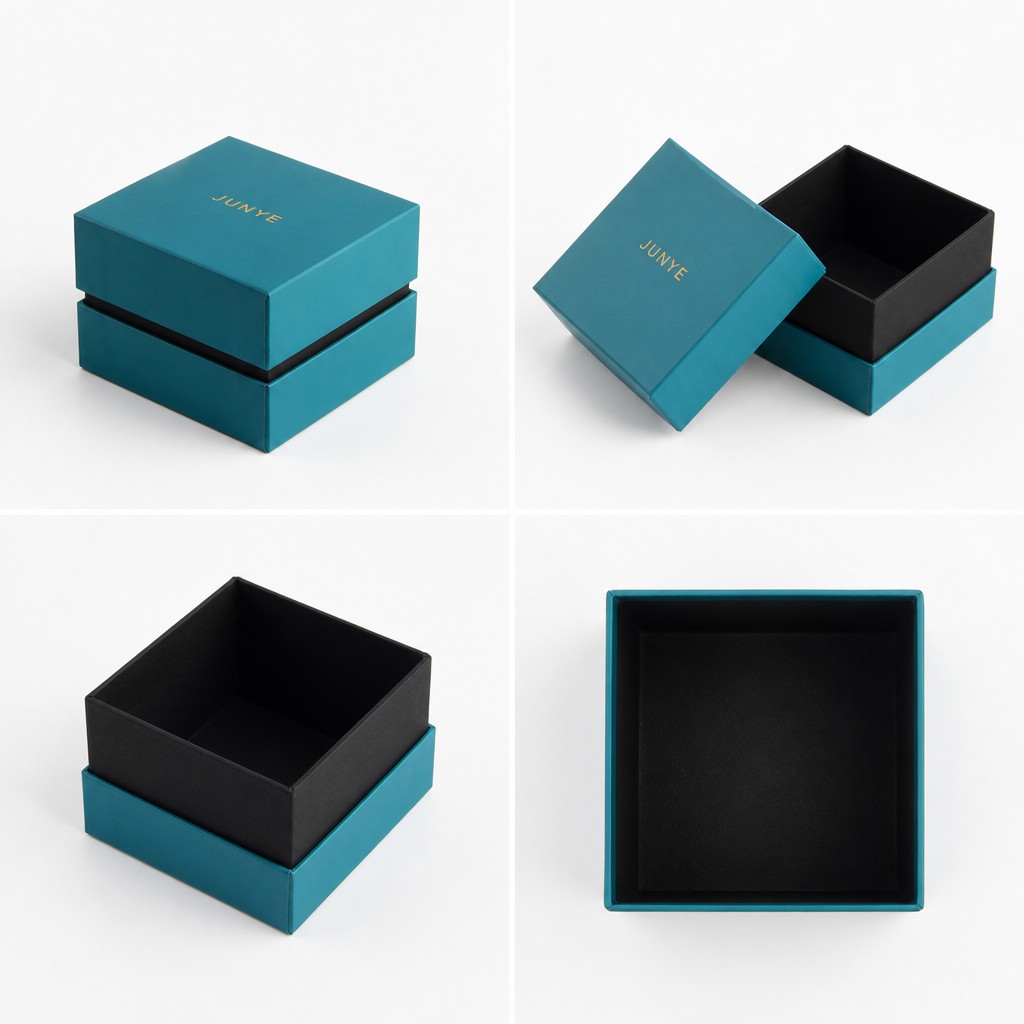
| Parts | Skirted lid plus open base tray |
| Motion | Lid lifted vertically, then lowered back down |
| Joint | Overlap of skirt onto tray, friction fit |
| Not present | Hinge, magnet, sleeve, sliding tray |
Why a Deep Base Changes What You Can Ship in One Box
Depth is the design decision buyers feel first. A shallow tray holds a ring and little else; six centimetres of interior height lets a pendant sit on its chain without the chain being coiled into a tangle against the lid.
That height also protects in transit. A piece that rests on the floor of the tray cannot move upward against the lid, which is where most polishing marks come from on a small box.
| Ring | Slots into a pad; crown stays clear of the lid |
| Drop earrings | Stand upright rather than lying flat |
| Pendant | Sits on the tray floor with the chain around it |
| Small set | Two pieces separated inside one 7 x 7 cm tray |
Interior Colour Is a Decision, Not a Default
The outside of this box is teal. The inside is matte black, and the two choices are made together rather than separately, because the interior is the background your piece is photographed against.
On a light interior a small silver piece loses its edge; on matte black the same piece reads as a deliberate object. The matte finish also holds up better in a retail setting, where a box is opened and closed many times a day and a light lining starts to show every touch.
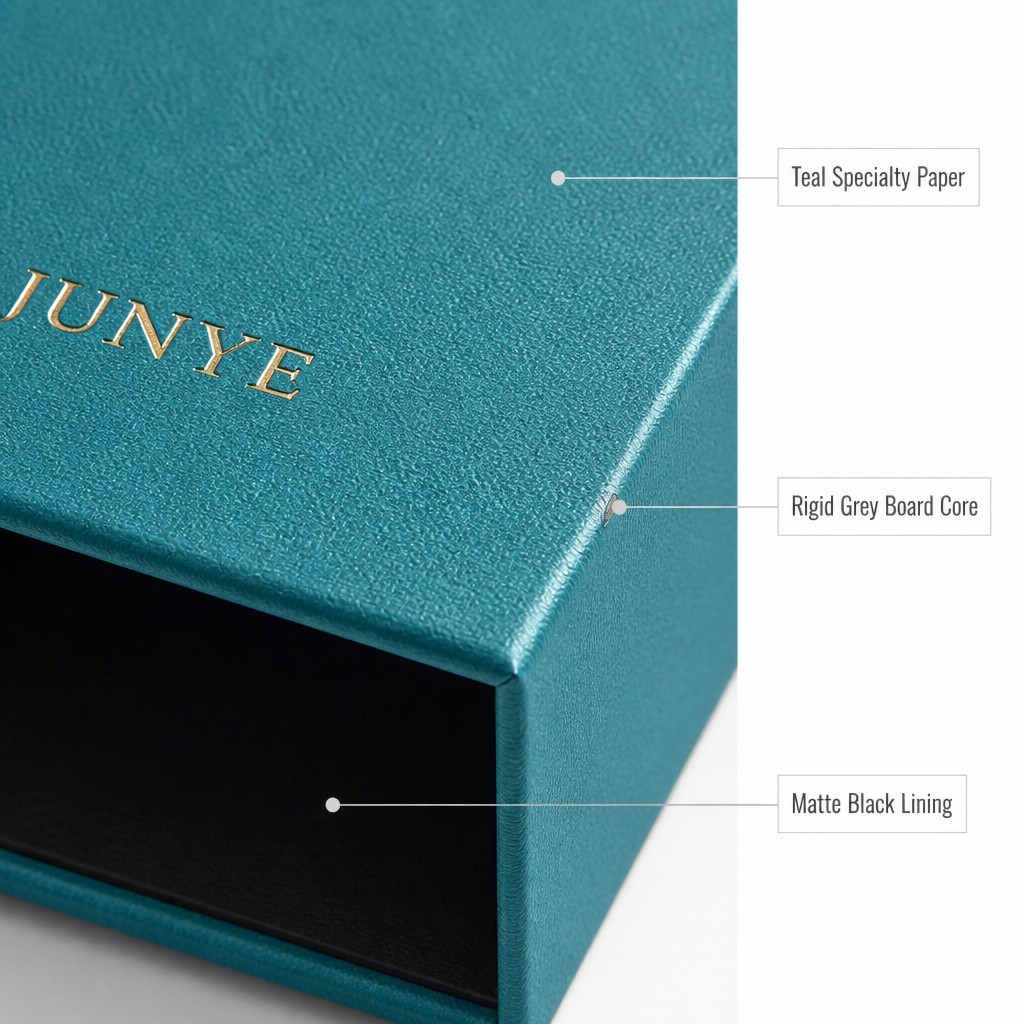
| Exterior | Teal specialty paper, matte grain |
| Interior | Matte black lining |
| Board | Rigid grey board under the wrap |
| Effect | Contrast for gold and silver; marks stay hidden |
The Insert Question: Cut Card, EVA or Velvet
The box is quoted without a fixed insert, and for a small jewellery line that is usually the right starting point: the tray is the product until your piece tells us what shape the cut should be.
| Die cut paper card | A printed platform with a shaped window |
| EVA slot | Firm grip for a ring or an earring post |
| Velvet pad | Soft contact surface for a chain or a stone |
| No insert | Full tray depth, piece sits on the lining |
What a 7 x 7 cm Lid Has to Carry
The lid is the only large flat panel on the box, so the logo goes there. On teal, the finish decides how the mark behaves at arm’s length.
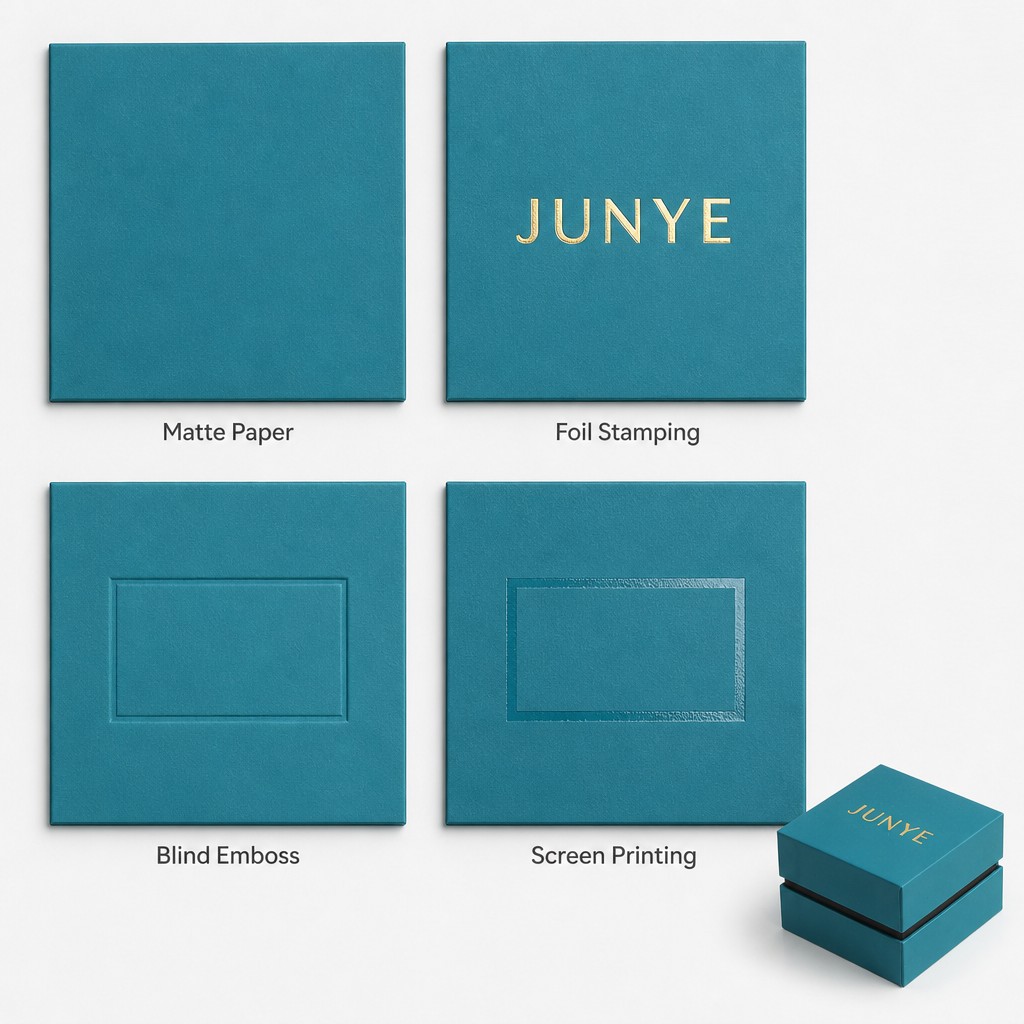
| Foil stamping | Metallic mark, strongest read on a matte wrap |
| Screen printing | Flat colour, holds fine letterforms |
| Emboss or deboss | Tone on tone; felt before it is seen |
| Spot UV | Gloss against matte, catches light at an angle |
Measuring Before You Draw the Cut
A cut that is a fraction tight will not release the piece. Before a drawing is issued we ask for four numbers.
| Outline | Tracing, or a photo of the piece on squared paper |
| Height | Highest point, so the lid still clears it |
| Range | Smallest and largest piece sharing the box size |
| Release | Lifted by hand, or tipped out |
Where a range is wide, one slot serves none of them well. We either open the cut to the largest piece or quote two inserts against the same tray.
Five to Seven Days to a Sample in Your Hand
Artwork and the die drawing come first, normally within one to three days and at no charge, with revisions until the shape is right. The physical sample then takes five to seven days.
Hold the sample before you commit. Teal is a colour that changes with the paper stock and the light in your showroom, and the weight of the board in the hand is the part a screen cannot show you.
Questions We Get About Rimmed Lid and Base Boxes
Does the lid stay on without a magnet?
Yes. The skirt overlaps the tray on all four sides and the fit holds the lid down. Nothing else is needed to keep the box closed.
Can the lid come off completely?
It always comes off completely. The lid is a separate part, so there is nothing left attached to the base when it is lifted away.
How deep should the interior be for a pendant?
Six centimetres suits a pendant with its chain. If the chain is heavy or the pendant is wide, tell us the dimensions and we will confirm the depth before the sample.
Can the same tray take different inserts?
Yes, and that is the point of quoting without a fixed insert. The tray stays the same while the cut changes between SKUs.
What is the minimum order?
300 pcs for the standard box, 500 pcs where a custom size or a new die is involved, and 1,000 pcs where a printed logo is added.
If your line also runs to bracelets or bangles, the wider bracelet box format takes the same construction. For a single stud or a pair of small drops, a smaller earring box box keeps the footprint down. Send the piece and the quantity and we will quote the tray, the insert and the print; the sample page route starts with a free drawing, and the FAQ page collects the questions that come up most often. The wider family sits under lid and base boxes.