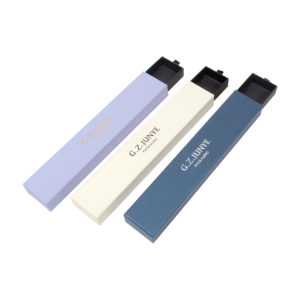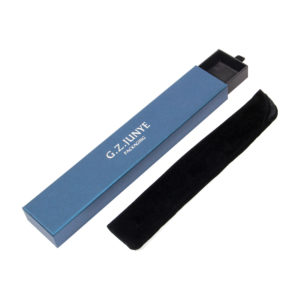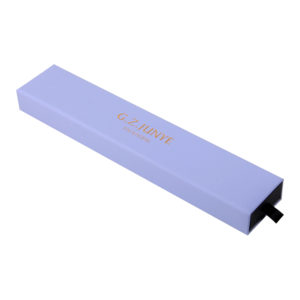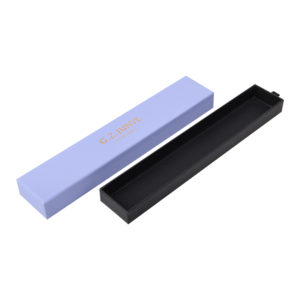
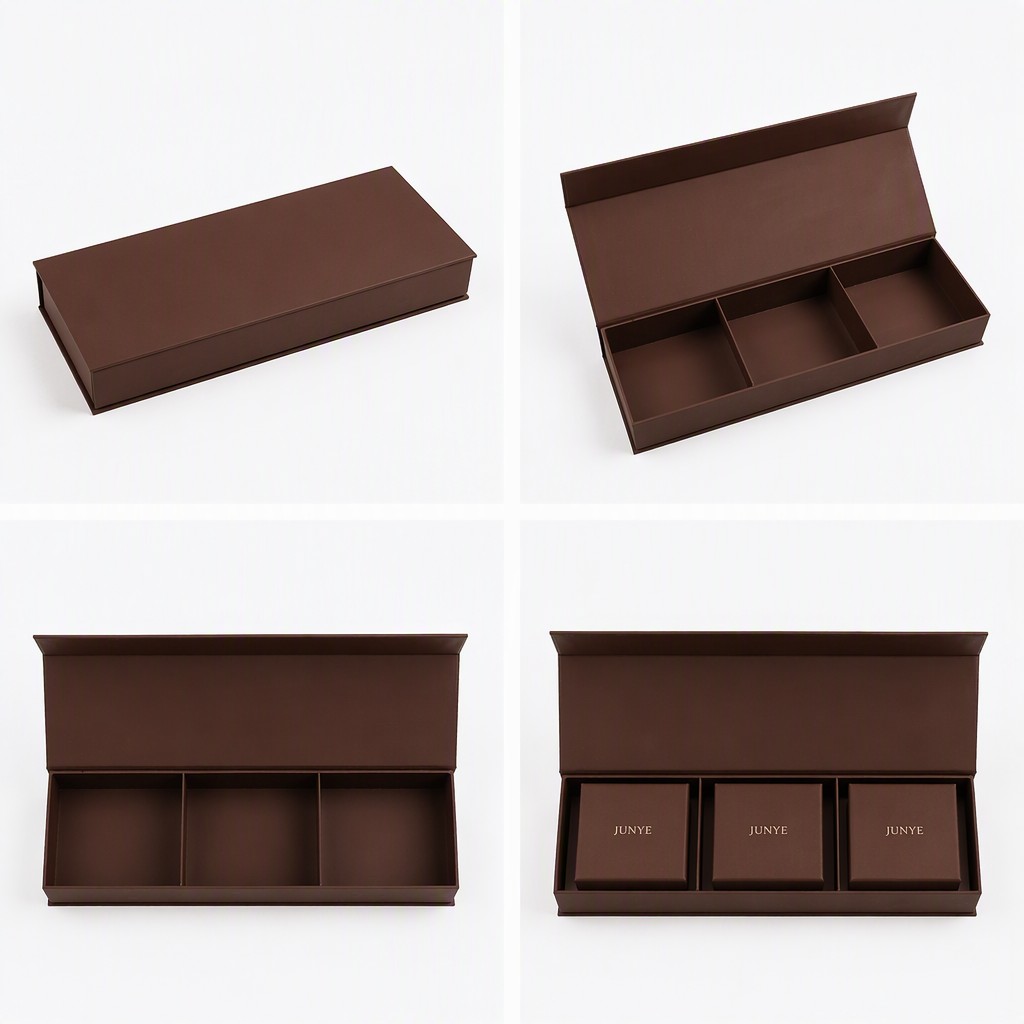
A set box is not a bigger single-piece box. The moment two dividers go in, the insert has to work in three
compartments at once — and that changes the measurements, the depth and the way the box is packed.
Here is what the compartment layout actually decides, in the order it comes up on a real order.
Why a Set Box Cannot Be Sized Like a Single-Piece Box
A single-piece box is measured around one item. A set box is measured around the group, and the group is what makes it
long: three compartments side by side need length rather than depth, which is why this build is 26 x 9 x 4 cm rather
than a deep square.
The length comes from the compartments
Each compartment has to clear the widest piece it will hold plus the divider. Run the arithmetic before choosing the
outer size, not after: a 9 cm width and a 4 cm depth are set by the pieces, while the 26 cm length is set by how many
compartments you need.
Depth stays shallow on purpose
Four centimetres keeps the box a presentation case rather than a chest. It also means pieces lie in one plane, so the
whole set is visible the instant the lid lifts.
Three Compartments: What the Dividers Decide
The dividers are part of the box, not a loose insert. Two of them create three equal bays, and that is the detail
that does the most work in this design.
Pieces stay apart
Chains cannot cross into the next bay, stones cannot touch a bangle, and a finished set arrives looking arranged
rather than settled. On a 26 cm box, that separation is most of the reason to choose compartments over a flat foam pad.
One shell, several configurations
Because the bays are equal, the same box can take a cut insert for a full set, or hold three small boxes with no
insert at all. One die covers the box; only the insert changes.
Option A: A Die Cut Insert for the Whole Set
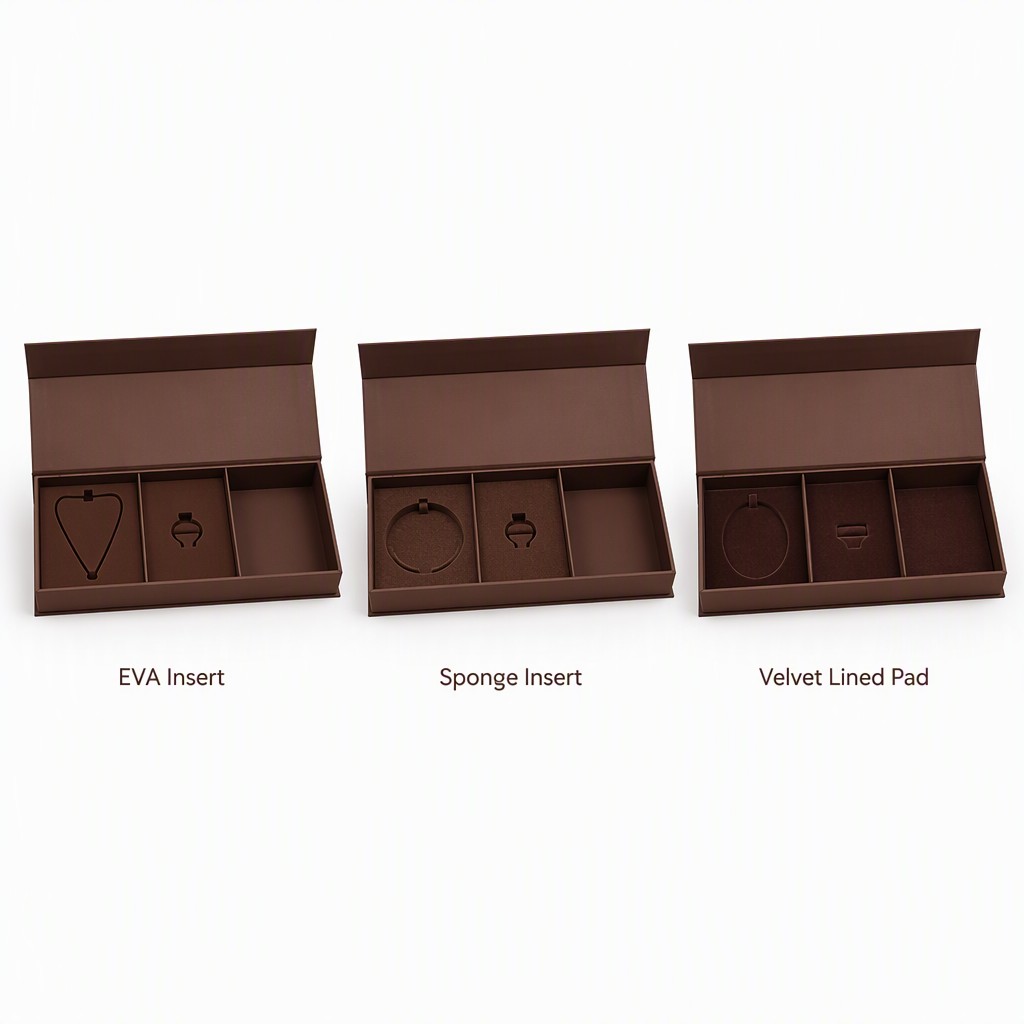
The first configuration keeps the dividers and adds a cut insert that gives each piece a fixed position.
| Necklace | Run along one bay, pendant resting on the insert surface |
| Bracelet or bangle | Laid flat in its own bay |
| Ring and earrings | Cut slots side by side in the third bay |
| Material | EVA, sponge or velvet lined pad, cut to the same drawing |
This is the version to choose when the set is the product — a bridal group, a gift-with-purchase, or a launch
where the pieces are meant to be seen together. Individual pieces still sell well in a
necklace box or a ring box when they ship alone.
Option B: Three Small Boxes, No Insert at All
The second configuration uses no insert. Leave the three bays plain and place three of your own small jewellery boxes
inside, one per bay.
What it is used for
A retailer presenting three price points in one case, a brand shipping a set with an inner box per piece, or a
gift-with-purchase where the outer box is reusable after the inner boxes are given away.
What has to be agreed
The inner box dimensions. Divider spacing is set so the inner boxes drop in without play and without pressure on the
lid. Send the measurements at enquiry stage and the spacing is drawn around them.
Sitting Height: The Number That Decides the Fit
Whatever fills the bays, one measurement settles the box: how high the contents finish relative to the rim of the
base.
| Below the rim | Lid closes flat and the magnets pull evenly across the length |
| Level with the rim | Lid touches on closing; workable, but there is no margin |
| Above the rim | Lid sits proud, the edge line breaks and the closure looks weak |
On a long box this shows more than on a small one, because any pressure is spread over 26 cm. Leave a few millimetres
of clearance and set the insert depth from that figure.
EVA, Sponge or Velvet: Choosing the Insert Material
Material choice is about how the piece sits, not about the box.
| EVA | Firm, precisely cut; ring slots and heavier pieces stay put |
| Sponge | Softer, forgiving on shaped pieces; holds a form without pressing on it |
| Velvet lined pad | Softest surface under a chain or a stone, and the most formal in a photograph |
Because all three are cut to the same drawing, the material can differ between SKUs without touching the box, the
dividers or the artwork.
What to Send Before the Cut Is Drawn
Four things, and none of them needs to be a technical drawing.
| 1. The pieces | Outlines, or the pieces themselves for measuring |
| 2. Bay assignment | Which piece goes in which compartment |
| 3. Inner boxes | Dimensions, if you plan to use the three-small-boxes option |
| 4. Sitting height | How high each piece should finish in the bay |
From that you get a box drawing, an insert layout and a physical sample to test with your own set loaded — ask for
one through the free sample page.
Questions We Get About Set Box Inserts
Do the compartments have to be equal?
No, but equal bays are the most flexible layout: the same box then works with a cut insert or with three inner boxes.
Unequal spacing is drawn to your set.
Can the insert be removed?
Yes. A cut insert lifts out, so the box can be sold with the insert or used plain with three small boxes.
Does the box close without a ribbon?
Yes. Two magnets in the opening edge hold the lid; this build has no ribbon or bow, so nothing has to be tied to keep
it shut.
What are the order quantities and lead times?
300 pcs minimum, sampling in 5-7 days and bulk production in 18-25 days after approval. Structure questions are on our
FAQ page.