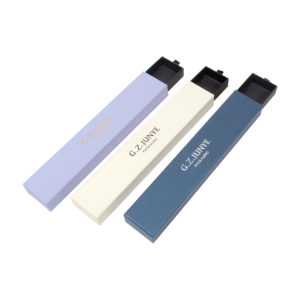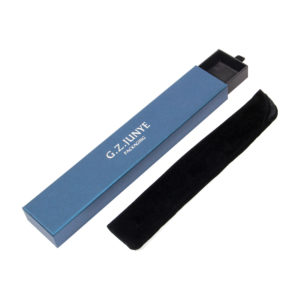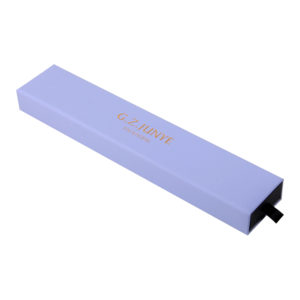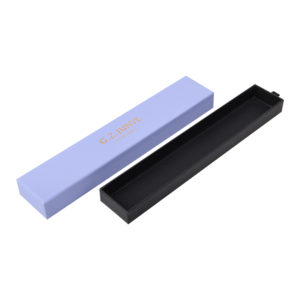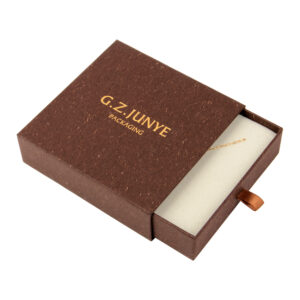
Five assumptions about a drawer jewelry box insert cost buyers a second sample round more often than anything else.
The insert — not the box — decides what a drawer box can hold, and the slot you approve is the slot you have to live
with for the rest of the run.
Below are the five we correct most often, with what is actually true and what to send us so the first sample is right.
Misconception 1: The Box Size Decides What Fits
The common assumption is that an 8 x 8 x 2.5 cm shell can only carry a ring. In practice the shell sets the outer
footprint, and the insert decides what sits inside it.
Why the slot, not the tray, sets the limit
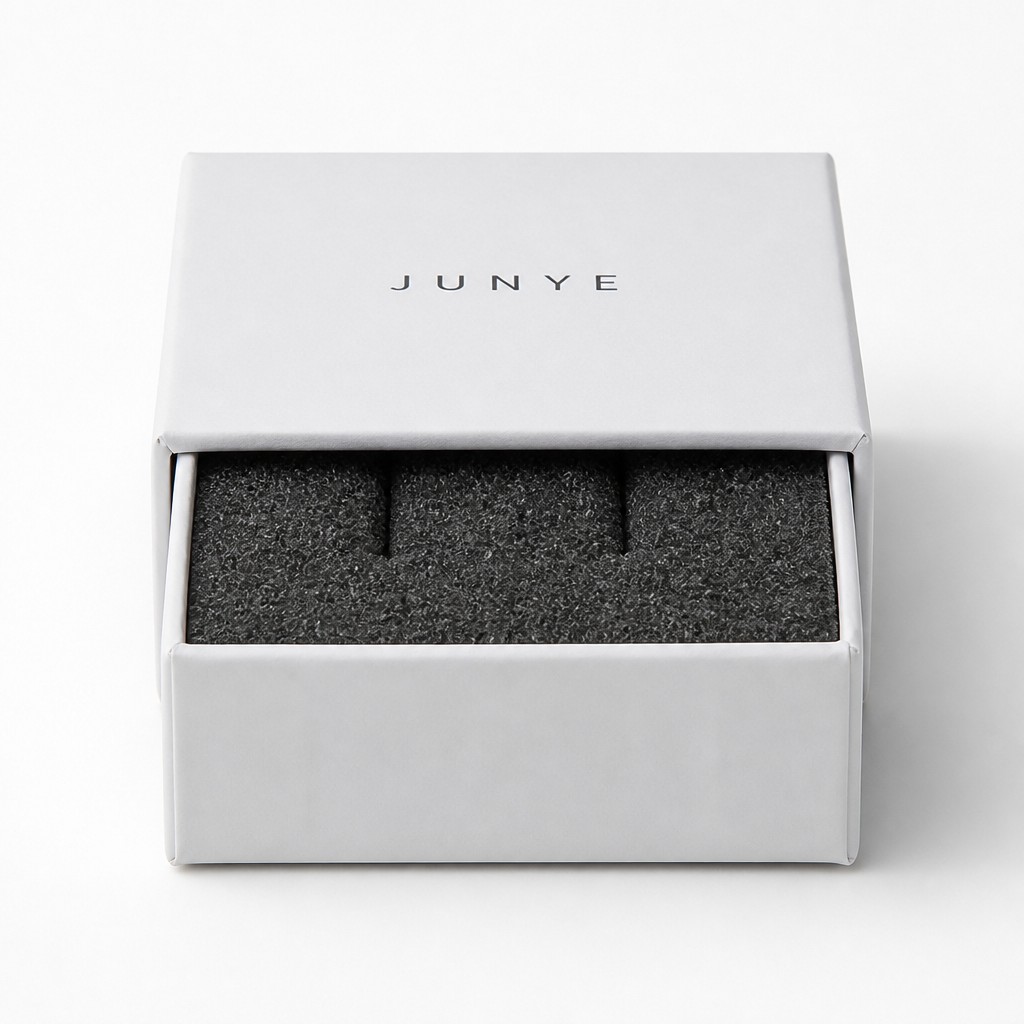
A die cut slot holds a piece in a fixed position, so the same drawer box tray can carry a ring on Monday and a pair of
earrings on Tuesday. What changes is the cut outline, not the box.
Sharing one shell across a range
Because the sleeve, print and lining stay identical, a ring box and a bracelet box can come off the same
construction. Only the insert drawing changes between them.
Misconception 2: A Deeper Tray Holds More
A deeper tray does not hold more — it holds the same piece with more foam around it. For small jewellery, depth is
mostly wasted volume, and it changes how the box opens.
A shallow tray has one real advantage: the piece is visible the moment the tray clears the sleeve, with no lift-out
step. That is why a 2.5 cm tray is the usual choice for rings, earrings and pendants.
Depth also changes how the box photographs and how it sits on a shelf. A shallow tray keeps the box low and stable,
and the opened box reads as one flat composition instead of two stacked levels. If a piece genuinely needs depth — a
wide bangle, a watch, a small set in two layers — the better answer is usually a taller tray with a deeper slot
rather than a deeper box with more air around it.
Misconception 3: Any Foam Will Do
Sponge, EPE and EVA are not interchangeable. They differ in firmness, how they hold a cut edge, and how they behave
in transit.
| Sponge | Soft and low cost | Light items, gift sets, soft presentation |
| EPE foam | Light and resilient | Pieces that must not move in shipping |
| EVA | Dense and firm | Rings and heavier pieces; sharpest slot edge |
The firmness you need follows from the weight of the piece, not from the price of the box.
Misconception 4: A Drawer Box Opens One Way
Most buyers picture a drawer box with one open end and one closed back. A two-way drawer box is different: the
sleeve is open at both ends, so the tray can be pushed out towards whoever is looking, front or back.
On a counter that means the piece comes out towards the customer without turning the box. In a shoot, the printed
sleeve face stays towards the camera.
The motion is still a straight horizontal pull — the tray is never lifted, hinged or folded open.
One consequence is easy to miss at the artwork stage: because the tray can leave from either end, both long faces of
the sleeve are on show at different moments. If the logo is printed on one face only, the box looks blank whenever it
is opened the other way. Printing both faces costs a second pass, and it is the difference between a box that works in
two directions and one that only works in one.
Misconception 5: Sampling Only Checks the Print
Buyers often treat the sample as a print proof. On a drawer box the sample is really an insert and fit test.
| Fit | Tray slides in and out from both ends without catching |
| Flushness | Both tray faces sit flush with the sleeve when closed |
| Insert | Slot outline matches the drawing and the piece sits flat |
| Logo position and ink density match the approved drawing |
Sampling runs 5-7 days, and the die cut drawing comes back for approval first — which is why the insert should be
settled before the sample is ordered, not after.
What to Send Us Before the Insert Is Cut
| 1. Outline | A tracing, a photo on graph paper, or the physical piece |
| 2. Depth | How far the piece must sit below the tray rim |
| 3. Clearance | Any curve or clasp that could catch on the sleeve edge |
| 4. Range | The other pieces that should share the same shell |
Four inputs, one drawing, one sample round. For a ring box or an earring box line the same shell is simply re-cut with a
different outline.
Frequently Asked Questions
Does the insert come with the box?
Yes. The insert is cut to your outline as part of the same order; it is not a separate product you buy elsewhere.
Can I change the insert after the first order?
Yes, as long as the tray shell does not change. A new insert outline needs a new die and one sample round.
What is the MOQ for a custom insert?
300 pcs, the same as the box. Sampling takes 5-7 days.
Will the piece move during shipping?
Not if the slot depth and foam firmness are matched to the piece weight. That is checked on the sample, not assumed.
Can one box cover a whole collection?
That is the point of a cut insert: one jewelry packaging box shell, several outlines, one consistent look across the range.
Getting the Insert Right on the First Sample
Send the outline and the range you want to cover, and the drawing comes back before anything is cut. Questions about
structure or paperwork are answered on our FAQ page, and a sample can be requested through free sample.