
How a Rim Skirt Becomes the Grip
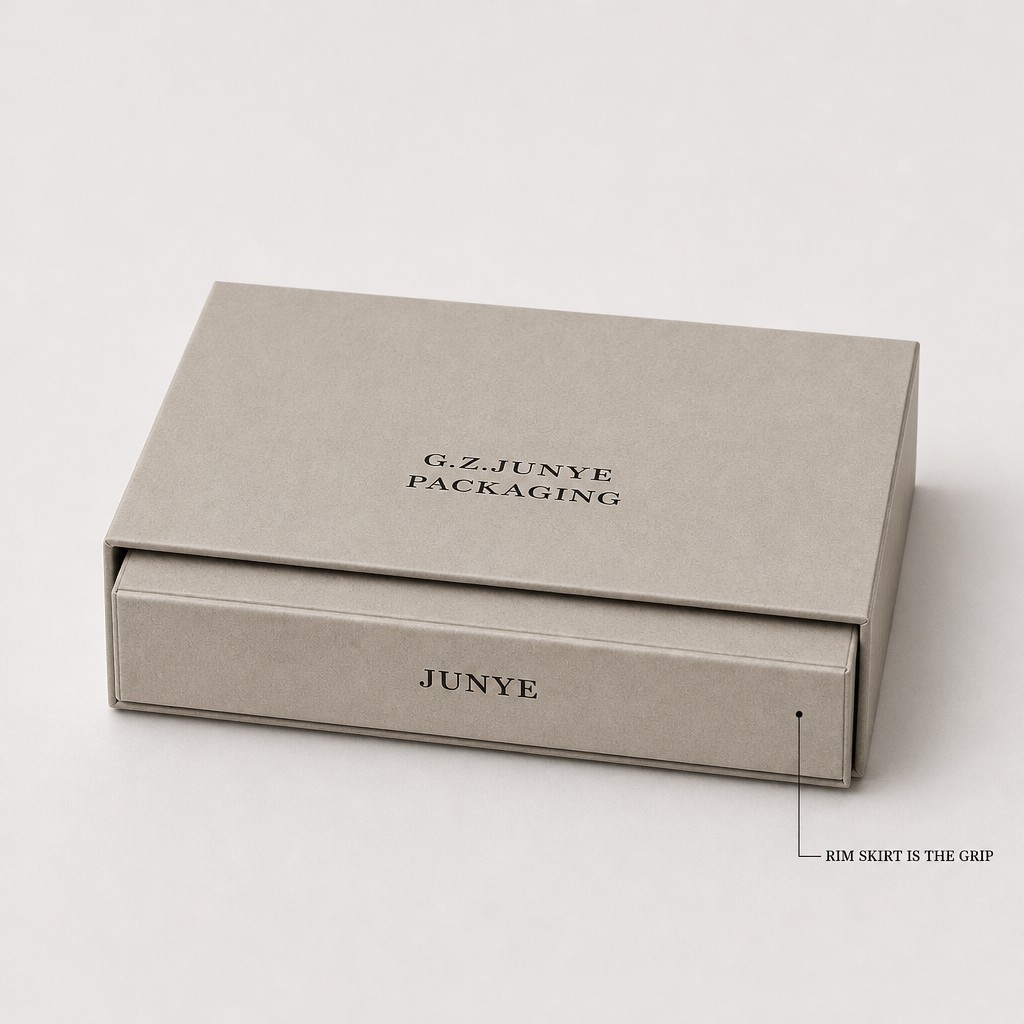
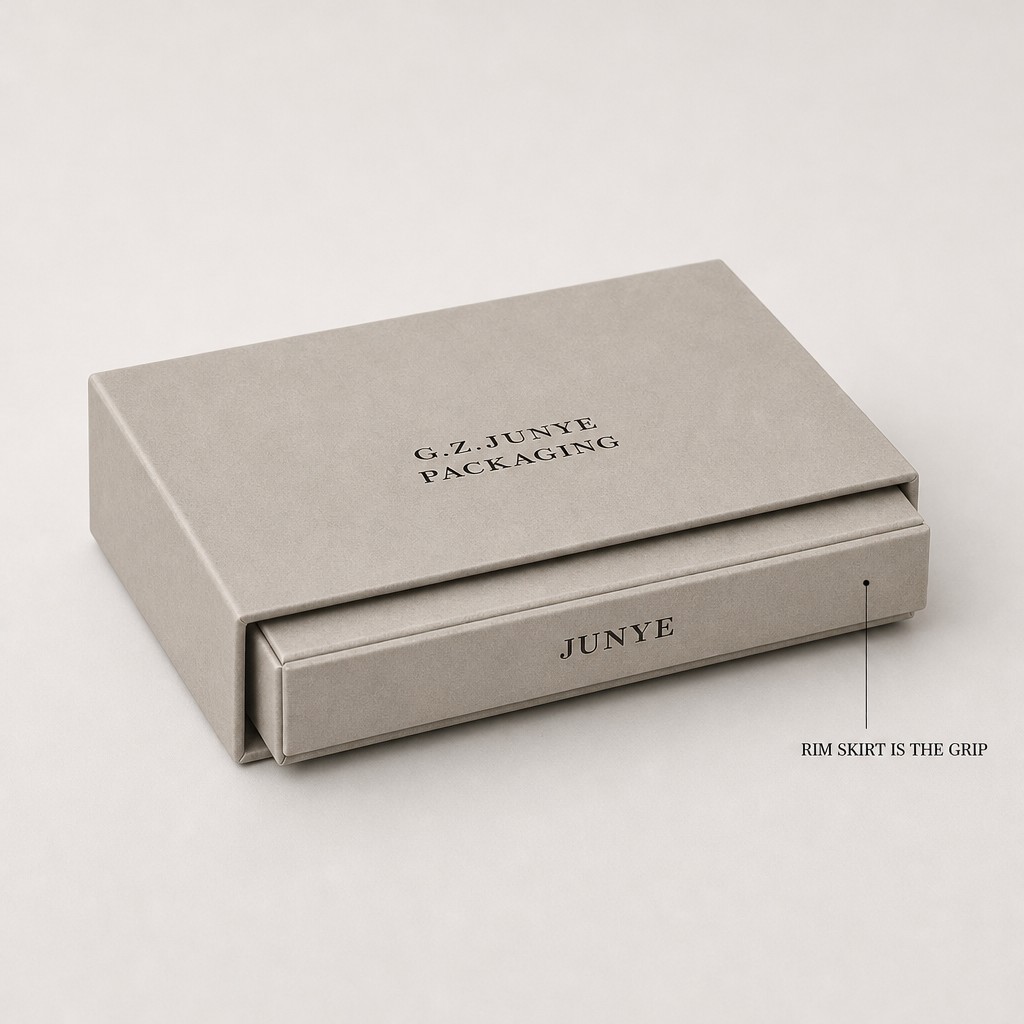
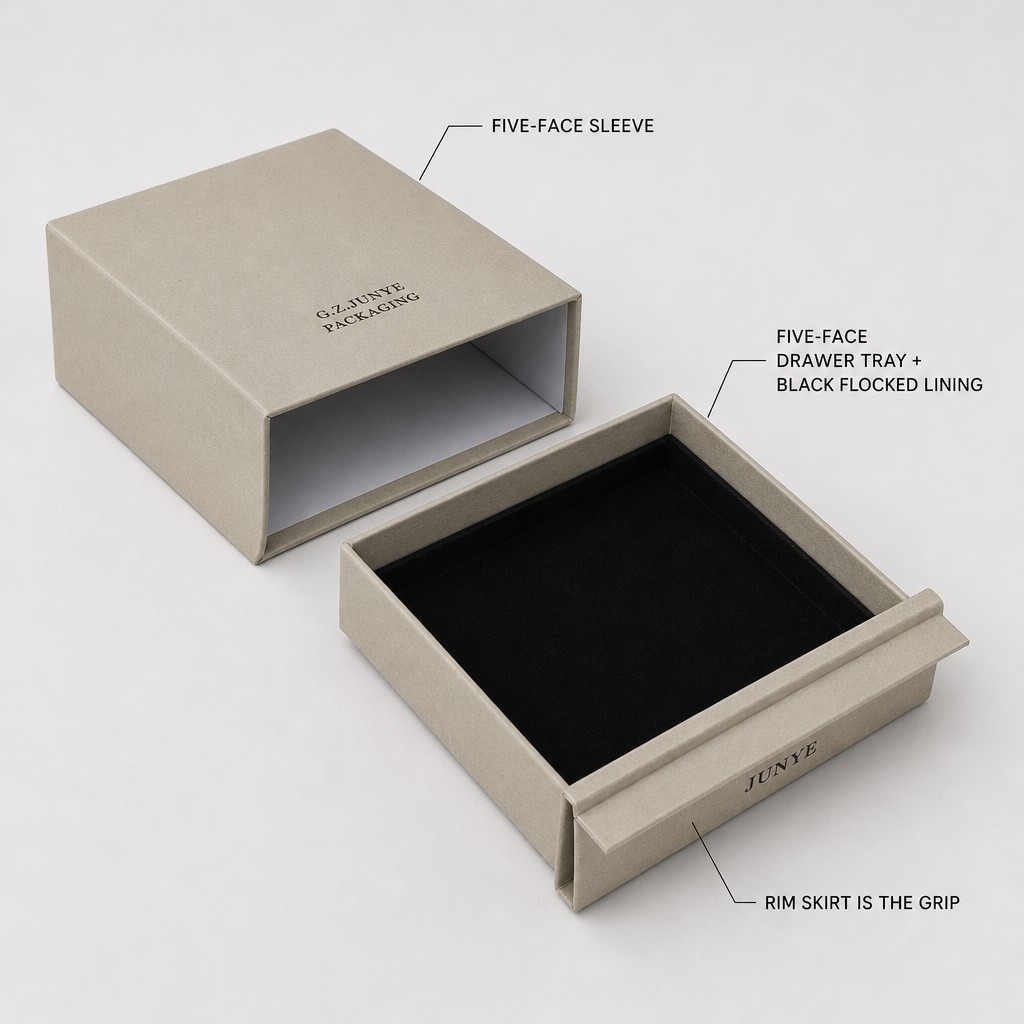
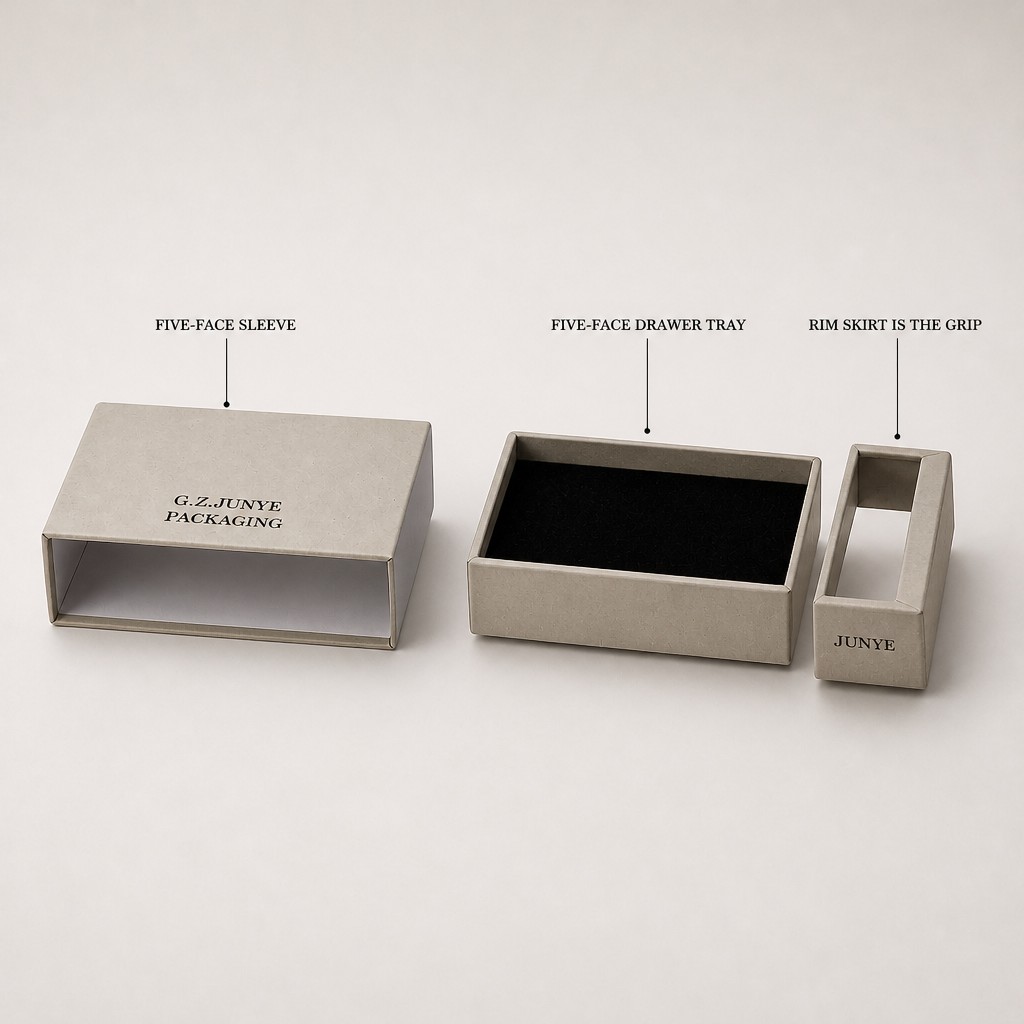
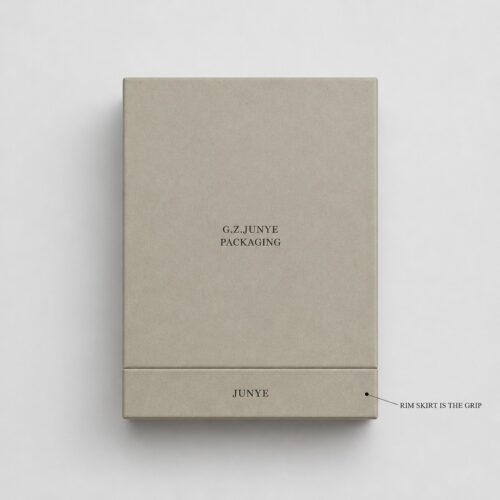
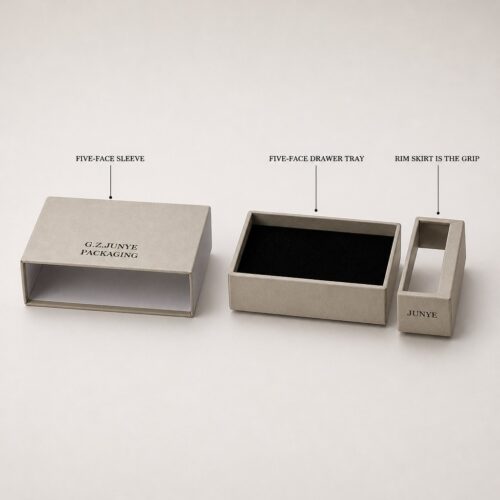
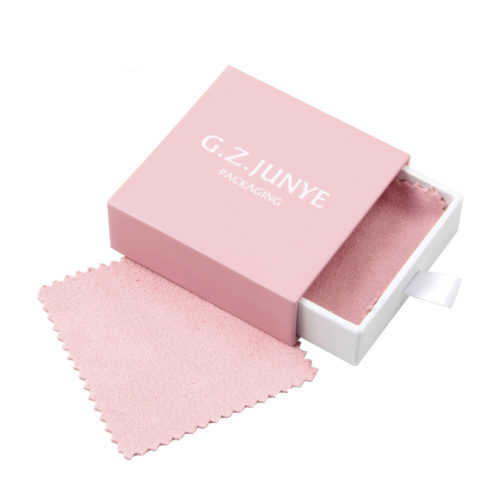
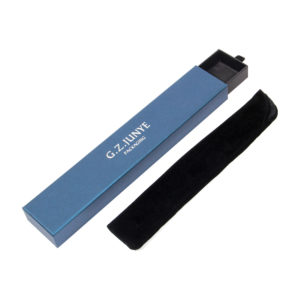
This rim fold jewelry case is two paper parts, and the part you pinch is not a fitting. It is a band of board wrapped around the end of the tray and cut to the same outer size as the sleeve, so it never sits proud of the box. Compared with a plain drawer box, the only difference is how the tray end is finished.
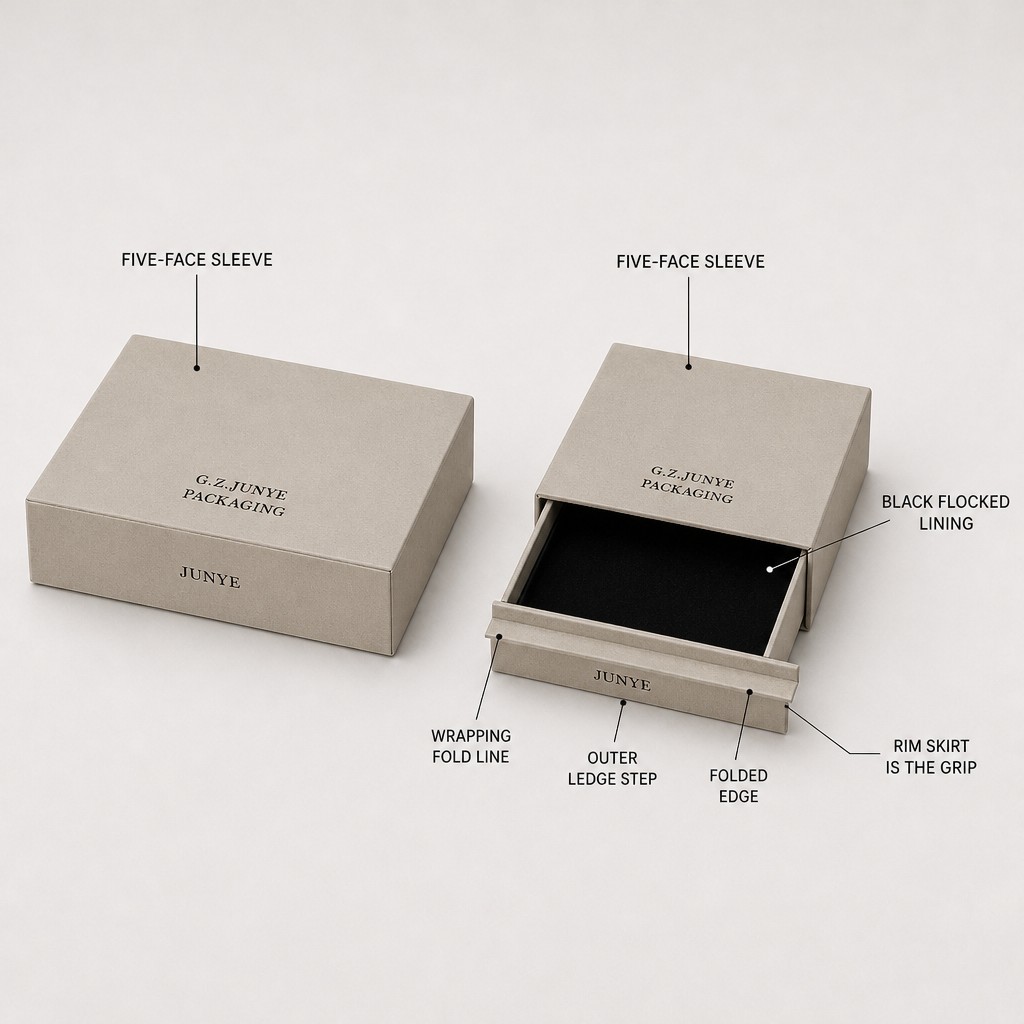
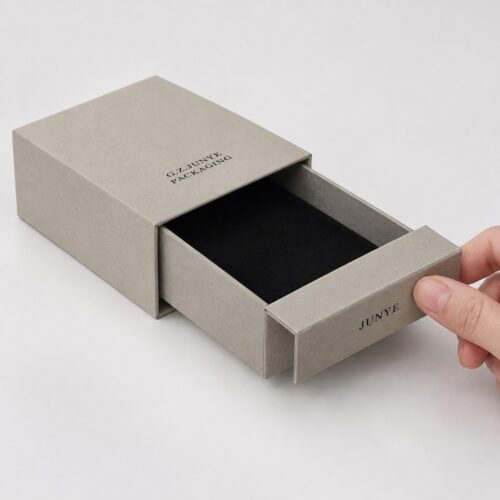
The band is wide enough to take a thumb and forefinger together, which is the whole point. Nothing is sewn, glued on or riveted, so no part can come loose in transit or in a display tray.
| Item | Detail |
|---|---|
| Outer size | 13 x 8 x 3 cm (custom sizes on request) |
| Parts | Five-face sleeve, open at the front + five-face drawer tray |
| Grip | Rim skirt band around the tray end, cut to the sleeve outer size |
| Closed look | Flush outer face, one hairline seam |
| Lining | Flat black flocking over board, one slim inlay line |
| Compartments | None as standard; slots and wells on request |
| Outer paper | Light grey-beige matte specialty paper |
| Board | 1.8 mm grey board, wrapped |
| Gross weight | 0.5 kg per piece |
| MOQ | 300 pieces, mixable across colours and print |
One Solid Block When Closed: Reading the Hairline Seam
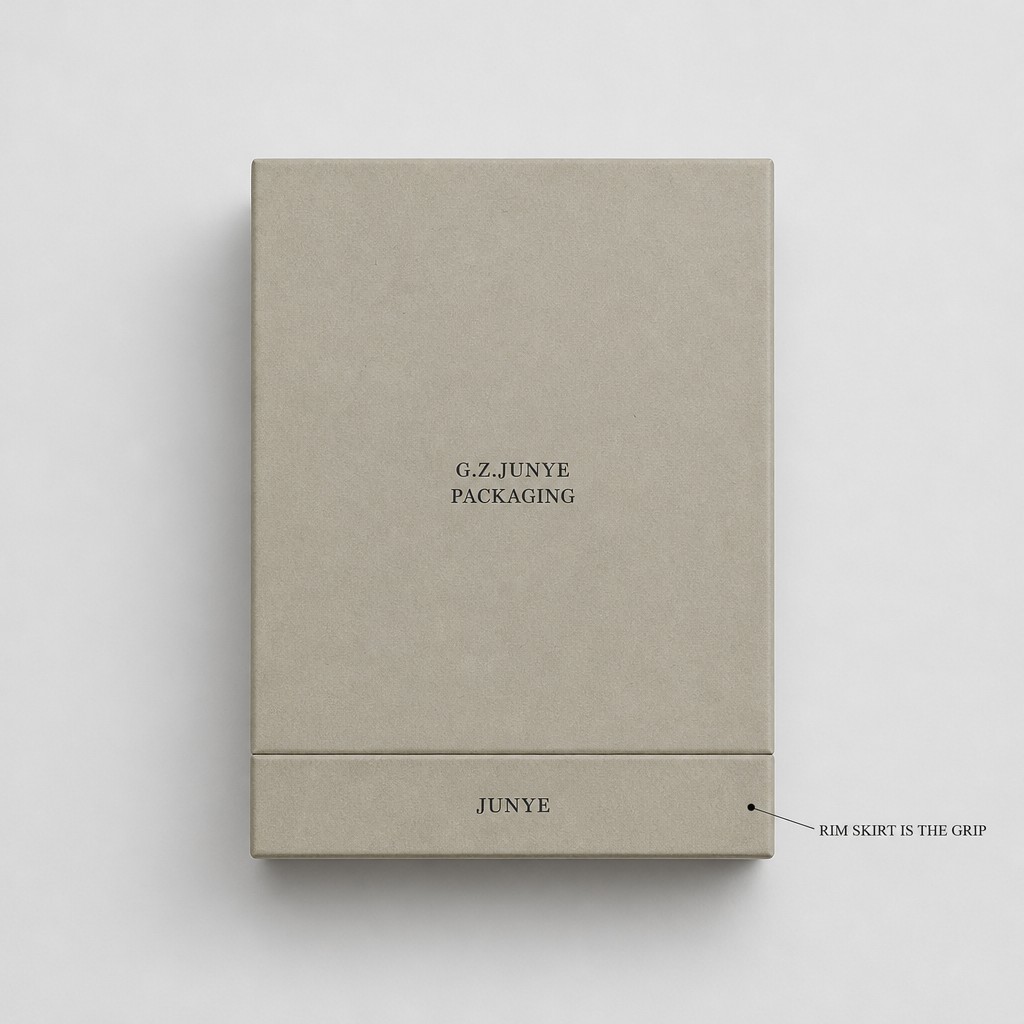
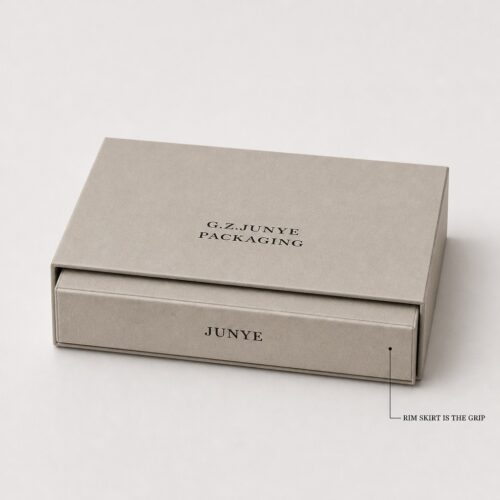
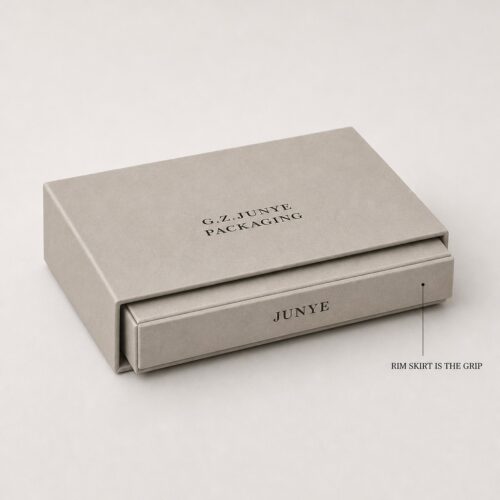
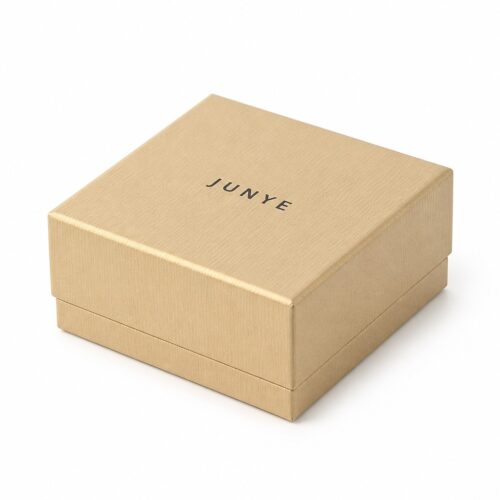
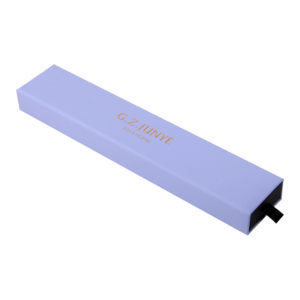
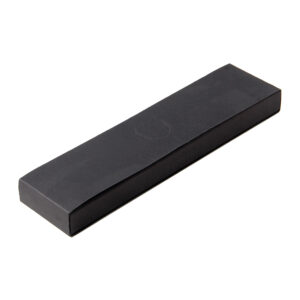
Closed, the case reads as one slab of paper. The only clue that it opens is a hairline seam where the band meets the sleeve wall. Buyers who photograph jewellery flat often want that look, because nothing in the shot competes with the piece.
Because the band shares the sleeve outer size, the seam stays even all the way round. An uneven seam is usually a sign that a skirt was cut to the tray instead of to the sleeve.
The Outer Ledge Step You See on Opening
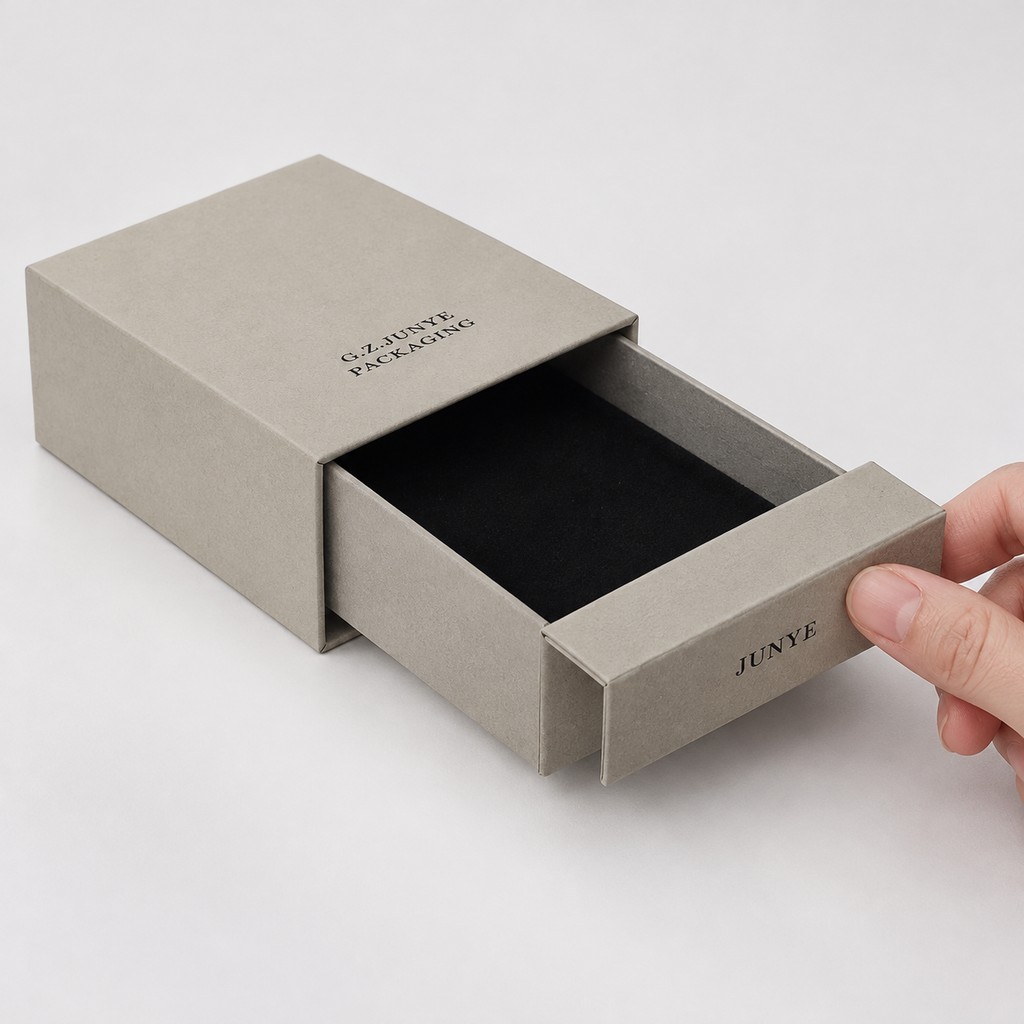
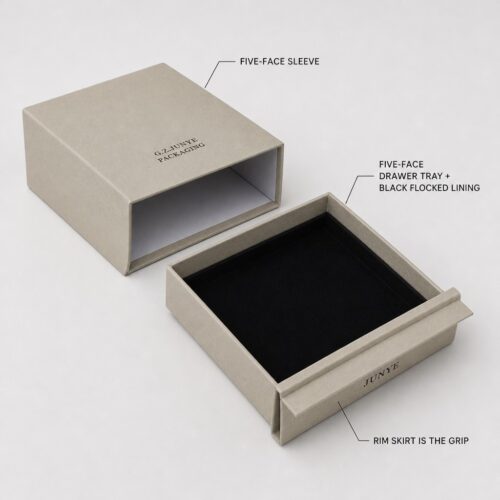
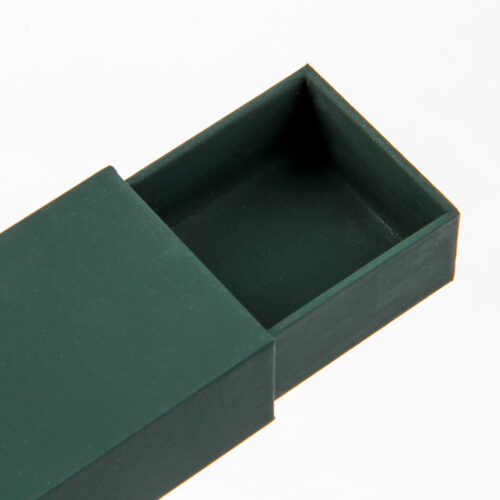
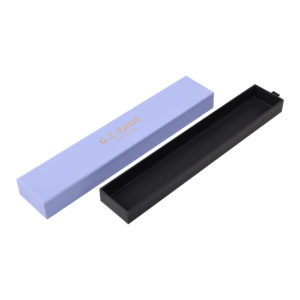
Pull the tray and a step appears: the skirt is wider than the tray wall behind it. That outer ledge is the overhang that created the flush face, and it is also what your fingers close on. It is a shape, not an add-on part.
The ledge depth is set by how much board the skirt adds over the tray. Deeper ledge, easier pull, wider gap when open. We set it against how often the case is opened in the shop.
Five-Face Sleeve and Five-Face Tray: The Two Paper Parts
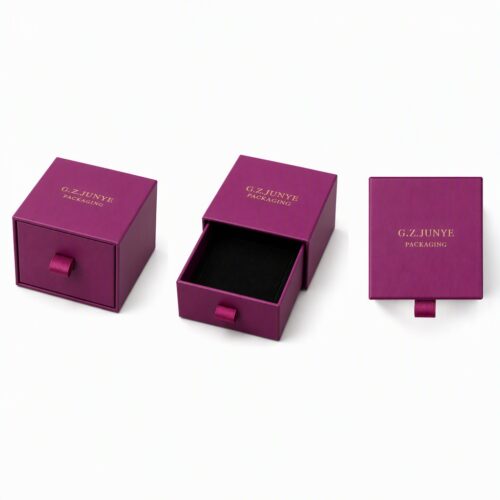
The sleeve is closed on five faces and open at the front, with bare grey-white board inside. The tray is also a five-face box, and it is the tray that carries the skirt and the lining.
Two parts means two wrapped sets of board rather than a moulded shell, so the box is built from paper throughout. It also means a change to the skirt or the liner is a board change, not a tooling change.
Flat Black Flocking Inside, with a Slim Inlay Line
The standard lining is flat black flocking over board, with one slim inlay line running around the inside wall as a trim. There are no compartments as standard, so a bracelet lays out straight and a row of rings can be spaced by hand, which a ring box with fixed slots cannot do.
Flocking is a fibre surface, so it holds a piece a little and keeps it from sliding when the tray is pulled. Because the depth is shallow, nothing drops down behind a wall.
13 x 8 x 3 cm: What a Shallow Tray Does for a Bracelet
At 13 x 8 x 3 cm the case is flat and wide rather than tall. Here flat box proportions are set by the tray, not the sleeve, so the useful question is how your piece sits on the pad rather than how tall the box stands.
That footprint suits pieces that want to be seen laid out: a bracelet opened to full length, two rings side by side, a chain looped once. A 3 cm wall holds a thin pad and a piece, and shallow enough that nothing falls below the eyeline of the pad. A slotted insert tray is the alternative when every piece needs its own slot.
Which Pieces This Flat-Wide Case Suits
The shape is chosen most often for a bracelet box that opens flat, for rings sold as a set, and for pendants that ship on a card. It also works for a jewelry packaging box set where both items sit flat.
Pieces that need height, such as a wide bangle on a raised pad or a watch, usually move up to a deeper wall. If you are unsure, the useful test is whether your piece can be laid down without touching a neighbour.
Light Grey-Beige Matte Paper over 1.8 mm Grey Board
The outer sheet is a light grey-beige specialty paper with a matte finish, wrapped over 1.8 mm grey board. A matte sheet keeps fingerprints and glare off the outer face, which matters when a case is handled in a shop.
The colour is a mid-tone, so it sits beside both yellow and white metal without picking a side. Other sheets, including textured and soft-touch grades, are available where the colour has to match an existing range.
Why There Is No Ribbon, Fitting or Metal Part
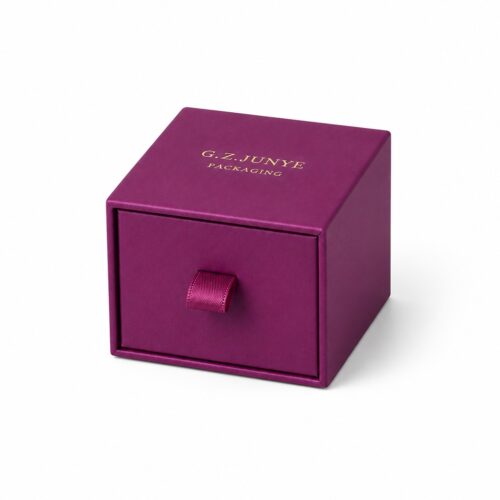
There is no ribbon on this case, and no metal fitting either. The grip is the skirt itself, so the box has one less part to source, attach and inspect, and one less thing that can be missing from a carton.
For buyers shipping to shops, that also removes a snag risk: no loose end to catch on neighbouring stock. Where a brand wants a decorative accessory, it can be added as a separate item rather than as the pull.
| Question | Rim skirt grip | Ribbon or tab pull |
|---|---|---|
| Part to attach | None | Ribbon, tab or eyelet |
| Shape when closed | One block, hairline seam | Pull hangs outside the line |
| How it is opened | Pinch the skirt band | Find the loose end |
| What can fail | No glued or sewn part | Loose or torn pull |
| Outer face | Skirt sits flush with the sleeve | Pull breaks the outer line |
Print Methods for the Rim Skirt Face
The skirt face is a flat, narrow band, so it takes short wording and marks well: a logo, a short line, a pattern. Four methods cover most briefs.
| Method | Where it works best | Typical use |
|---|---|---|
| Hot foil | Logos and short wording | One metal tone on the skirt face |
| Screen print | Bold flat colour | One or two ink colours |
| Emboss or deboss | Texture without ink | Tonal, unprinted look |
| UV spot | Gloss against matte | Highlight over a matte sheet |
Liner Options: Flat Pad, Ring Slots or Necklace Recess
The flat pad is the standard, because it works with the widest range of pieces. Where a range needs order, the pad can be cut instead of left flat.
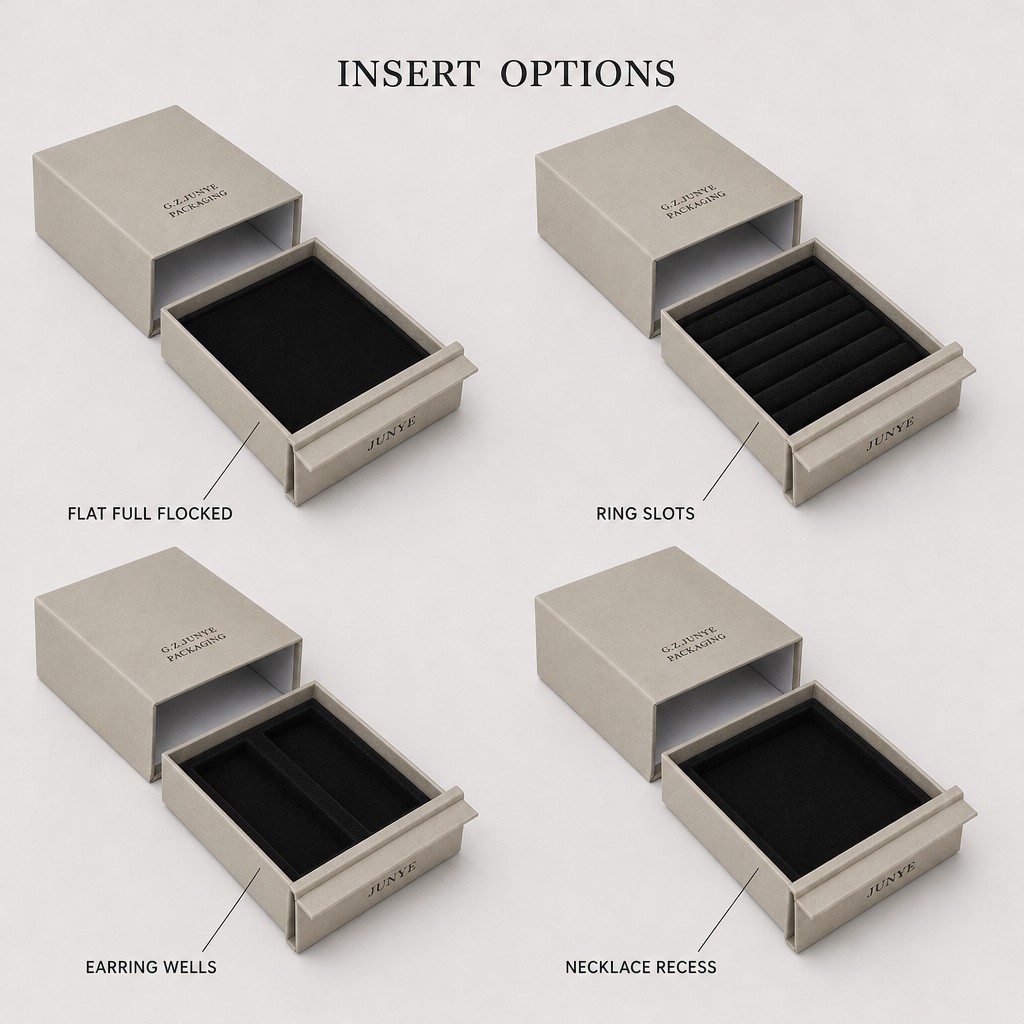
| Liner option | Best for | What you see closed |
|---|---|---|
| Flat full flocking | Bracelets, chains, folded pieces | Flat black pad, one inlay line |
| Ring slots | A row of rings | Evenly spaced grooves |
| Earring wells | Studs and small pairs | Shallow paired depressions |
| Necklace recess | A chain with a pendant | One wider hollow |
Gate Tests Between Sample and Bulk
A case with a flush skirt lives or dies on three measurements: skirt width over the tray, seam line when closed, and glide on opening. All three are set at the sample and held for the run, and the workshop checks the seam line and glide on every batch.
| Stage | What is checked | Who signs off |
|---|---|---|
| Artwork | Wording, placement, foil tone | You approve the digital proof |
| Sample | Skirt width, seam line, liner depth | You approve the physical sample |
| Pre-production | Board, paper, flocking colour | Factory report before the run |
| Bulk | Seam line and glide on each batch | In-house check sheet |
Carton, Gross Weight and Carton-Cube for This Size
A flat-wide case of this size travels well because it stacks without a raised lid. The export figures are simple to work from.
| Item | Value |
|---|---|
| Outer size | 13 x 8 x 3 cm |
| Gross weight per piece | 0.5 kg |
| Piece footprint for carton maths | 15 x 10 x 5 cm |
| Shipped form | Sleeve and tray together |
| Carton plan | Confirmed against your quantity before the run |
Papers, Compliance and Recycling Scope
The papers and board used here carry the certificates listed below, and the plant holds ISO 9001. We share current documents with a quotation rather than describing them from memory.
Because the box is wrapped board rather than a moulded shell, it can enter paper recycling where your local stream accepts coated grey board. Where a market has its own rules, the EPR numbers listed are the ones to quote.
Pinch Width, Drawer Glide and What to Specify
When you send a specification, four numbers do most of the work: outer size, skirt width over the tray, liner depth, and the gap you want at the seam. From there the sample confirms the feel.
If you have a piece in hand, tell us its thickness and how you want it laid out. That is usually enough to choose between a flat pad and a cut liner before you see anything physical. A sample request is the usual first step, and the FAQ below covers the terms most buyers ask about first.
Reviews
There are no reviews yet.