
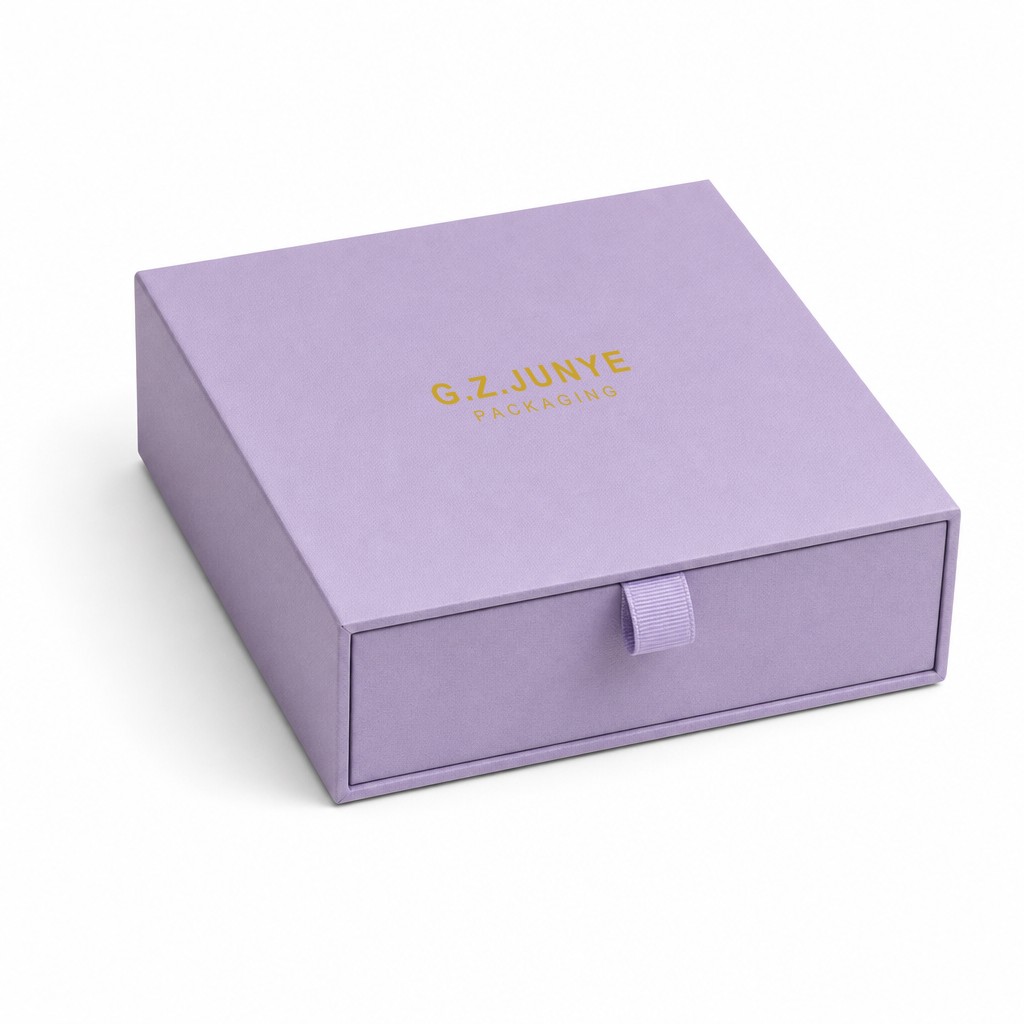
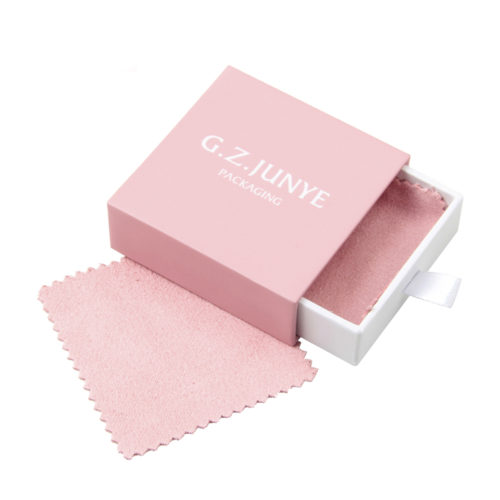
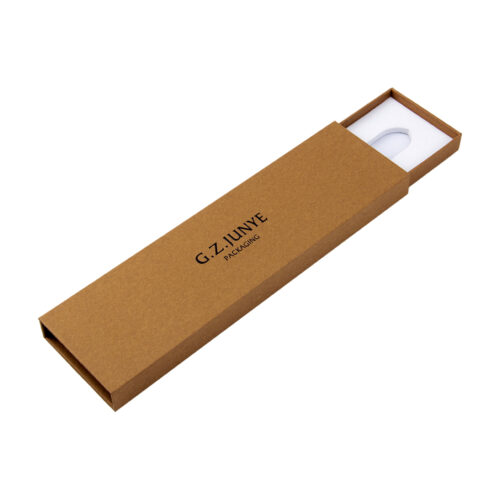
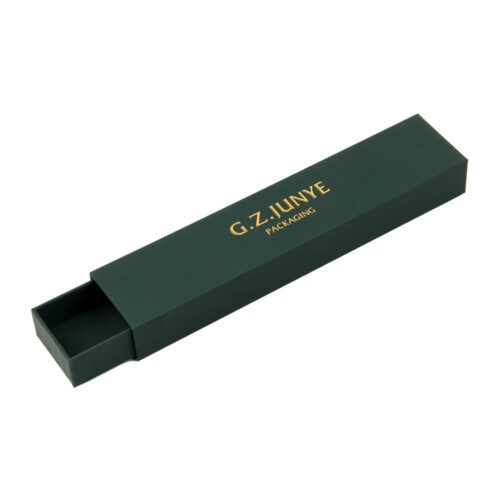
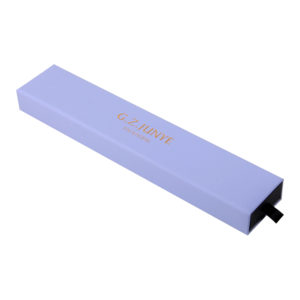
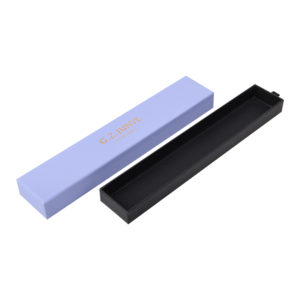
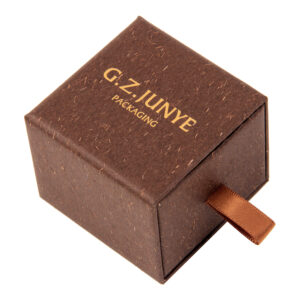
A purple drawer box in 11 x 11 x 3 cm, wrapped in matte purple paper, with one gold foil block on the sleeve top. Two pieces: an outer sleeve and a tray that slides out of one open end. Inside, a white foam insert sits flush with the tray mouth and is cut with one main cavity, a finger notch and a lower opening for the accessory.
Specification at a Glance
| Dimension | Value | Note |
|---|---|---|
| Length | 11 cm | front face, left to right |
| Width | 11 cm | equal to the length |
| Height | 3 cm | closed, outside |
| Footprint | 11 x 11 cm | square in plan |
| Height to side | 3 : 11 | a flat box, not a cube |
Two Pieces, and Only One of Them Moves
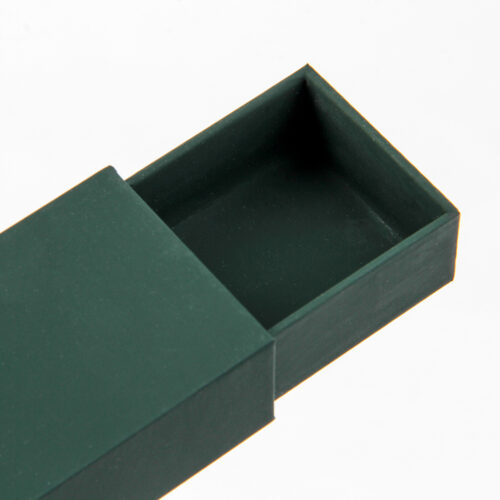
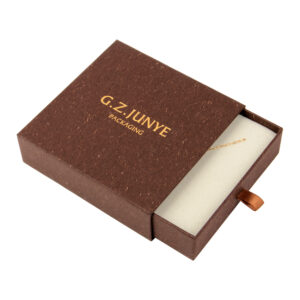
The outer sleeve is five panels: top, bottom, front, back and a closed panel at the left end. The right end stays open. The tray, made of a base board, four walls and a front face board, slides out through that opening like a drawer. Nothing lifts, nothing turns on a hinge.
Because the sleeve wraps five faces, the tray cannot come out of the wrong end, and there is no second opening to line up on the packing line. Both parts are built the same way we build our paper boxes: greyboard cut and corner taped, then wrapped by hand.
| Part | What it is | What it does |
|---|---|---|
| Outer sleeve | five panels: top, bottom, front, back and the closed left end | wraps the tray on five faces; the right end stays open |
| Sliding tray | base board, four walls, front face board | carries the product and slides out of the open end |
| Flat loop pull | same-colour paper loop, 8 to 10 mm wide | pressed inside the tray face; lies flat when the box is shut |
| Foam insert | white foam, cut level with the tray mouth | one main cavity, a finger notch and a lower opening |
The Only Seam Is Where the Tray Face Meets the Sleeve
Shut, the box reads as one block. The single visible line is the fine straight joint between the tray front board and the sleeve opening. It sits at the end of the box rather than halfway down a wall, so both long sides stay unbroken and the gold foil sits on a panel with no joint across it.
That is the difference between this and a lid that drops over a base: no overlap band, no shadow running around the middle, no second line to keep parallel. We set out the reason in how a sleeve and tray box closes. If you need the opposite look, a box with a deliberate step, that is a different construction and we would quote it separately.
The Pull Is a Flat Loop, 8 to 10 mm Wide
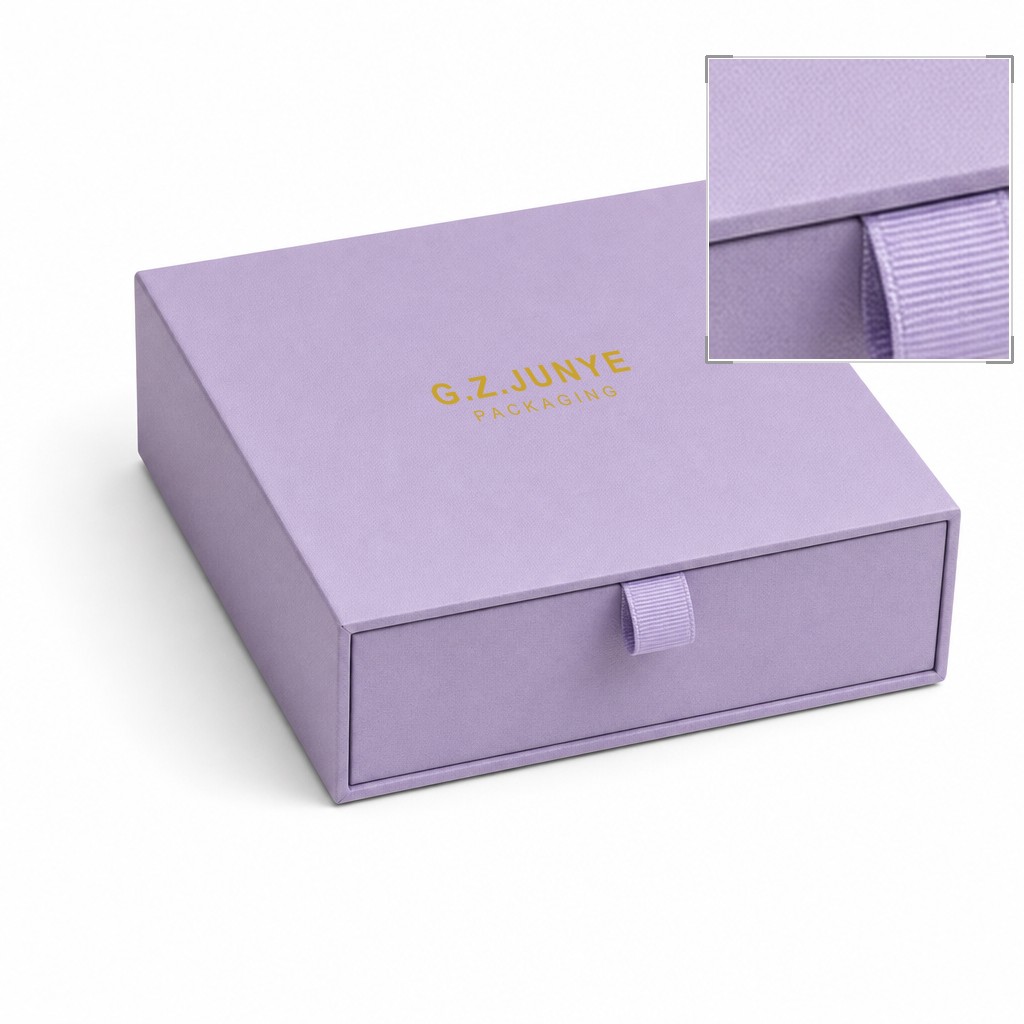
A short loop of the same purple paper, 8 to 10 mm wide, is pressed into the inside of the tray face so that one small ring shows when the box is closed. Pressed flat, it adds almost nothing to the profile and cannot catch on the wall of an export carton.
There is no notch cut into the board and no folded paper tab. That matters more than it sounds: a notch leaves an exposed cut edge where the wrap can lift, and a tab stands proud where it can bend in transit. A loop has neither failure, and the box still opens with one hand.
A White Foam Insert, Flush With the Tray Mouth
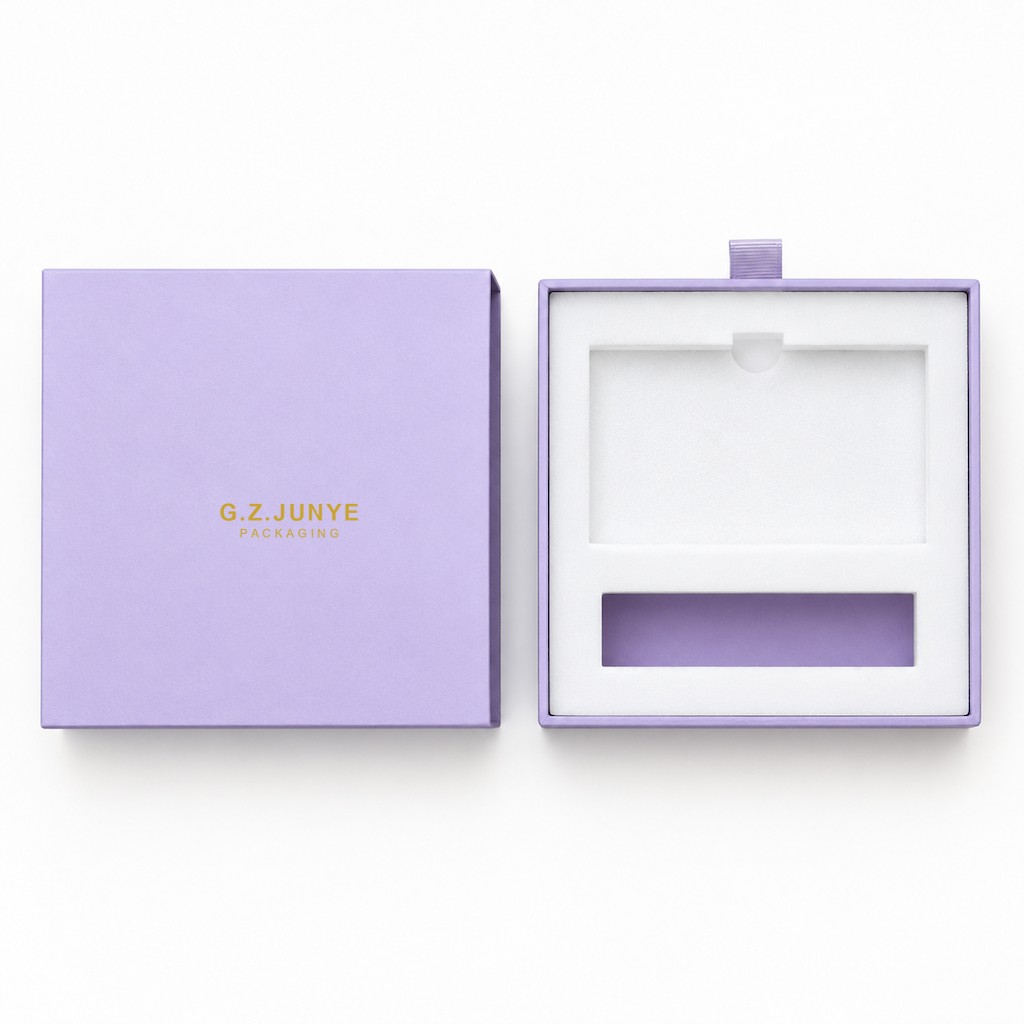
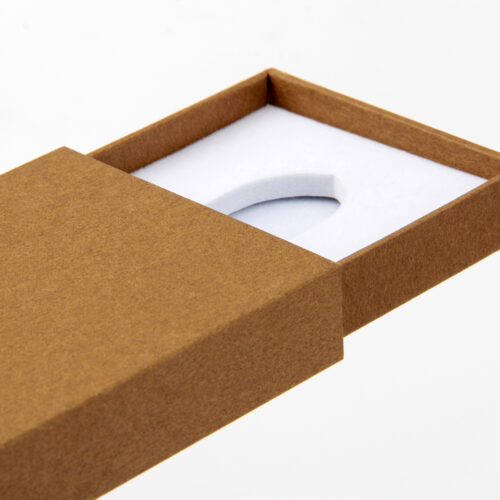
The insert is white foam, fine-pored, laid across the whole tray cavity and cut level with the wall mouth, so a closed box does not press on the product. It carries one large rectangular cavity with a narrow step all round and the foam floor left white: the product sits on foam, not on paper.
A semicircular finger notch, about 2.5 cm across, is cut into the middle of the cavity upper edge, so the item lifts out without a tool. Below it a second opening passes through the foam and shows the purple tray floor, which is where a cable, a spare tip or a card sits.
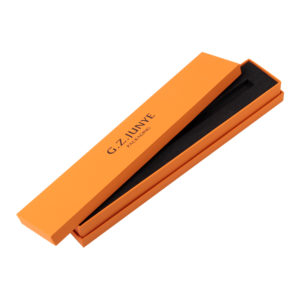
The cavity can be cut to your 3D file. Send the model and the insert is machined to the outline, with the notch and the accessory opening where your packing line needs them. Other layouts we build for drawer boxes include EVA, a flocked tray and a paperboard platform.
What Fits Inside 11 x 11 x 3 cm
The footprint is square and the box is flat: 3 cm of height against an 11 cm side. That suits objects wider than they are tall. A cream jar or a compact; a pair of earbuds in a case or a charger; a medal in a small sleeve, a pen, a commemorative piece.
It is a retail and display pack rather than a shipping carton. The product lies in the cavity, the sleeve top carries the brand, and the whole thing goes into an export carton for the journey. For anything taller than the box, this is the wrong construction and we will say so before quoting.
Paper, Board and One Gold Foil Block
The body is greyboard, cut, corner taped and wrapped by hand in matte purple paper. Hand wrapping is what keeps the corners square and the long edges straight, and it lets the paper grain run the same way on all five sleeve panels, so the colour reads even under a single light.
The colour is a lavender purple, measured on the sleeve top at a mean of (217.0, 176.2, 228.4) in RGB. It is slightly blue rather than pink, which is why it photographs clean in daylight and does not turn mauve in a warm room.
Print is one gold foil block on the sleeve top, the largest unbroken panel: G.Z.JUNYE on one line and PACKAGING on the next, centred. There is no other printing on the box, and the tray face stays clean, so one construction carries several products without new artwork.
Sizes, Colours and the Sample Route
The 11 x 11 x 3 cm size is a stock size and starts at 300 pcs. A bespoke size or bespoke artwork starts at 500 pcs per size. Paper colour, print, foil and insert layout are made to order on the same two-piece construction.
Send a drawing, a reference or a 3D file and a dieline and a 3D mockup come back free within 1 to 3 days. A physical sample follows in 5 to 7 days. Bulk production takes 18 to 25 days after sample approval, and small runs take 10 to 15 days. DDP door to door is standard; FOB Nansha and EXW Guangzhou are also quoted. If you want to feel the paper before committing to a run, ask for a free sample.
Paper is FSC compliant. ISO 9001:2015 certificate ZYC24Q00141R1S, RoHS reports, German and French EPR registration and a GPSR EU responsible person are on file and quoted on request. Those are the only documents we cite, and each one can be checked.
Questions Buyers Ask Before the First Run
Is the loop glued on, or does it pass through the board?
One end of the loop is pressed into the inside of the tray face before the paper is turned in, so the wrap itself holds it rather than an adhesive patch on the outside. It sits flat when the box is shut and stands up when you pull.
Can the foam be replaced with something else?
Yes. EVA, a flocked tray or a paperboard platform can replace the foam on this construction. Foam is the usual choice for a flat box because it holds a shallow cavity without adding height.
Does the tray come all the way out?
It does. There is no stop and no tether, so the tray lifts clear and the packing line can load it flat. If you need the tray to stop at a fixed point, say so before the dieline is cut.
How is the box packed for export?
Each box goes into a PP bag, then an export carton, then a pallet. The drawer box is the retail pack, not the shipper, and the carton is what protects it. Full terms are on the FAQ page.
What is the minimum order?
300 pcs on the stock 11 x 11 x 3 cm size, and 500 pcs per size for a bespoke size or bespoke artwork. Colours can be mixed across a run on the same construction.




Reviews
There are no reviews yet.