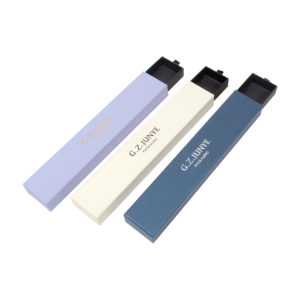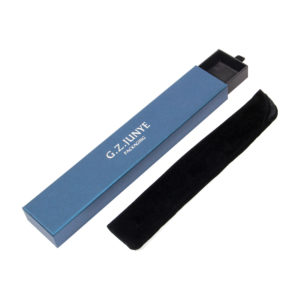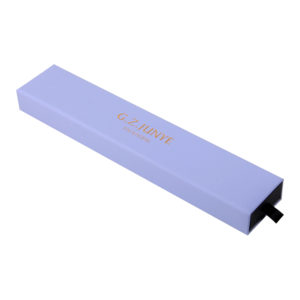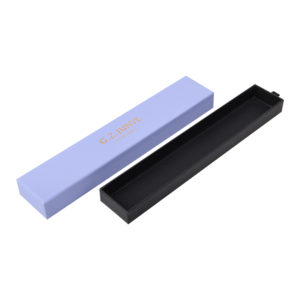
An one end sealed sleeve box is a two-piece paper box where the outer sleeve closes five faces and seals one end, leaving a single opening for the tray. It sounds like a small detail. It decides which way the box opens, how the front face lines up, what a buyer sees on the shelf and what the packing line can get wrong.
What The Sealed End Actually Does

A sleeve is the simplest way to hold a tray: five faces of board and paper, wrapped in one piece, with the tray sliding out of the sixth. The question is what you do with the sixth face at each end. Seal one, and the tray has one exit. Leave both open, and it has two.
The Sleeve Wraps Five Faces
Count the faces on this 9 x 8 x 2.5 cm box: top, bottom, two large sides, and the sealed panel at the back. That is five surfaces of board, wrapped in one run of paper that turns the corners and finishes inside. The opening is the sixth face, and it is not a gap: it is the cut ends of the walls, which is why the closed side shows a black border round the white drawer face.
| Face | Covered by the sleeve | What it is |
|---|---|---|
| Top | yes | the panel that carries the foil block |
| Bottom | yes | flat, so the box stands without rocking |
| Two long sides | yes | the faces a buyer sees edge-on |
| Back | yes | a sealed panel, not an opening |
| Front | no | the cut ends of the walls and the drawer face |
Why The Tray Cannot Leave The Back
With one end sealed, the drawer travels one way. Push it from the front and it stops against the back panel; pull the cord and it comes out at the mouth. There is no second opening to line up, no chance of the tray being loaded in reverse, and nothing that falls out of the far side when the box is picked up by the sleeve.
On a two-way box the tray can leave either end. That is useful when two products share one case and each opens to its own side, and we build those too: the two way drawer jewelry box is the same idea with both ends open. For a single piece, one sealed end removes a whole class of packing error.
A Flush Face Needs A Sealed End
Flush is a consequence, not a decoration. The drawer panel is 9 x 8 cm, the same as the sleeve mouth, so when the tray is home the panel sits level with the cut ends of the walls and the only visible line is a hairline seam. About 1 to 2 mm of black shows above and below the white face.
That alignment only works one way round. With one sealed end, the drawer has a stop. It cannot be pushed through and out the other side, which is what would break the flush line if it could.
What Changes When Both Ends Are Open
You gain a second way in, and you lose the stop. A two-way sleeve is a tube: the tray can be pushed out from either side, so it needs a different way to hold its position, and the front face stops being a single reference point. Packing instructions get longer, and a buyer who picks the box up by one end can send the tray out of the other.
Neither is wrong. A two-way box is the right answer for a case that opens to two products; a one-way box is the right answer for one piece that has a front. The mistake is ordering one and expecting the other.
Where A Sealed End Costs You Something
Three cases. If the piece is longer than the sleeve is wide, it has to load from the front along its long axis, which can be awkward on a deep box; a shallower tray is usually the fix. If two products share the case and each needs its own opening, one sealed end is the wrong build. And if the brief calls for the tray to be pushed out from the back for a display unit, this construction cannot do it.
Everything else is a paper decision. The sleeve takes any colour, the drawer takes any colour, and the pull can be a cord, a ribbon or a leather-look tab threaded through the same hole.
Cord, Ribbon Or Leather On The Pull

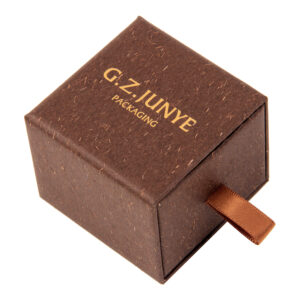
The pull is a loop through a hole in the centre of the panel, knotted behind, hanging 2 to 3 cm. A cord is the quietest: flat against the face, no width, nothing to crease in a carton. A ribbon reads softer and suits a gift; a leather-look tab sits flatter still and takes a stamp. All three leave the same hole in the drawing, so the pull can be changed late without touching the dieline.
The tray behind it stays plain. No flocking, no grooves, no insert: the floor is one flat white sheet, just under 2 cm below the sleeve top, so a ring or a bracelet sits up where it is seen. A flocked or EVA bed can be added to your drawing whenever the range settles. See the rest of our drawer boxes for the insert layouts we build.
What To Send, And What Comes Back In A Week
Send four things: the piece or its 3D file, the footprint and depth you want, the paper colours, and the pull you have in mind. A dieline, artwork and a 3D mockup come back free within 1 to 3 days, and a physical sample in 5 to 7 days. Bulk runs 18 to 25 days after sign-off, or 10 to 15 days on a small trial order. DDP is the default term, with FOB Nansha or EXW Guangzhou on request.
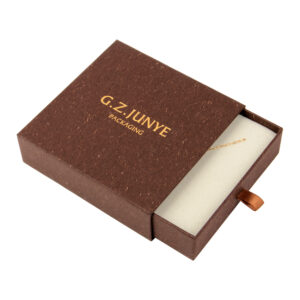
The stock 9 x 8 x 2.5 cm size starts at 300 pcs; a bespoke size or bespoke artwork starts at 500 pcs per size, and printing at 1,000 pcs. The box in the photographs is the stock build with our own mark in gold foil. Ask for a free sample and check the seam and the pull in your hand.