A Cube Is Not a Flat Box with Taller Walls
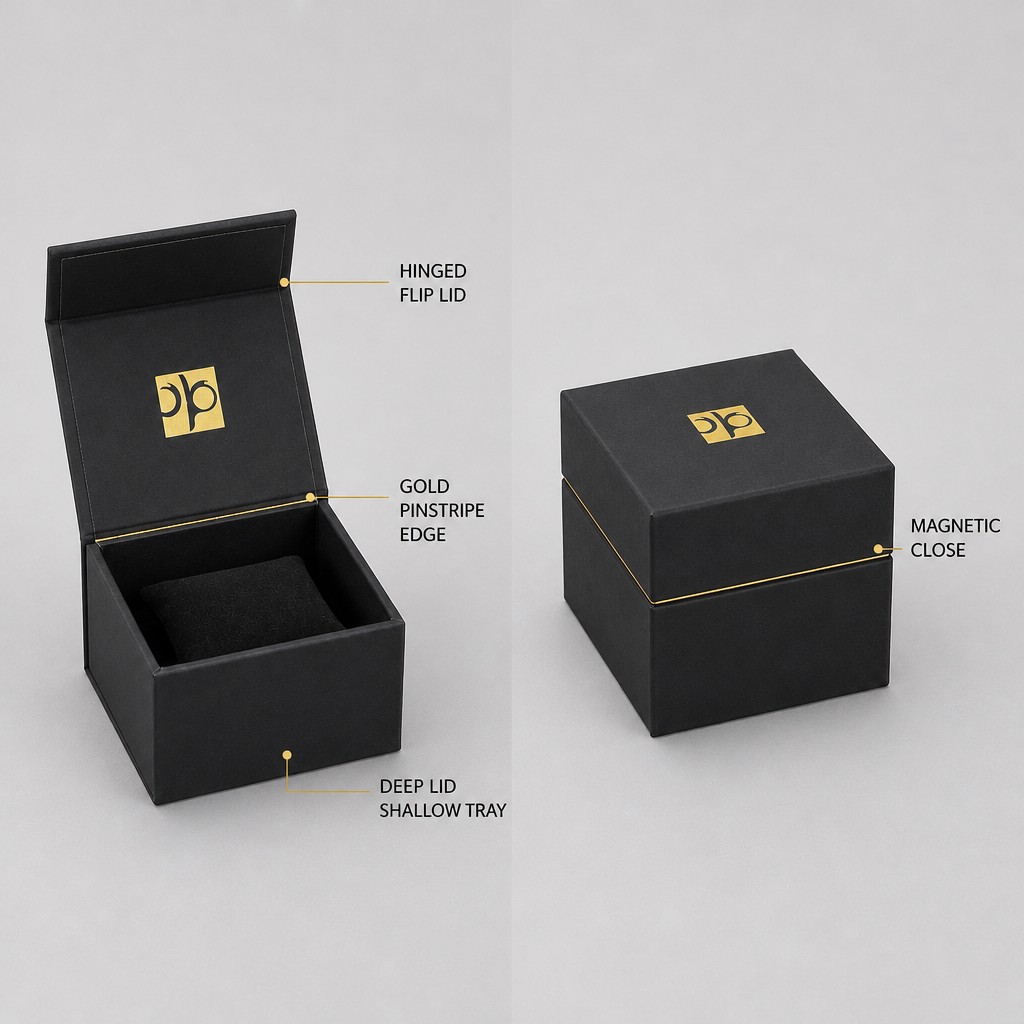
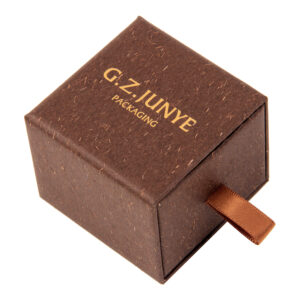
Take a 9 x 9 x 2.5 cm box and multiply the height by two and a half and you do not get this box. A cube changes what the piece does inside: the lid has room to swing, the tray gets a raised middle, and the buyer sees the item at the moment the box opens rather than looking down into a well.
The construction behind that is simple. The lid stays joined to the base along one back edge, swings about a hundred degrees and closes on hidden magnets, so there is no ribbon, no clasp and nothing to line up. The interesting decisions all happen inside.
Why the Lid Takes Most of the Height
Of the six centimetres, the lid carries most and the tray stays shallow. That split is deliberate: a deep tray would swallow a ring, while a deep lid leaves the piece sitting high in a shallow tray, close to the rim where the eye lands.
| Lid | Deep — most of the 6 cm height, hinged along one edge |
| Tray | Shallow, with a raised cushion in the middle |
| What the buyer sees | The piece at or near the tray rim when the lid clears |
| What it avoids | A ring or studs lost at the bottom of a deep well |
The Cushion: Pad or Raised Block
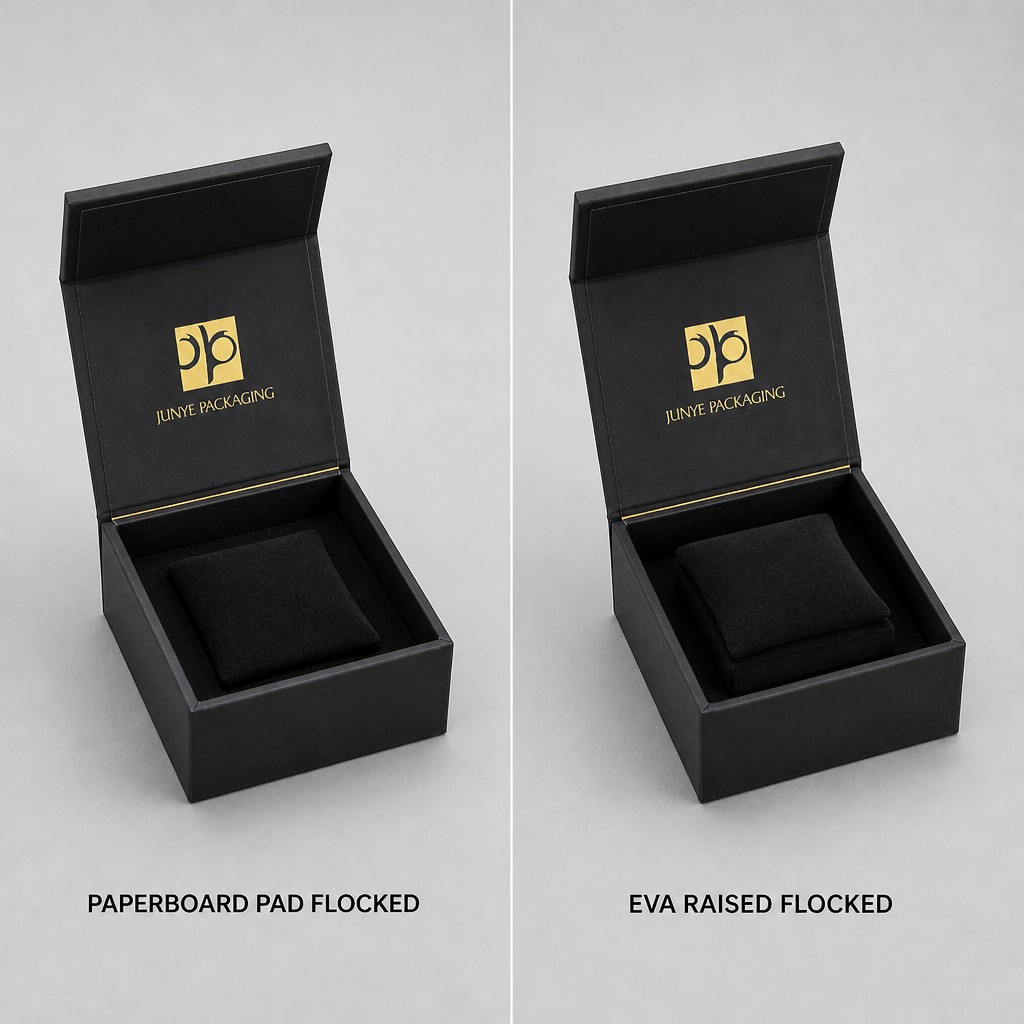
The insert is built one of two ways, and the choice is about height, not quality.
| Flocked board pad | A grey board pad cut to the outline and flocked black. Light, flat, right for a ring, studs or a pendant that lies down. |
| Raised EVA block | An EVA block set to the height your piece needs, then flocked. Right for a bangle, a wide band or anything that has to stand up. |
| Both | Black flocking matched to the paper; cushion cut to the outline of the item |
A raised block is not “better” — it is taller. Put a flat pendant on a high block and it looks unsupported on a necklace box layout too; put a bangle on a flat pad and it disappears into the tray.
Flocking Is a Finish, Not a Filling
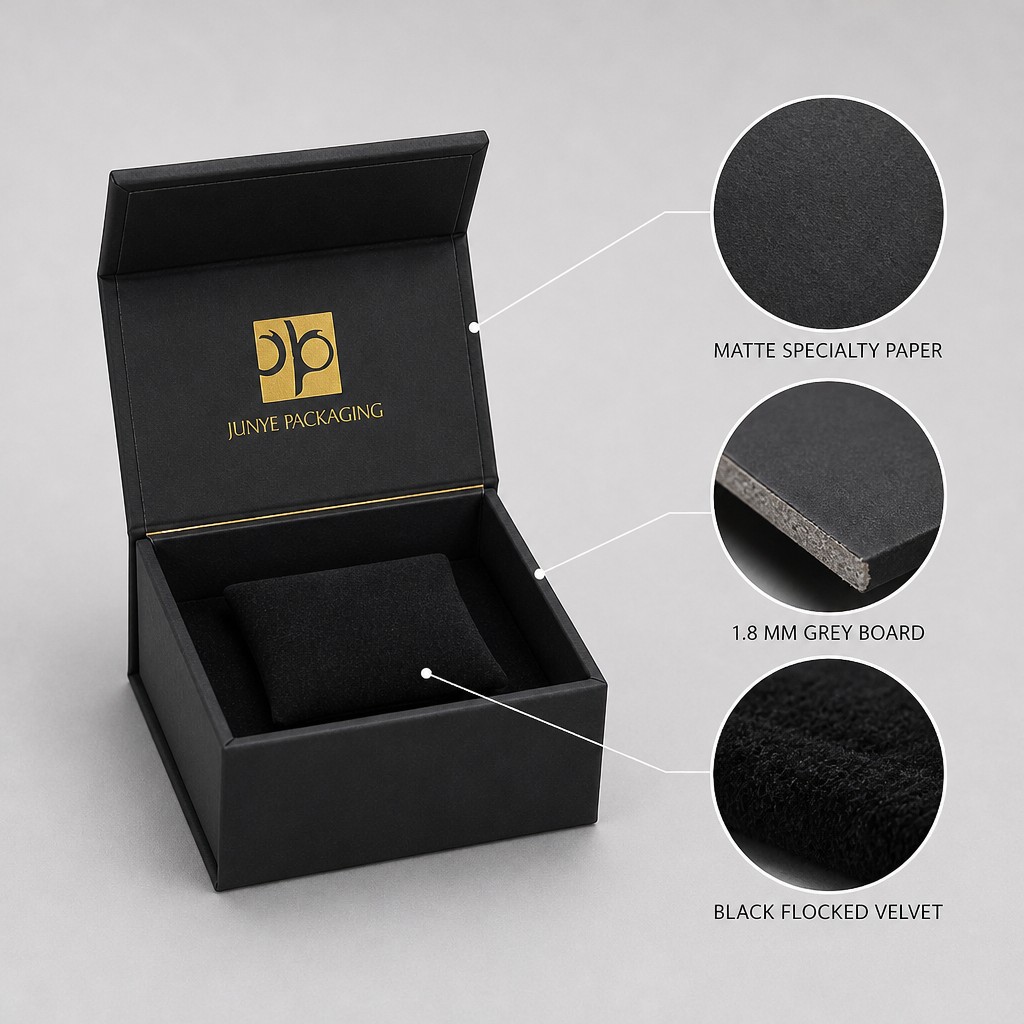
Flocking is the black fibre surface bonded over the insert. It does three jobs at once: it hides the cut edge of the board, it stops metal sliding in transit, and it gives a matte surface that photographs without hotspots.
| Surface | Short black fibre flock |
| Hides | Cut edges, board grain, glue lines |
| Grip | Keeps a ring or chain from sliding during shipping; ring box trays rely on the same grip |
| Photography | No specular highlight under studio light |
Flock can be matched to a colour reference, though on a black box the usual reason to change it is to lift a pale piece — a white gold pendant reads differently on grey flock than on black.
How the Piece Meets the Tray Rim
The number that decides whether the box looks made for the piece is the gap between the top of the cushion and the rim of the tray. Too low and the piece rattles; too high and the lid presses on it when the magnets pull shut.
| Target | Piece finishes level with, or a millimetre under, the tray rim |
| Too low | Piece sits in a hollow; the box reads empty |
| Too high | Lid presses on the piece; stone or setting takes the load |
| Clearance | Checked with the piece in the box before the sample ships |
This is why a sample matters more for a cube than for a flat box: the tolerance is small and it is decided in three dimensions.
Drawing an Insert for a 6 cm Cube
Send the piece and we build the tray around it, or start with a sample request. Three things are needed from you.
| Outline | A tracing, a drawing with dimensions, or the physical piece |
| Depth | How much of the piece sits below the cushion |
| Range | One piece per box, or a tray that carries a small set |
From that we set the cushion height, choose pad or raised block, and cut a template before any production board is used. If two pieces share a tray, we draw the layout so neither piece can shift into the other.
What Changes When the Run Covers Several Pieces
A single-piece tray and a tray for a whole range are drawn differently, and the difference shows up in the mould cost rather than the box.
| One layout | Every box carries the same cushion — cheapest per unit |
| Two layouts | Separate trays for, say, a ring and a bangle in the same outer box |
| Shared tray | Slots for a small set: studs, a pendant, a chain |
Because the outer box stays the same, a brand can ship several collections in one cube and change only the insert. That keeps the shelf presence consistent while the range changes.
Questions We Get About Cube Box Inserts
Can the insert be swapped later?
Yes. The outer box is one construction and the tray is a separate part, so a later run can use a new layout in the same cube.
Will a raised block add weight?
Barely. EVA is light, and the block is mostly air-filled foam; the outer box and board dominate the shipping weight.
Is the flock safe against polished metal?
Yes. Flock is soft and does not carry grit, which is why it is used against plated and polished surfaces.
How many units do we need for a custom tray?
300 pcs for this construction. Below that the tooling cost is spread over too few boxes to make sense. Details are on the FAQ, and the flip top box range uses the same closure.