
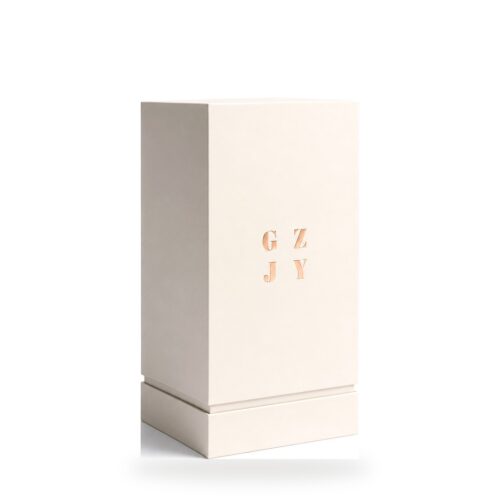
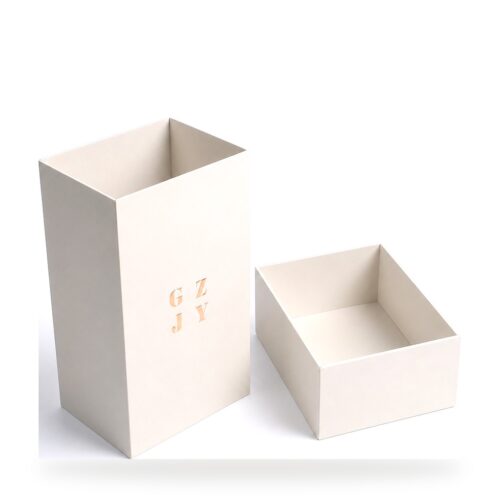
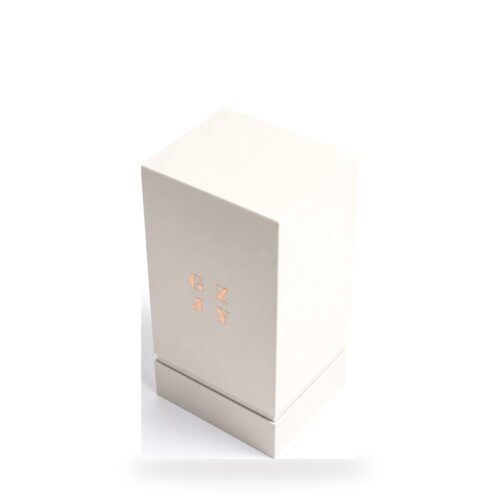
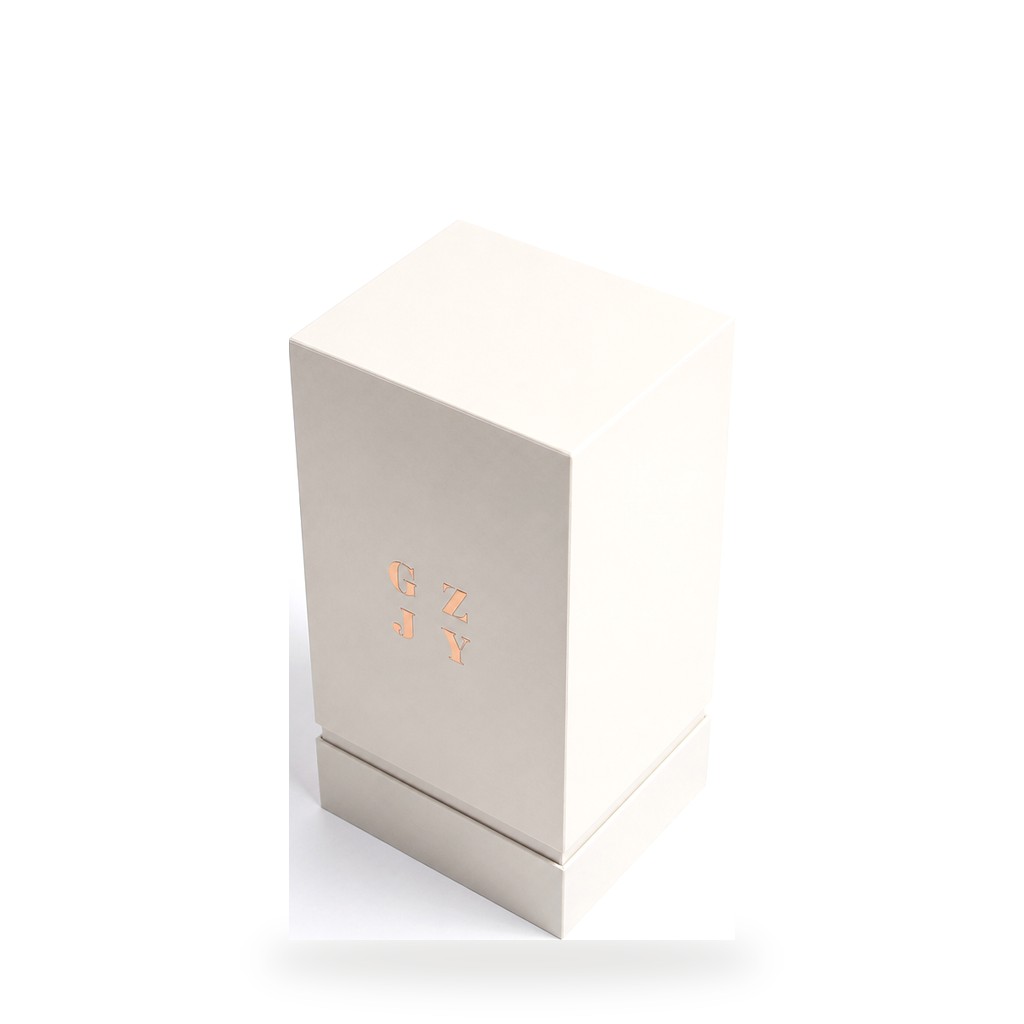
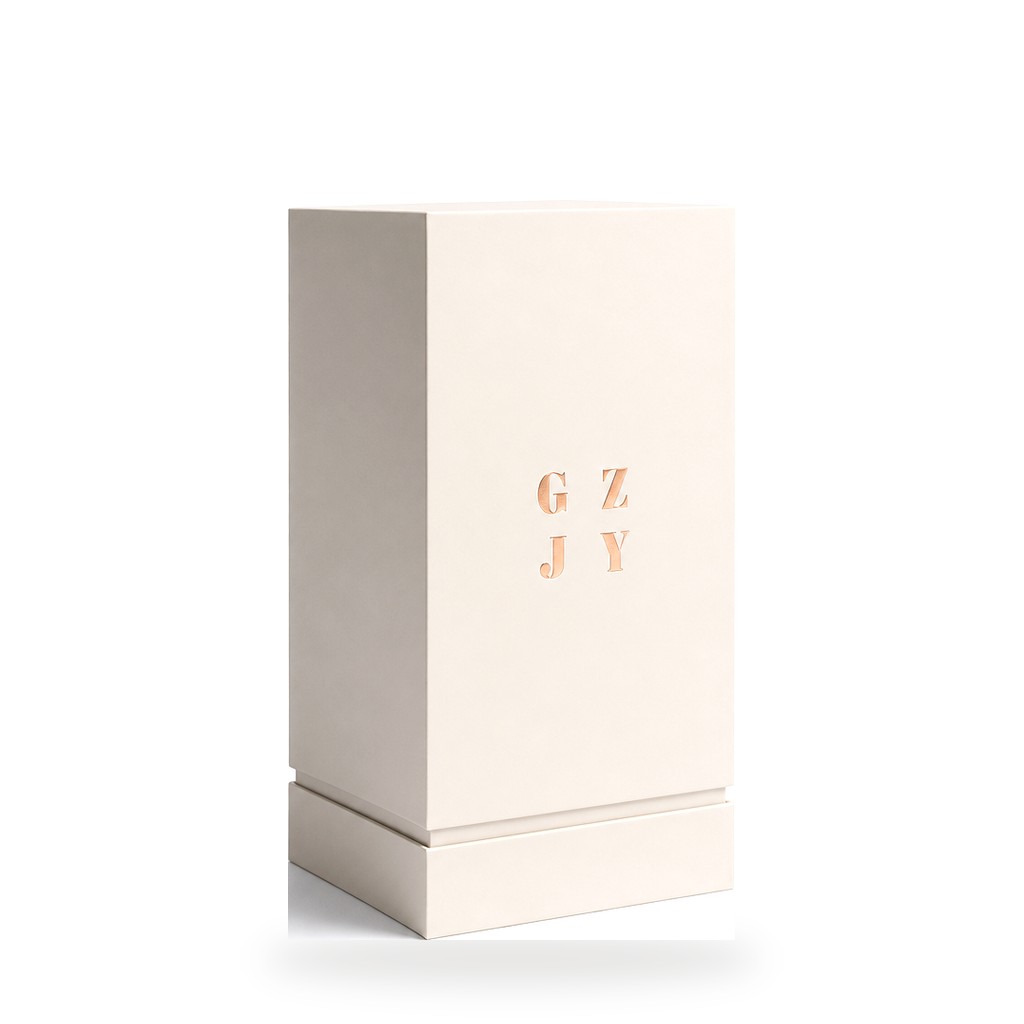
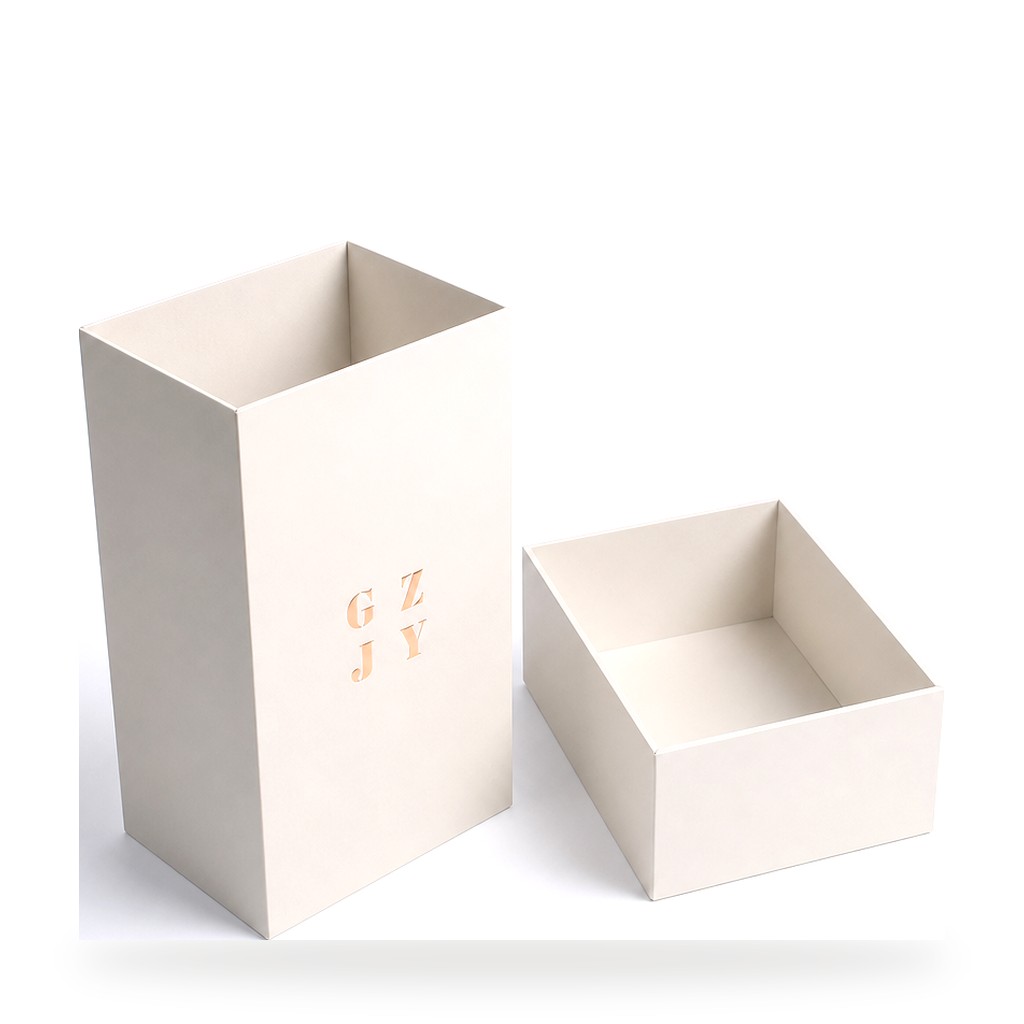
A tall rigid gift box built on an 11 x 11 cm square footprint and standing 25 cm high. Two pieces only: a cover that lifts straight off, and a base whose four walls form the neck the cover sits on. The base shows 17% of the total height, about 4.3 cm, so the cover carries 83% of the silhouette. That proportion is what makes the box read as a column rather than a carton, and it is the reason a tall product stands up inside it instead of lying down.
A Column, Not A Carton
| Measure | Value | Note |
|---|---|---|
| Footprint | 11 x 11 cm | square in plan, straight walls |
| Height | 25 cm | closed, cover and base together |
| Height to width | 25 : 11 | the column ratio |
| Cover | 83% of the height | approx. 20.7 cm, lifts straight off |
| Base | 17% of the height | approx. 4.3 cm, this is the neck |
| Cover interior depth | approx. 20.4 cm | mouth to the inside of the top panel |
| Base interior depth | approx. 4.0 cm | mouth to the floor |
| Board | 1.5 to 2 mm grey board | wrapped, not laminated |
The Base Is the Neck, The Cover Is the Height
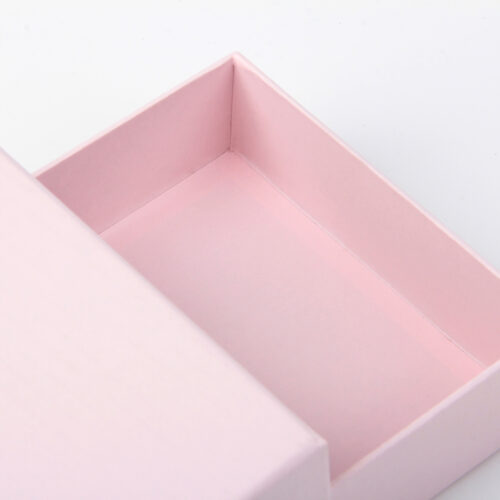
Construction is a rigid two-piece lid-and-base, with one difference that decides everything else: the base does not stop at the mouth. Its four walls keep going up to 17% of the total, and that standing wall is the neck the cover drops onto. The cover is a plain sleeve, open at the bottom, closed at the top.
| Part | What it is | What it does |
|---|---|---|
| Cover | a plain sleeve, wrapped outside and ivory inside | carries 83% of the height and the whole foil face |
| Base | four straight walls on a flat floor | forms the neck, and carries the weight |
| Joint | cover overhangs the base all round | reads as a stepped shadow line, not a seam |
| Insert | optional, cut to your product | drop-over, recessed, EVA, moulded pulp, paper card or flocked |
One Board Proud, All Round
The cover is built about one board thickness larger than the base in both directions, so it sits proud all round rather than flush. At the joint that gives a clean stepped shadow line: a small ledge, then shadow, then the base below. It is one board of difference, and it is deliberate. A flush joint on a 25 cm column shows every variation in the wrap; a stepped joint turns the same variation into a shadow that reads as a shadow.
Nothing releases and nothing slides. The cover lifts straight up, and the product stays upright the whole way through, which matters when the contents are heavy or breakable.
Matte Off-White, and Two Foil Stamps
The wrap is a matte off-white paper with no pattern, no embossing and no gloss, close to a warm ivory: measured on the front panel at approximately RGB 229 224 218 on the lit face and 200 196 190 on the shaded face. The board core is a dense neutral grey pulp at 1.5 to 2 mm, wrapped rather than laminated, so the corner is a fold and not a cut.
The only decoration is a hot foil stamp in a rose-gold tone, applied twice: once in the centre of the top panel, once in the middle of the front panel. On the sample photographed the stamp reads GZJY, four letters set two by two in a serif face with wide spacing. That mark is one customer’s own artwork, stamped here to show the process. It is not our brand, and we do not supply it as a logo.
What Fits in 20.4 cm of Interior
The interior height is the constraint that matters. A cover gives about 20.4 cm from the mouth to the inside of the top panel, and the base gives about 4.0 cm of its own. Measure the product and whatever it sits in before fixing a size, and remember that anything wider than 10 cm across will not go into an 11 cm footprint without a custom size.
Confirmed applications are products that are tall rather than wide: desktop speakers and audio accessories, small home appliances, charging docks and hair tools; mugs and saucers, tea sets, single ceramics and cutlery sets; tall skincare bottles and serum sets; candle jars and vase-shaped objects; and corporate gift packaging where the box is part of the presentation.
The Insert Is Yours to Specify
The box ships with a plain base, and the interior is the same ivory paper as the outside, not lined and not flocked. A shaped insert can be cut to your product outline in EVA foam, moulded pulp, folded paper card or flocked board, with cut-outs placed where your packing line needs them.
Inserts seen in some sample photographs are bespoke to those customers’ products and are not part of this box. Tell us the outline and the lift point, and the insert is drawn to that, not to a template.
Height, Split and the Sample Route
Finish options on this box are hot foil in gold, rose gold, silver, copper or matt white; deboss; emboss; spot UV; soft-touch, matt or gloss lamination; and Pantone matching on the wrap paper. Print is litho or digital depending on run length. None of these change the geometry, because the 17 and 83 split and the square footprint stay fixed whatever the surface does.
Minimum order is 300 pieces. Sampling takes 3 to 5 days, and artwork proofs come back before a sample is cut. Paper sourcing is FSC compliant, and we hold ISO 9001:2015 certificate ZYC24Q00141R1S. Ask for a free sample if you want to hold the joint before committing to a run.
Questions Before a Tall Box Is Cut
Does the cover stay on in transit?
It is a friction fit over the neck, with no magnet and no tape. For a 25 cm column we set the fit so the cover needs a deliberate lift; if your carton will be stacked, say so and the fit is tightened.
Can the height change but keep the proportions?
Yes. Change the height and the cover to base split stays at the same ratio, so the joint stays at the same height on the silhouette. The footprint can change too, as long as it stays square in plan for this construction.
Is the inside lined?
No. The interior is the same ivory paper as the outside. Flocking, a paper lining or a fabric lining can be added, and the insert is a separate decision from the lining.
How is it packed?
Each box goes into a poly bag, then an export carton, then a pallet. The box is the retail pack, not the shipping carton. Read the rest on the FAQ page.
Can the foil go anywhere else?
It can, but on a tall face we keep to two positions: top panel centre and front panel centre, both vertically centred. A 25 cm front panel takes a single block well; two lines of type start to compete with the joint, so we set one block.
For the joint in detail, see where the step comes from. Other rigid lid-and-base builds are listed under lid and base boxes.


Reviews
There are no reviews yet.