
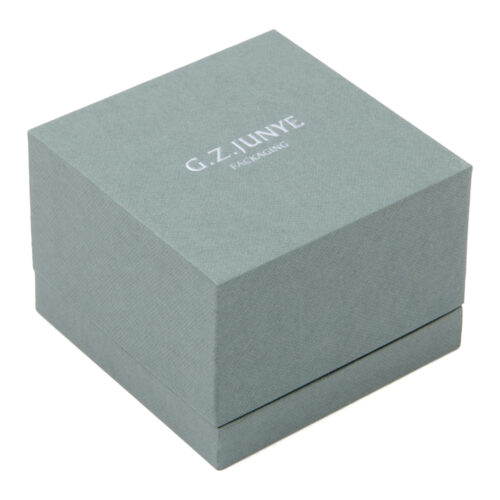
A mint green gift box, 16 x 16 x 7 cm, wrapped in matte paper and lined with white satin. Two pieces: a lid with a flat top and four shallow walls, and a base tray with a separate band glued around its outside. The lid drops straight down onto that band, so a shut box shows one continuous step line and a single hairline gap.
The Box, Measured
| Dimension | Value | Note |
|---|---|---|
| Length | 16 cm | front face, left to right |
| Width | 16 cm | equal to the length |
| Height | 7 cm | closed, measured over the lid and the band |
| Footprint | 16 x 16 cm | square in plan |
| Height to side | 7 : 16 | just under half |
| Rim band | about a quarter of the height | external, standing proud of the wall below |
Two Pieces: a Flat Lid and a Rimmed Tray
Nothing lifts on a hinge and nothing clicks shut. The lid comes off in one movement, the tray stays where you put it, and the box goes back together the same way every time, which is what a packing line needs when it is closing several hundred boxes an hour.
| Part | What it is | What it does |
|---|---|---|
| Lid | flat top with four shallow walls | lifts straight off; the skirt stops a hair above the band |
| Rim band | separate paper band glued round the upper outside of the tray | carries the lid, covers the wall joint, protects the edge |
| Tray | greyboard box with four walls and a base board | holds the product and the lining |
| Satin lining | white satin, laid in by hand | covers the tray floor and walls, tucked under the band |
Why the Lid Rests on a Band, Not on the Wall
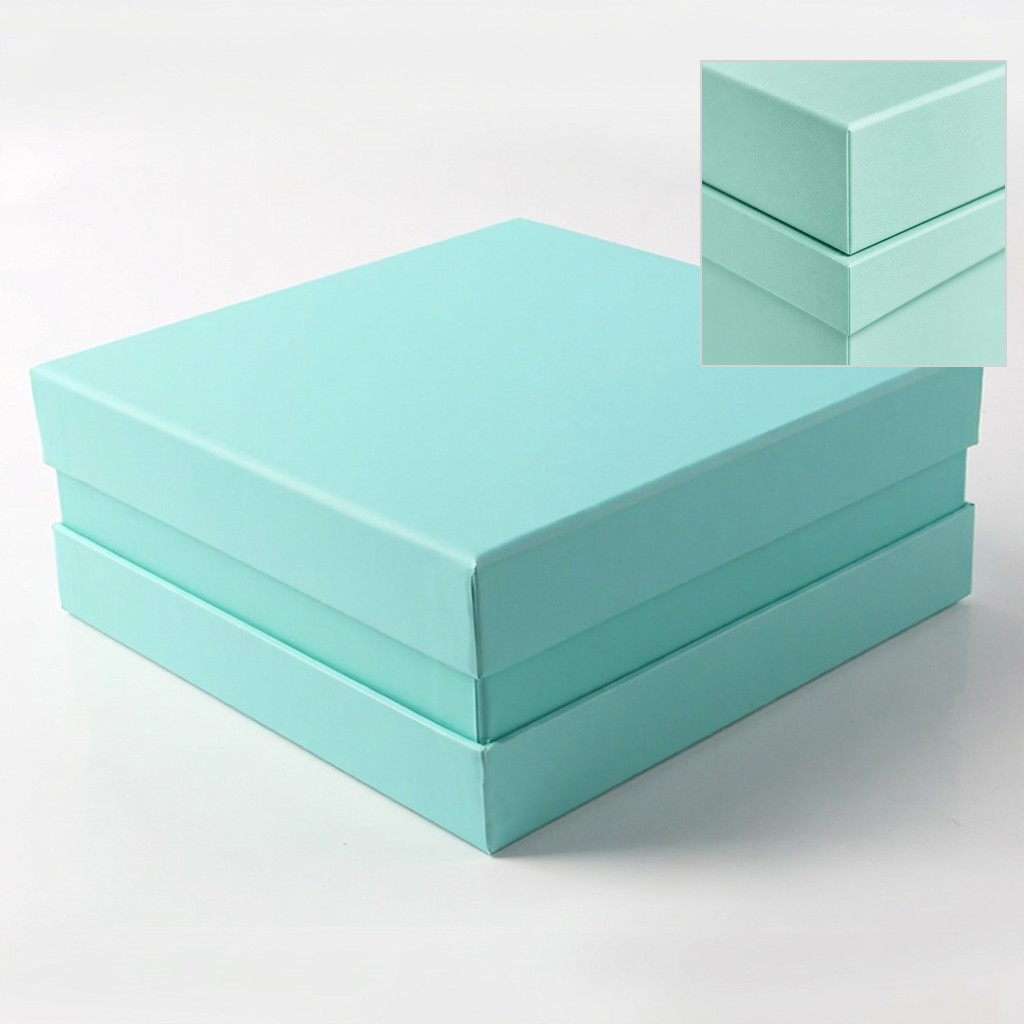
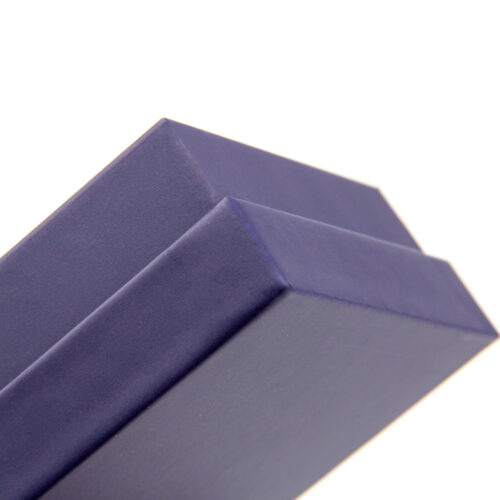
On a plain lid and base box the lid skirt runs down and stops somewhere in the middle of the wall, so the closed box reads as two stacked halves and the seam cuts the side in two. Here the skirt lands on the top edge of the band instead. The band stands about two millimetres proud of the wall below it, which gives the lid a shelf to sit on and leaves one continuous step running right round the box.
Two things follow. The lid cannot slide sideways, because the band holds it square. And the long panels stay unbroken, so the print area is not split by a line. We set out the band mechanics in how a rimmed lid and base box seats its lid; this page is about the 16 cm version and what the size does to it.
The Satin Is Laid In by Hand, and It Stops Below the Edge
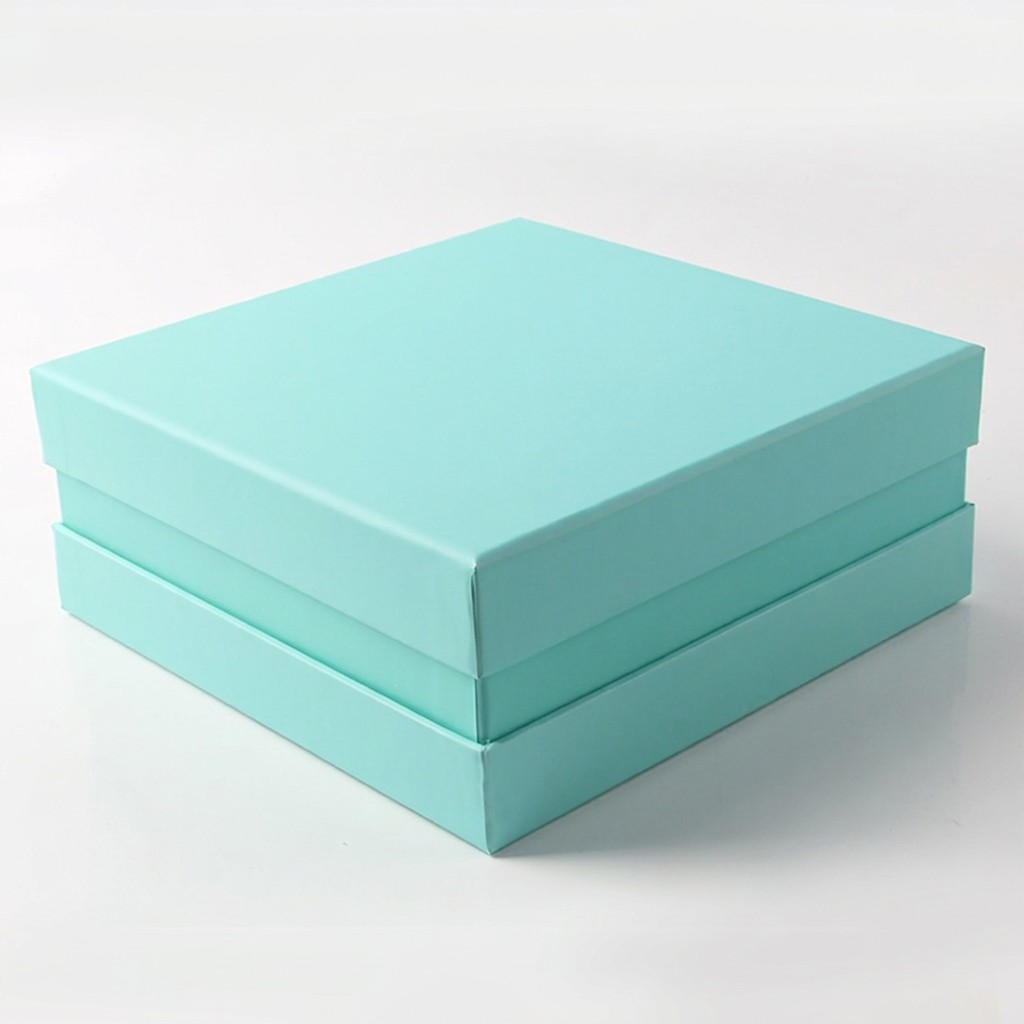
The lining is one piece of white satin, laid over the tray floor and up the four walls by hand rather than glued down in panels. It falls into soft folds, which is what gives the inside its depth, and the edges are tucked under the rim band and stop below its upper edge. Nothing spills over the band, so the lid still closes on paper against paper.
That last point is the one that fails most often on a cheaper build: satin run past the edge gets pinched in the joint, and after a hundred openings it starts to fray at the line. Tucking it below the edge costs a few seconds per box and removes the problem.
What a 16 cm Footprint Takes
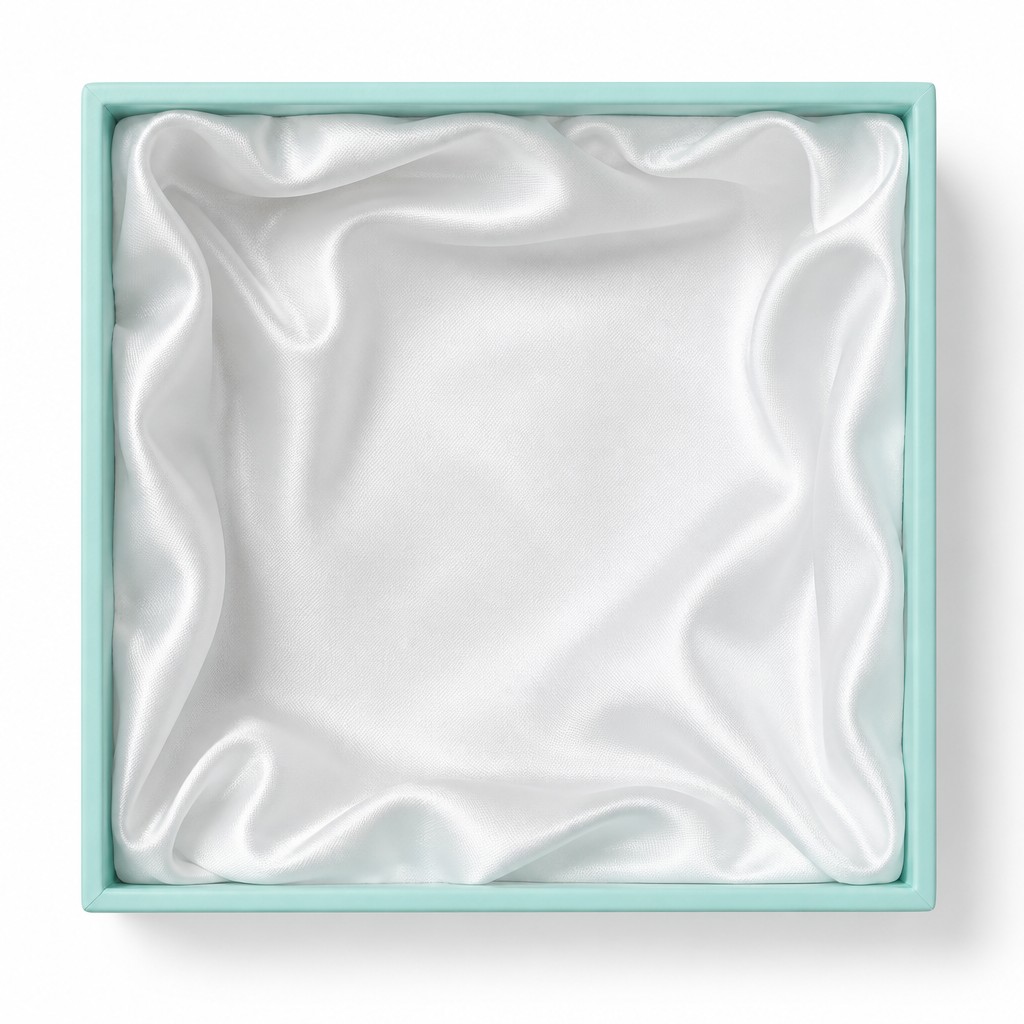
At 16 x 16 x 7 cm this is a set box rather than a single-item box. A cosmetic jar with a bottle beside it; a mug with four coasters; a pair of small plates or bowls; a tea cup and saucer. The satin holds the pieces softly, and where they must not move at all we cut a foam or paperboard platform with one cavity per item and line over it.
It is also the size where the band starts earning its place structurally: a 16 cm span flexes more than a 13 cm one, so a band glued round the outside stiffens the top edge.
Greyboard, Hand Wrapping and the Print Panel
Body, band and lid are greyboard, cut, corner taped and wrapped by hand. All three come off the same sheet of matte paper, so the colour reads as one block under a single light instead of three slightly different greens.
The lid top is the largest unbroken panel and the natural print area: one logo, one foil block or one colour field, read from arm length. The band takes a second colour or a foil line without touching the lid. The box in the photographs is plain mint, with nothing printed on it.
Sizes from 10 to 30 cm, and the Sample Route
Sizes are cut to your drawing: any footprint from 10 x 10 cm to 30 x 30 cm, any height from 4 cm to 12 cm, with the band and the tray depth set so the step line lands where you want it. The 16 x 16 x 7 cm size is a stock size and starts at 300 pcs; a bespoke size or bespoke artwork starts at 500 pcs per size.
A dieline and a 3D mockup come back free within 1 to 3 days of your drawing, a physical sample in 5 to 7 days, and bulk runs in 18 to 25 days after sample approval, with small runs at 10 to 15 days. DDP door to door is standard; FOB Nansha and EXW Guangzhou are also quoted. Ask for a free sample if you want to handle the satin and the band before committing to a run.
Paper is FSC compliant. ISO 9001:2015 certificate ZYC24Q00141R1S, RoHS reports, German and French EPR registration and a GPSR EU responsible person are on file and quoted on request. The wider range of lid and base boxes and gift boxes uses the same plant and the same paperwork.
Questions Before the First Run
What holds the lid on if there is no magnet?
The band. The lid skirt drops over it, so the band keeps the lid square and stops it sliding sideways, and the box is carried from the base. If you need a lock, a tie, a magnet or a sleeve can be added to the same construction.
Can the satin be another colour, or something else?
Yes to both. The satin runs in other colours from a reference, and it can be swapped for velvet, suede paper or a paperboard platform cut to your product. On a box this size the platform is usually the right answer for a set of rigid pieces.
Does the satin show when the box is closed?
No. It is tucked under the band and stops below the band upper edge, so nothing is visible in the joint and nothing gets pinched when the lid goes on.
How is the box packed for export?
Each box goes into a PP bag, then an export carton, then a pallet. The gift box is the retail pack, not the shipper. Freight terms and document questions are answered on the FAQ page.
What is the minimum order?
300 pcs for a stock size in one colour with one print pass, and 500 pcs per size for a bespoke size, a new dieline or multi-colour print. Mixed colours count per colour, so two colours of 300 pcs is a 600 pcs run.






Reviews
There are no reviews yet.