
A book-style box is judged by two things the photographs rarely show: whether the cover really lies flat when it opens, and whether it closes without anything to tie. This one does both, at 8 x 8 x 4 cm, and the way it is built explains why.
A Cover Hinged Like a Book
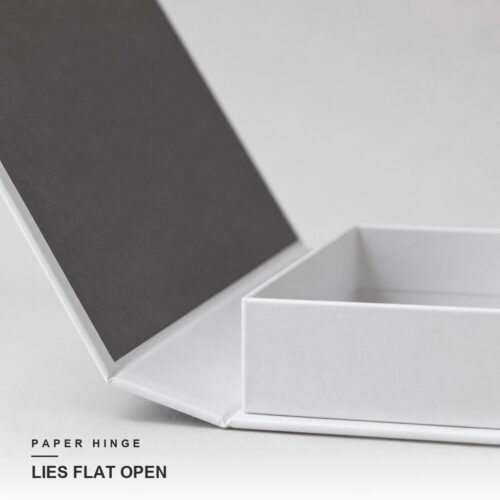
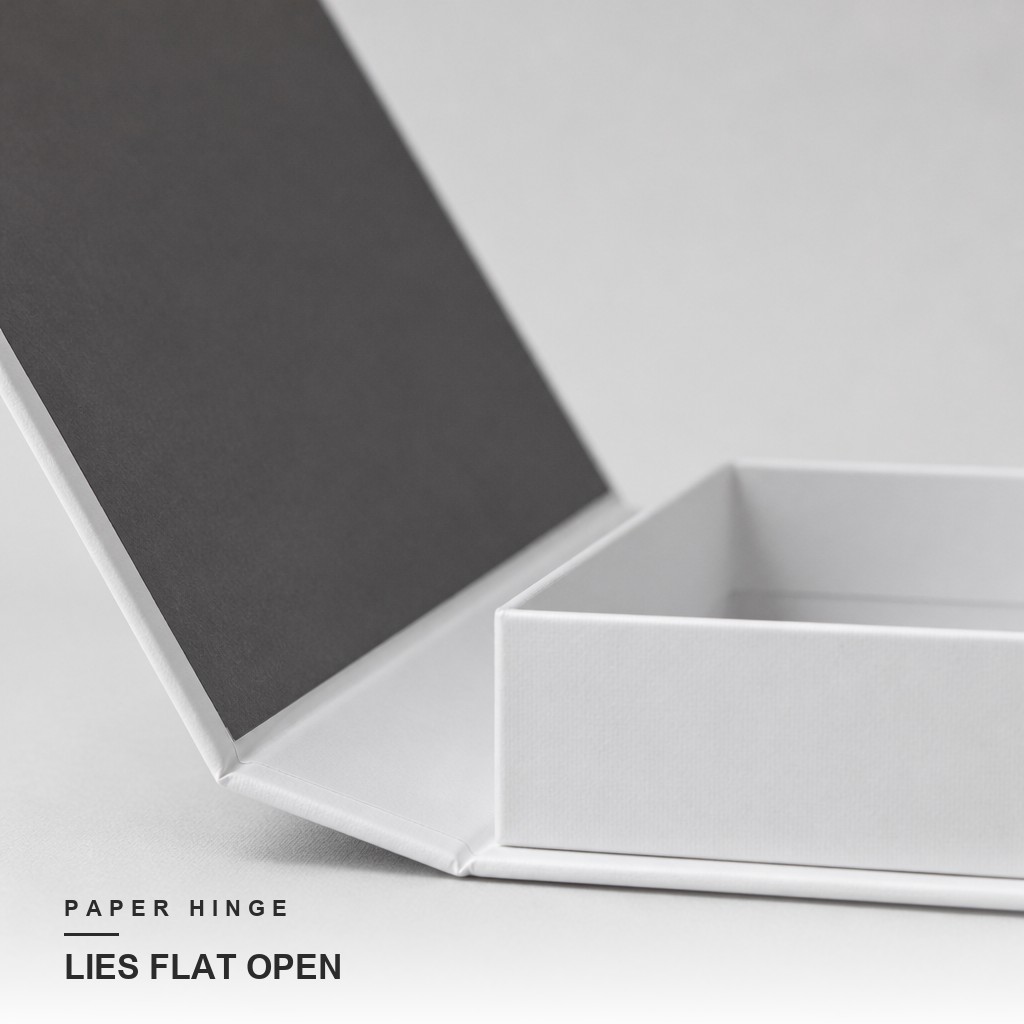
The cover is joined to the tray along one long edge only. That edge is the spine, and the join is made from the outer paper itself, folded back on the board: a paper hinge, with no metal hinge, no rivet and no pin to work loose.
Because there is one line of movement rather than four, the cover swings on a single axis. The other three edges are free, so the box opens the way a hardback opens, not the way a lid lifts.
Two Magnets, Embedded and Invisible
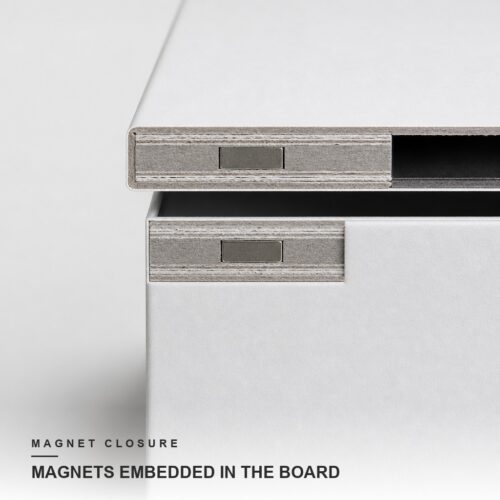
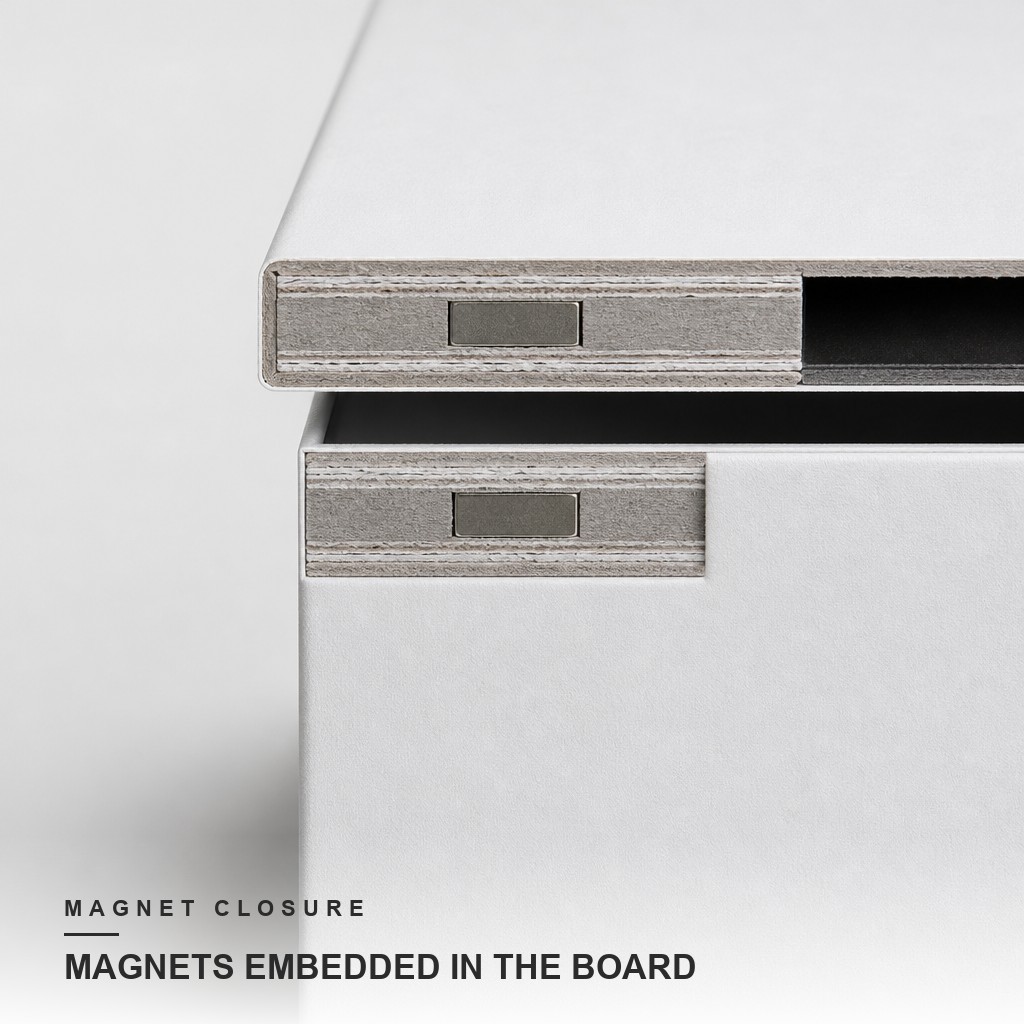
On the closing edge, opposite the spine, two magnets are set into the board. They sit between the greyboard and the white paper, so nothing shows on the surface. Bring the cover down and it pulls itself shut; lift it and the hold releases.
There is nothing to tie, no clasp to press and no tuck flap to fold in. That matters on a packing line: the closure is one movement, and it cannot be left half fastened.
A Thin Cover That Sits Flush
The cover is a thin panel, roughly two to three millimetres, not a deep shell that drops over the walls. Closed, its face comes level with the mouth of the tray, and the four outer walls read as one continuous white surface.
The only sign of the join is a hairline seam where the cover meets the mouth. Look along the side of a closed box and you see one plane, not a lid stacked on a base.
Eight by Eight by Four Centimetres
The footprint is square and the depth is four centimetres, which is what makes the box suit a bottle rather than only a flat item. Once board thickness is taken out, the tray clears about 7.5 x 7.5 cm and about 3.5 cm deep.
| Measurement | Outside | Inside clearance |
|---|---|---|
| Length | 8 cm | about 7.5 cm |
| Width | 8 cm | about 7.5 cm |
| Depth | 4 cm | about 3.5 cm |
| Cover panel | 2-3 mm thick | lined across the full face |
In practice that takes a 30 to 50 ml bottle, a 50 g cream jar, a compact, or a small spray or serum bottle, standing upright or lying flat.
Greyboard, Corner Tape and Matte White Paper
Both halves are greyboard, cut square, corner-taped and then wrapped by hand. The board gives the walls their thickness, so the corners stay sharp instead of easing into a radius, and the box keeps its shape when a filled tray is lifted by one corner.
The wrap is a matte white paper with no embossing and no pattern. Matte takes light evenly, which is why the box photographs as one tone rather than with a hot band across the top panel.
The Hairline Step Under the Tray
The base board is cut a fraction wider than the walls, so a fine step runs around the bottom edge. It is a detail you feel more than see: set the box down and it rests on that rim, not on the wrapped corner.
A Full-Face Liner Inside the Cover
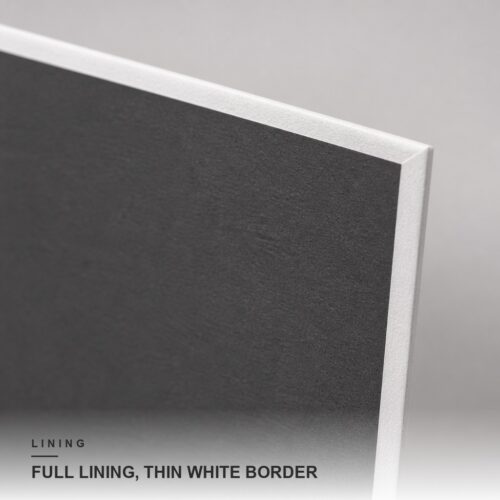
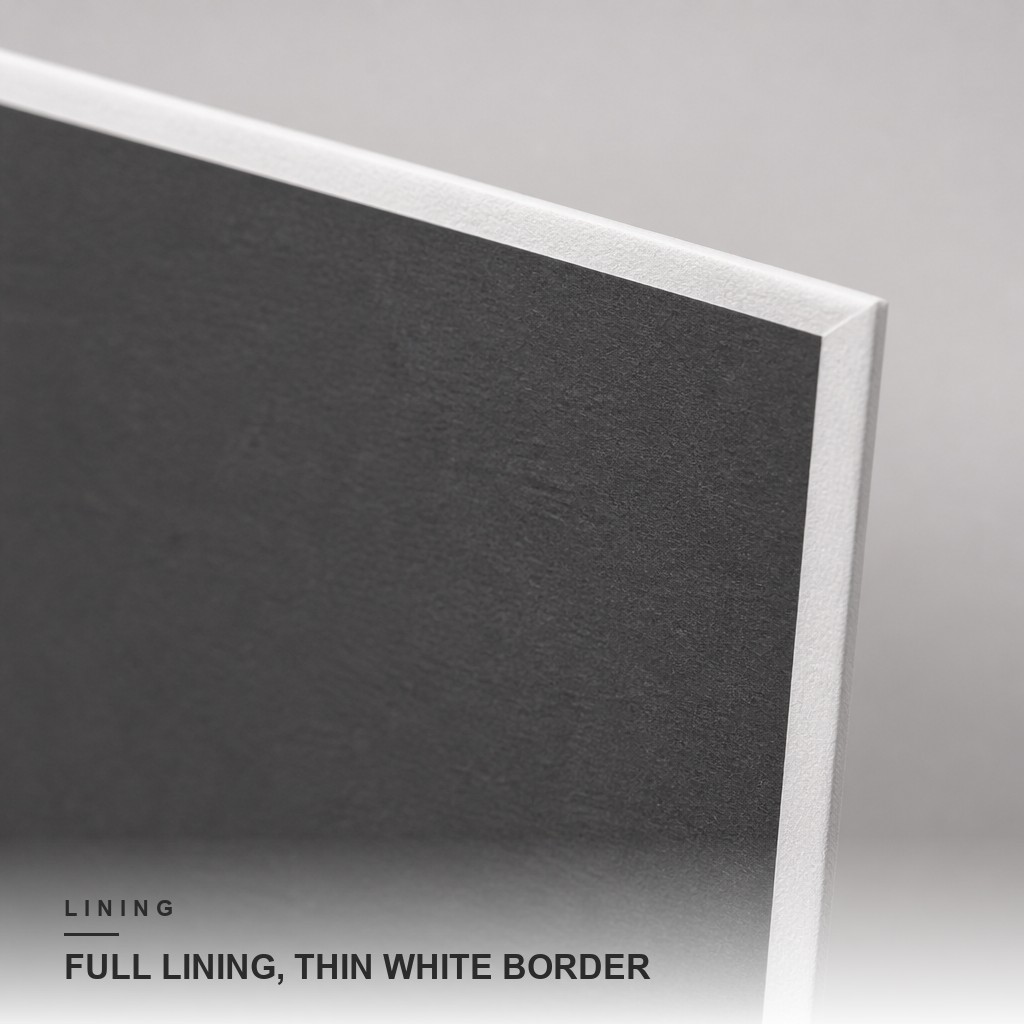
The inside face of the cover is lined across its whole surface with printed paper, with a narrow white margin left at the edges. That panel is the largest uninterrupted print area on the product: a brand line, a colour field or a foiled mark all sit there without competing with the outer wrap.
The sample liner is dark grey with light type. Your order carries your own artwork, or a plain liner if the outer face is doing the talking.
The Tray Is Left Open on Purpose
Inside, the tray is an open cavity: white paper on the floor and on all four walls, with no groove, no flocking and no foam in the standard build. Keeping it open means the insert can be designed around the product instead of around a cavity that was fixed before the product was known.
Cutting an Insert Around a Bottle
An insert is cut from your bottle drawing or a 3D file, so the cavity follows the shoulder, the collar and the cap rather than a generic cylinder. Four routes cover most cosmetics work.
| Insert | What it holds | When it is the right choice |
|---|---|---|
| Die-cut EVA | bottle held upright, pump clear of the cover | sprays and serums with a pump or collar |
| Foam block | a softer bed for glass | heavy bottles and short runs |
| Flocked tray | a cut-out with a soft face | gift sets where the inside is seen first |
| Paperboard platform | a jar or a compact seated flat | board-only packs and lower unit cost |
Deep enough matters as much as tight enough: the piece should sit below the mouth of the tray, so the cover closes on the board and never on the pump.
Cosmetics, Sprays and Cream Jars
The depth is the reason this box travels well in beauty: a spray bottle stands with its collar below the rim, a cream jar sits flat with room above the lid, and a compact drops into a shallow cut-out. The same shell takes all three with a different insert, so one dieline covers a small range.
For a beauty range the box is often the first thing a buyer handles, which is why the flush cover and the single seam do more work here than any printed claim.
Printing, Foil and the Liner Sheet
The outer wrap takes CMYK or Pantone print, and can be finished with foil stamping, embossing, spot UV or a matte lamination. The liner inside the cover is printed as its own sheet, which keeps a full-colour panel off the outside where it would compete with the shape.
Our own mark sits on the top panel of the sample; on your order that position carries your artwork or stays blank.
Sizes, Minimums and the Sample Route
A stock size starts at 300 pcs. A bespoke size or bespoke artwork starts at 500 pcs per size, and a custom logo print at 1,000 pcs. Artwork, a dieline and a 3D mockup come back free within 1 to 3 days of your drawing; a physical sample follows in 5 to 7 days, and bulk runs take 18 to 25 days after approval, or 10 to 15 days for small runs.
The plant has run since 2004, covers 5,000 square metres in Guangzhou, employs more than 50 people and ships to buyers in over 30 countries. Quality management follows ISO 9001:2015, certificate ZYC24Q00141R1S, valid to 28 November 2027.
Questions Buyers Ask Before Ordering
What is the cover made of, and how thick is it?
A thin greyboard panel about two to three millimetres thick, wrapped in matte white paper and lined on the inside face. It is not a deep shell that covers the walls.
Does the cover stay open while the box is loaded?
Yes. The paper hinge on the long edge lets the cover swing to about 180 degrees, so it rests flat and both hands stay free.
Can the insert be cut for our own bottle?
Yes. The tray ships open and the cavity is cut from your dimensions or a 3D file, in EVA, foam, flocked or paperboard. A test insert can be made at sample stage.
Can we print inside the cover as well as outside?
Both faces print. The outer wrap takes CMYK or Pantone with foil, embossing, spot UV or matte lamination, and the cover liner is a separate printed sheet across the full face.
What is the minimum order?
300 pcs for a stock size, 500 pcs per size for a bespoke size or artwork, and 1,000 pcs where a custom logo print is added.
How are the boxes packed and shipped?
Each box goes into a PP bag, then an export carton of 100 to 200 pcs, then a 120 x 100 cm pallet. DDP door to door is standard, with FOB Nansha or EXW Guangzhou on request.
What to Send Us Before the Dieline Is Cut
Four things fix the drawing: the outside size, the paper and finish, the liner artwork, and the product that goes inside with its insert route. With those the dieline can be cut and a sample made.
A sample request is the usual first step. The FAQ covers the common questions, the cosmetic packaging line shows where the box sits in our range, and the workshop can quote straight from a drawing.
The same construction is used across our paper box range, so a size change does not mean a new technique.






Reviews
There are no reviews yet.