The Liner Is the Only Part That Has to Change
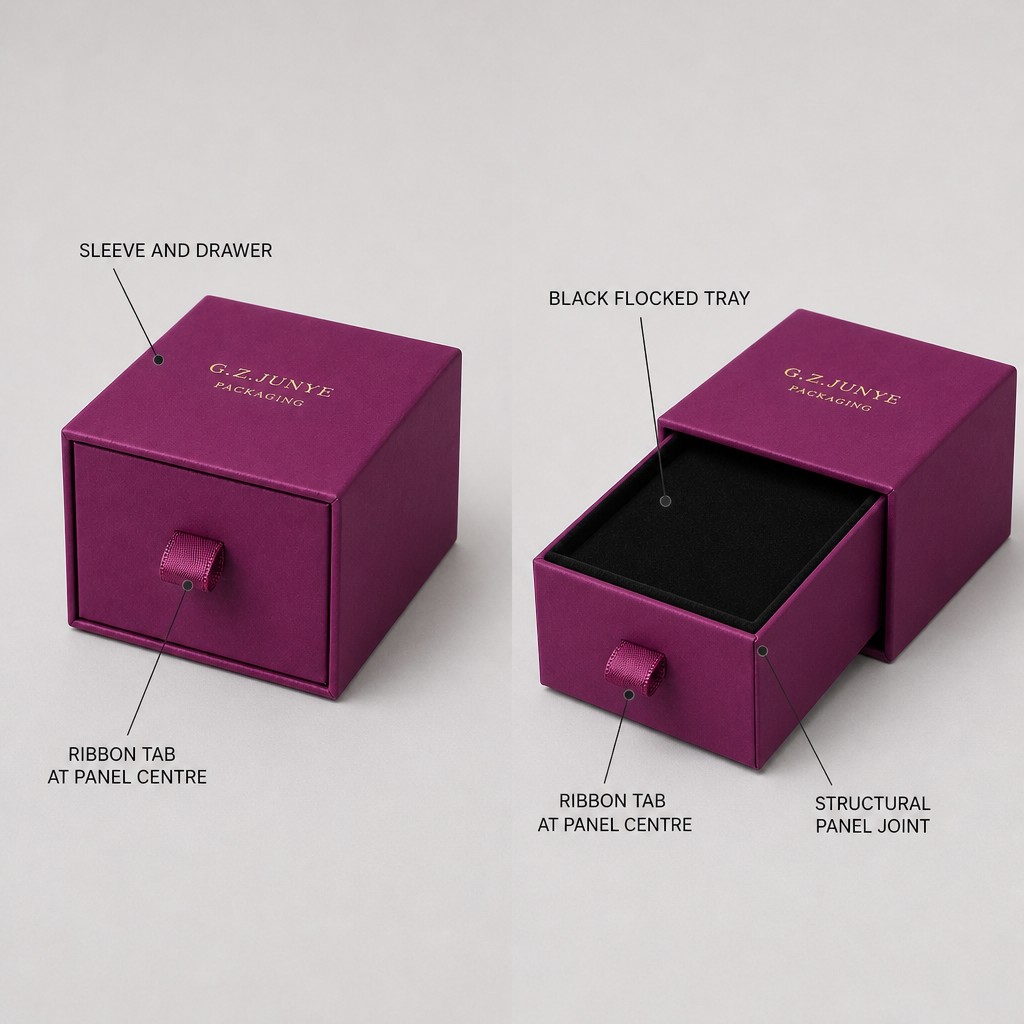
A jewellery line rarely stands still. A ring sells, so a pendant is added; the pendant sells, so a chain goes in the
same box. In most packaging that means a new box each time, because the shape of the box is tied to the piece. Here it
is not: the sleeve and the tray stay, and the flocked board inside is re-cut.
That is the whole idea behind an adjustable liner. Change the liner, keep the box, and one 8 x 7 x 7 cm size covers
a range instead of a single product.
Flat Pad as Shipped: What It Already Holds
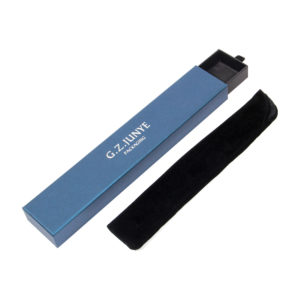
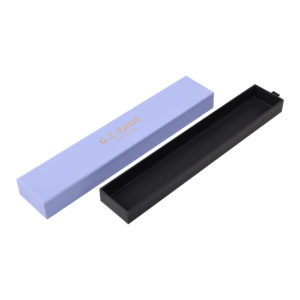
The standard liner is a plain flocked pad, laid flat, with no compartments and a light recessed border line
around the usable area. It arrives ready for the two most common pieces: rings and earrings.
Flocking does the holding. The fibre surface grips a band or a pair of studs so nothing slides when the drawer is
pulled, and because there is no cut, the same pad accepts pieces of different sizes without looking wrong.
| As shipped | Flat flocked pad, no compartments |
| Holds | Rings, earrings, brooches, loose sets |
| Border line | Recessed registration line around the pad |
Three Cuts, One Drawer: Flat, Necklace, Earring
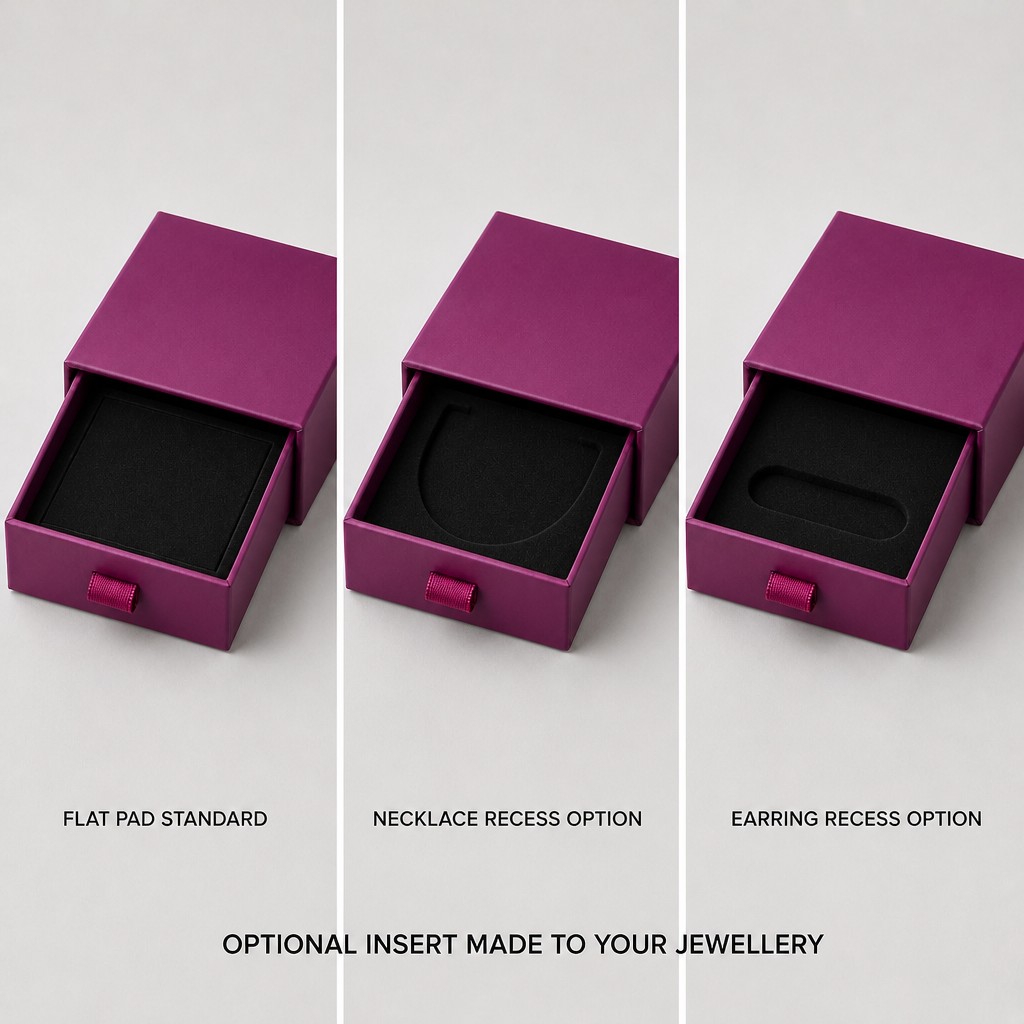
From the same board, three layouts are drawn. They differ in depth and outline, not in quality, and the outer box is
identical in all three.
| Flat pad | Full surface, nothing removed — the as-shipped standard |
| Necklace recess | A shallow recess cut to the chain outline so links lie level |
| Earring recess | A wide shallow pairing for a set of studs or drops |
Two of these can be combined in one board — a flat half for rings with a recess alongside for the chain — which is
what most mixed lines end up doing.
What a Necklace Recess Costs You in Depth
A recess removes material, and a chain has length. The recess has to run out far enough that the links lie flat
rather than bunching at the end, and it has to be shallow enough that the tray still clears the sleeve when it slides.
| Driven by | The chain length and the link thickness |
| Constrained by | Tray depth and the sleeve opening |
| Sent to us | Chain outline, length of the drop, or the piece itself |
In a 7 cm deep tray there is room for a recessed chain line and a flat area beside it. In a shallow tray there is
not, which is why the proportion of the box matters before the cut is drawn.
Border Line, No Compartments: Reading the Standard Liner
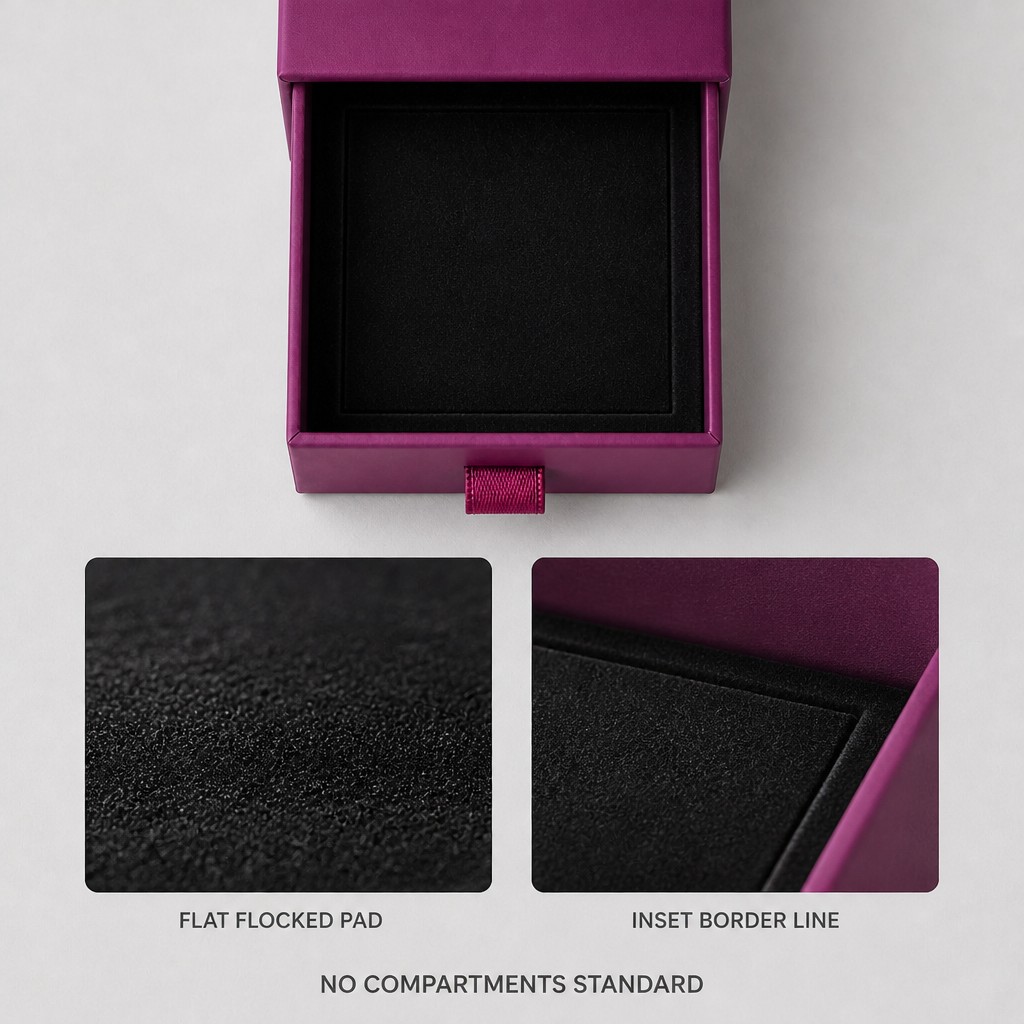
The recessed line around a standard pad is a cutting reference, not a divider. It marks where the usable area ends,
so a hand-cut recess stays centred from unit to unit across a run.
If you would rather have the pad unmarked, it is the same board and the same cut — say so at the drawing stage; the usual questions are on our FAQ page.
What the line never does is divide the pad into compartments; a standard liner stays open.
Measuring a Piece for a Cut Liner
Nothing exotic is needed to specify a liner. Three numbers decide it, and the rest follows.
| Outline | A tracing, a drawing, or the piece posted to us |
| Depth | How far the piece should sit below the tray rim |
| Orientation | Which way the piece faces when the drawer opens |
With those, the recess is drawn, and the sample is where you find out whether the chain lands where you expected.
A Sleeve, a Drawer and a Ribbon Tab
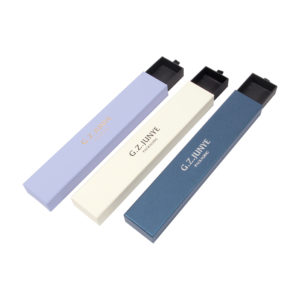
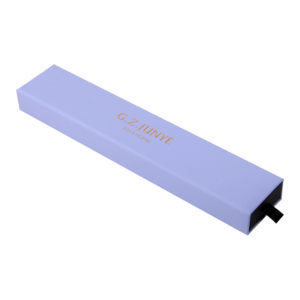
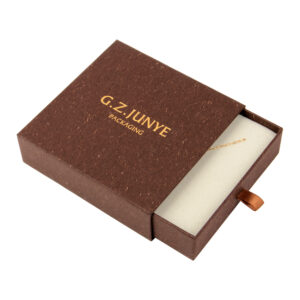
The mechanism is deliberately plain — the same drawer box construction we make in other sizes. A sleeve, open at both ends, and a tray that slides along the long edge. The
ribbon tab is a pull handle fixed at the centre of the tray face, folded into a loop and reaching past the sleeve mouth
so the drawer can be opened without a notch or a nail hold.
There is nothing to tie, knot or bow. A ribbon jewelry box uses the same ribbon in a different build. If a pull is not wanted, the tray face can be left bare, and the drawer still
opens by hand.
Questions We Get About Swapping a Liner
Does a new liner mean a new box?
No. Sleeve, tray, tab, colour and logo stay as approved; only the flocked board is re-cut.
Can two layouts share one liner?
Yes. A flat area and a recess are cut on the same board.
Does the sample have to be redone?
Yes, a new cut wants its own sample — five to seven days — because a recess is judged with the piece in it — a sample request covers both the print and the liner.
Is the flocked pad replaceable later?
The liner is a board that sits in the tray; give us the same drawing and further cutting runs match it.