
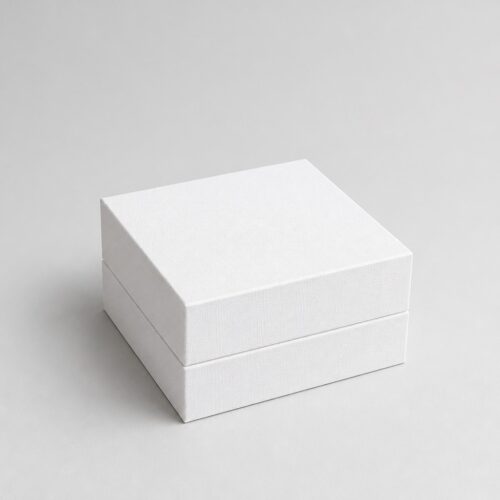

A rimmed lid and base box is bought for the way it closes, not for what it is called. The satin lined gift box here is 13 x 13 x 7 cm, square in plan, and the detail that sets it apart runs round the bottom half: a band wrapped over the base wall, standing proud of the lid above it.
A Rim Band That Carries the Lid
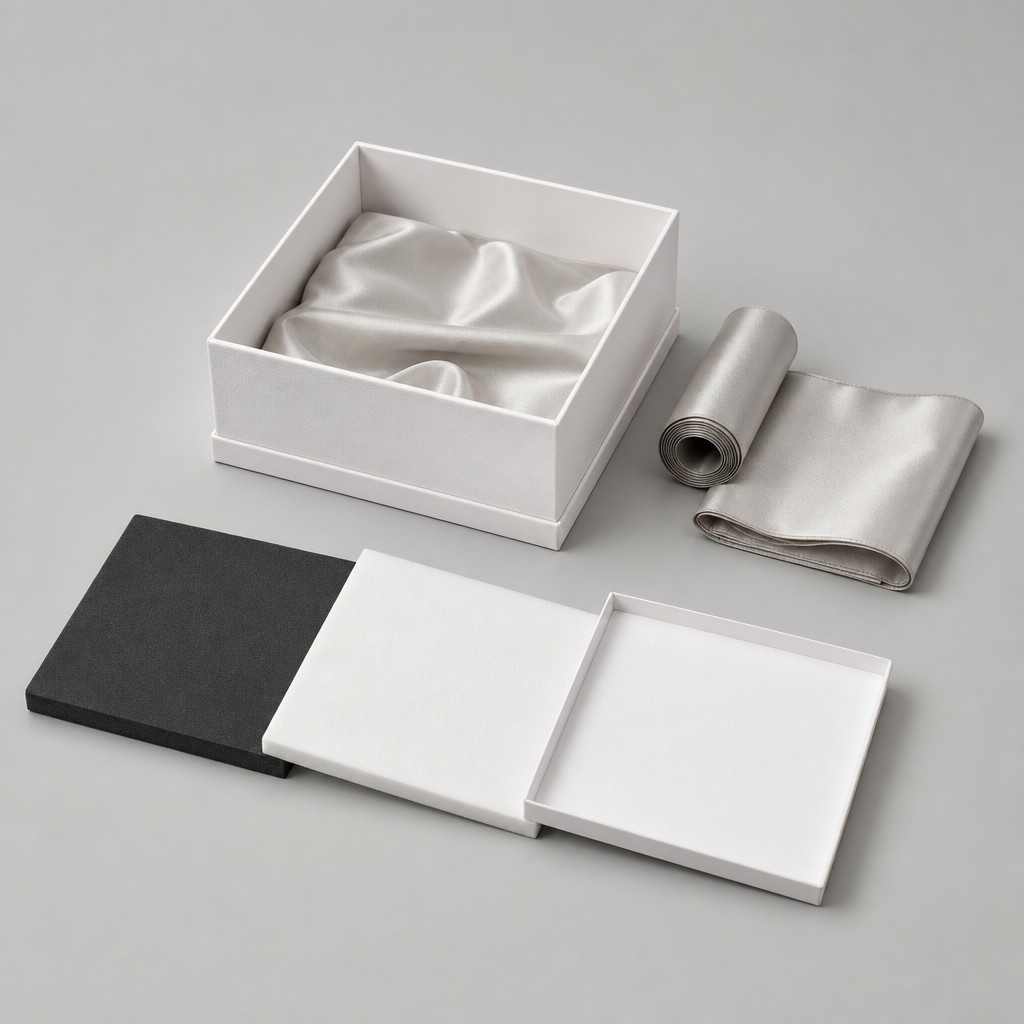
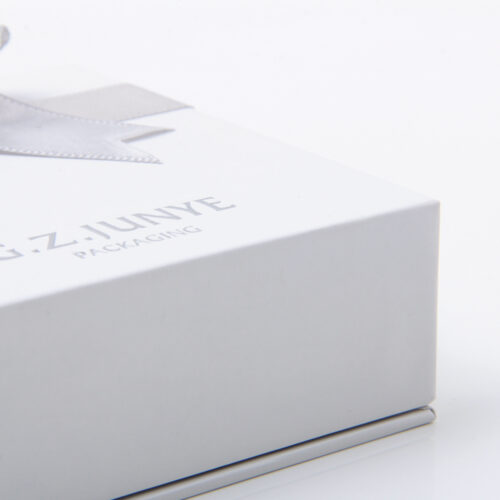
The base is a tray with four walls, built like any lid and base box we run. Over the lower part of those walls a separate strip of board is wrapped in paper and bonded on, running the whole way round without a break. Its top edge is cut level, and that edge is what the lid rests on when the box is shut.
The band is about 2.5 to 2.8 cm deep and stands out from the lid wall by about two millimetres. Small numbers, but they change how the box reads: there is a defined line to look at, and a defined place for a hand to sit.
What the Step Looks Like When the Box Is Closed
Shut the box and the lid edge meets the band edge within a hair. Because the band is wider than the lid, that meeting line becomes a continuous horizontal step of even width on all four sides. The eye reads one shadow line, not a join running up a wall.
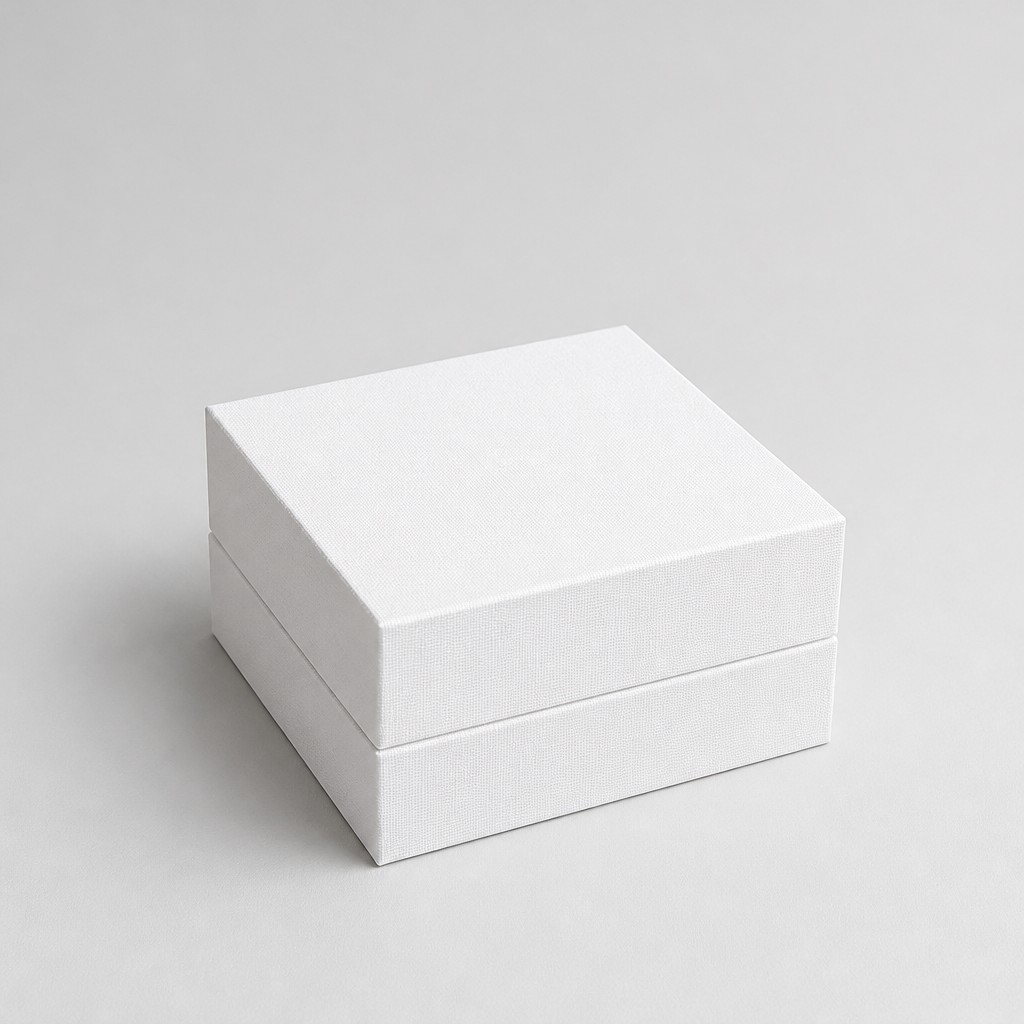
At the foot of the band, the paper returns to the base and finishes flush with the bottom, so the box stands on a flat face with nothing under it. A single lap seam in the wrap is visible along the bottom edge; it is a wrapping mark, not a part.
Thirteen Centimetres Square, Seven Deep
Length and width are equal, and the depth gives the box a little more presence than a shallow pack. The lid accounts for roughly the upper three fifths of the closed height and the band the rest, which is why the step sits low rather than at the middle of the wall.
| Dimension | Value | Note |
|---|---|---|
| Length | 13 cm | square plan |
| Width | 13 cm | equal to length |
| Depth | 7 cm | closed, outside |
| Lid outer height | about 4.0 – 4.3 cm | flat top plus four walls |
| Band depth | about 2.5 – 2.8 cm | lower part of base wall |
| Band projection | about 2 mm | proud of the lid wall |
Greyboard, Corner Tape and White Cloth Emboss Paper
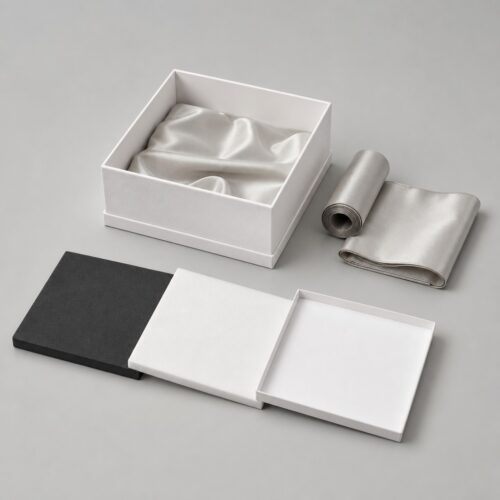
Shells start as greyboard, cut square, taped at the corners and wrapped by hand. The paper is white with a fine cloth emboss, matte rather than glossy, so the surface keeps a soft grain and light spreads across it instead of running down it.
Lid, walls and band take the same paper from the same lot, which is the reason the closed box holds together as one object. Nothing on the outside carries print or mark: the reference sample is plain white throughout.
Satin Laid by Hand, Not Cut to a Panel
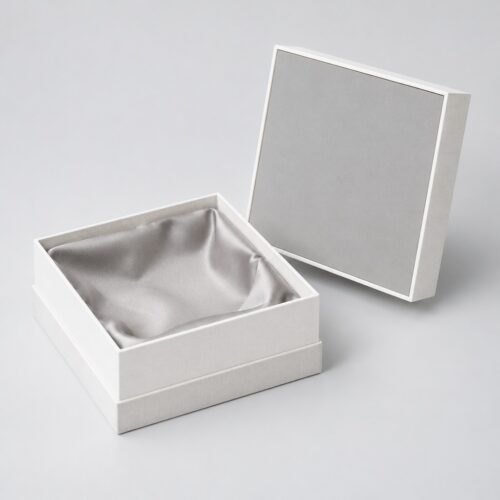
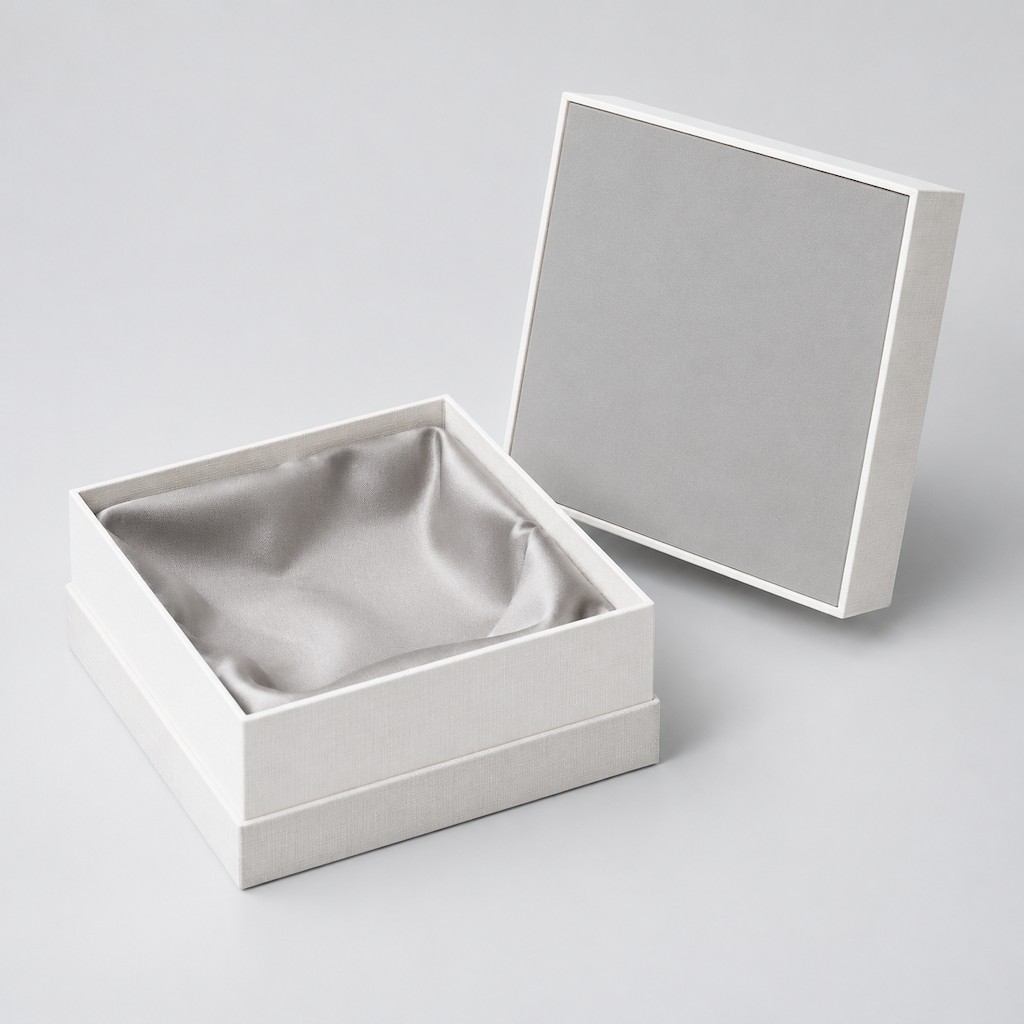
The cavity is lined in satin, and the fabric is laid in rather than trimmed to a flat sheet. It settles into soft folds with a low sheen, and its edges are turned down between the lining and the wall, so no raw edge appears at the mouth and no fabric rides over the rim.
The colour is a light grey with a warm cast, a shade deeper than the white outside. Under a lamp the highlights move as the fabric moves, which is the quality a print cannot copy.
The Lid Inner Face and Its White Margin
Inside the lid a grey cloth face is bonded across the panel, matte and flat, sitting only 1 to 2 mm below the lid edge. A narrow white margin runs round it, level with the cloth rather than cut into it, so the two surfaces read as one plane.
An Open Cavity, and Why It Stays Open
The standard build has no insert. A box of this size is usually bought for one object, and a cavity cut for that object is a decision better made with the product in hand than guessed from a photograph.
Leaving it open also means the satin does the first job on its own: a soft bed that will not scuff a lacquered speaker, a cut glass ornament or a stacked tea set before anything else is added.
Cutting an Insert for a Speaker, an Ornament or a Tea Set
Three formats cover most briefs, and they can be combined inside one cavity.
| Insert | Best for | What it does |
|---|---|---|
| EVA block | speakers, ornaments | cut to the outline, wrapped in satin |
| Foam block | lighter glassware | softer hold, lower weight |
| Paperboard platform | tea sets | a level shelf for stacked pieces |
| Flocked tray | small parts | a soft surface in the recess |
Send a 3D file and the cavity is cut to it, so the product sits below the mouth and the lid closes on empty space rather than on the product.
A Hairline Shadow, Not a Gap
Fit is set at the sample stage. Tight enough and the lid drags; loose and the step opens into a shadow wide enough to read as a defect. The target is a single hairline, even on all four sides, with the lid dropping under its own weight and lifting with a light pull.
Order Quantities and What Comes Back First
Size, paper colour, emboss and lining colour are made to order. Minimum order is 300 pcs for a stock size and 500 pcs per size for a bespoke size or artwork; dieline and 3D mockup come back in 1 to 3 days, samples in 5 to 7 days, and bulk runs in 18 to 25 days. DDP is the standard term. A sample request is the usual first step, the FAQ answers the rest, and the workshop can quote straight from a drawing.
Questions Buyers Ask
Is the band a separate piece?
Yes. It is a strip of board wrapped in paper and bonded round the base wall, not a fold in the tray wall. That is why its edge can be cut level and why it stands out from the lid.
Can the satin be another colour?
Yes, lining colour is made to order and matched to a swatch or a Pantone reference.
Does the box need an insert?
No. The open cavity suits a product that fills the space; an insert is added when the product is smaller than the cavity or needs to be held at an angle.
Can the outside carry print?
The sample is plain white. Decoration is quoted separately once the artwork is known, so the quote reflects what the file actually needs.
What is the minimum order?
300 pcs for a stock size, 500 pcs per size when the size or artwork is bespoke.
How is it packed for export?
Lids and bases are nested separately, wrapped, and packed in export cartons; DDP is the standard term.





Reviews
There are no reviews yet.