
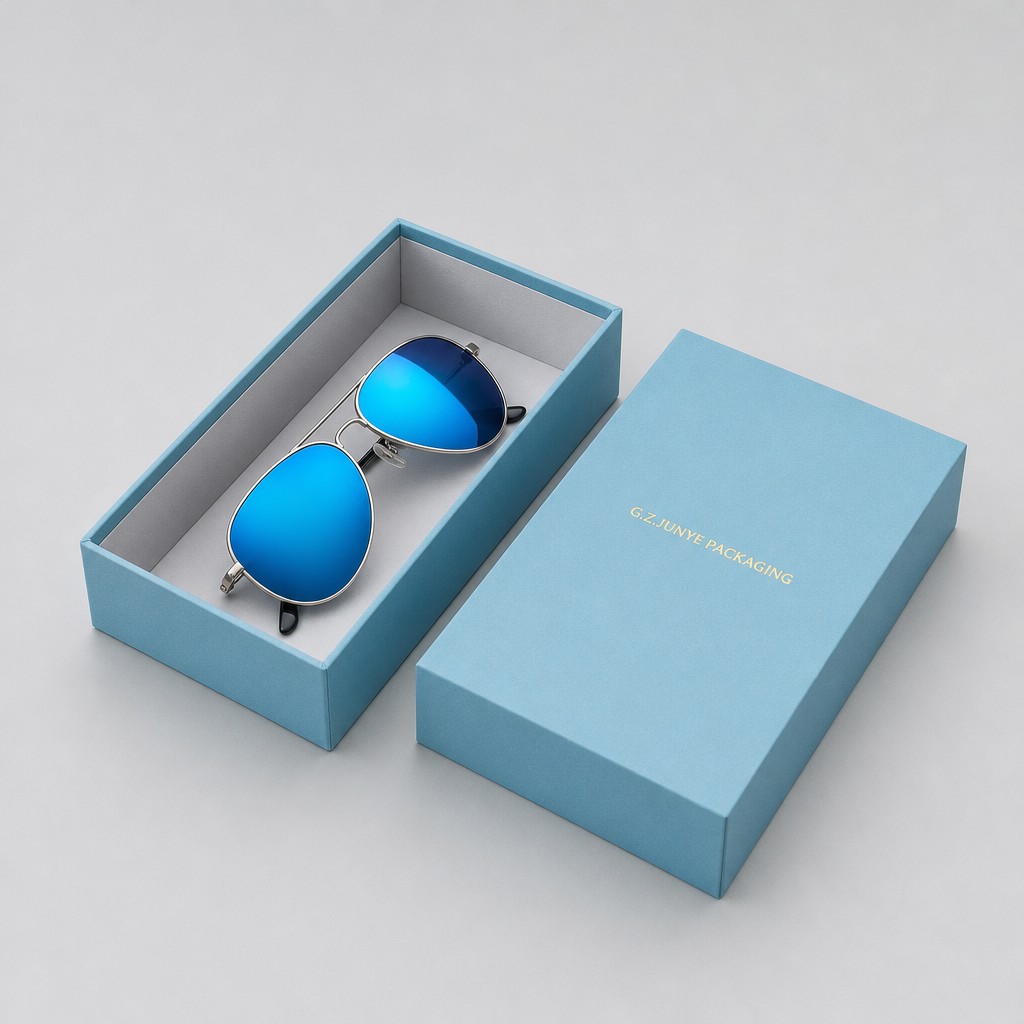
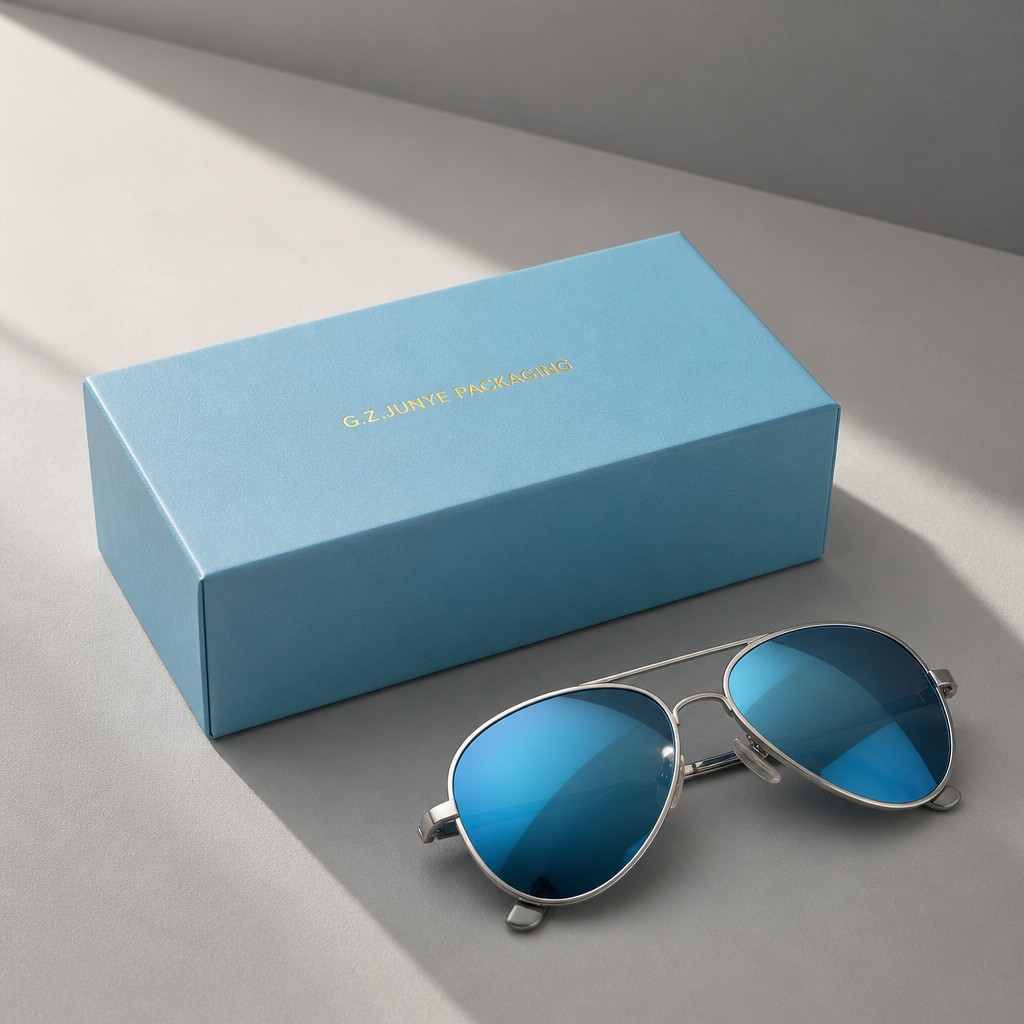
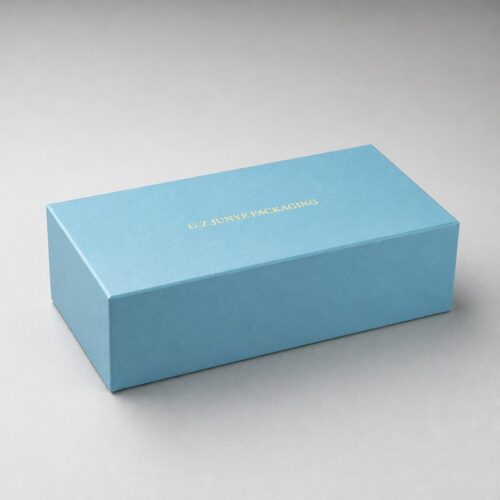
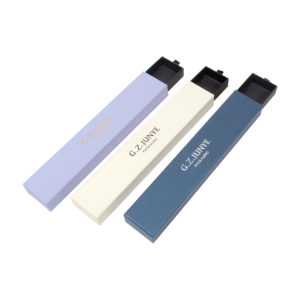
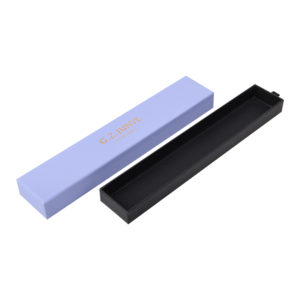
Most eyewear boxes tell you where the cover stops. This one keeps it quiet: the cover is cut deep enough that its lower edge meets the table, so a closed box reads as one blue block with no band of tray showing underneath. At 15 x 8 x 5 cm that decision shapes the whole pack, from the way it is wrapped to the way it is photographed.
A Cover That Reaches the Table
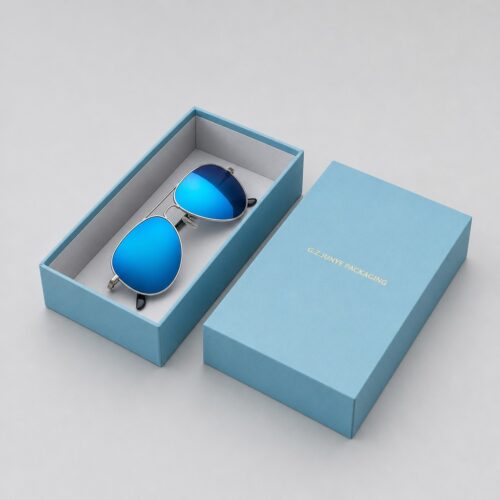
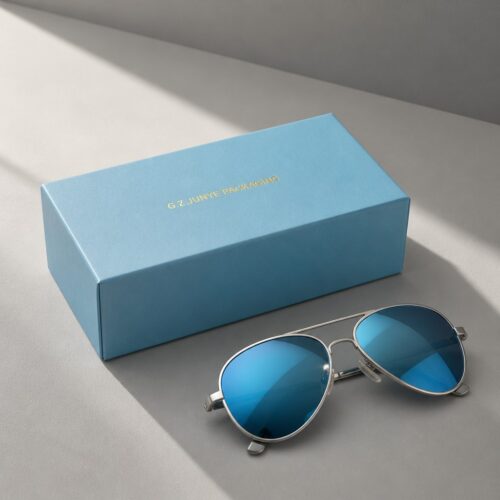
The cover is a box in its own right: a top panel with four walls, each cut to almost the full height of the product. Set it down over the base and the lower edge arrives at the table. Along the side there is no gap, no step and no strip of the tray showing through.
Depth is decided on the drawing, not on the press. Running the walls the full 5 cm is what makes the closed pack measure exactly 15 x 8 x 5 cm, with nothing added for a reveal.
Why the Closed Box Shows No Join Line
A two-piece pack normally leaves a line where the cover stops, and buyers read that line as either a gap or a fault. Here the line sits at the bottom of the pack, at the point where the box meets whatever it stands on, so a straight-on view loses it altogether.
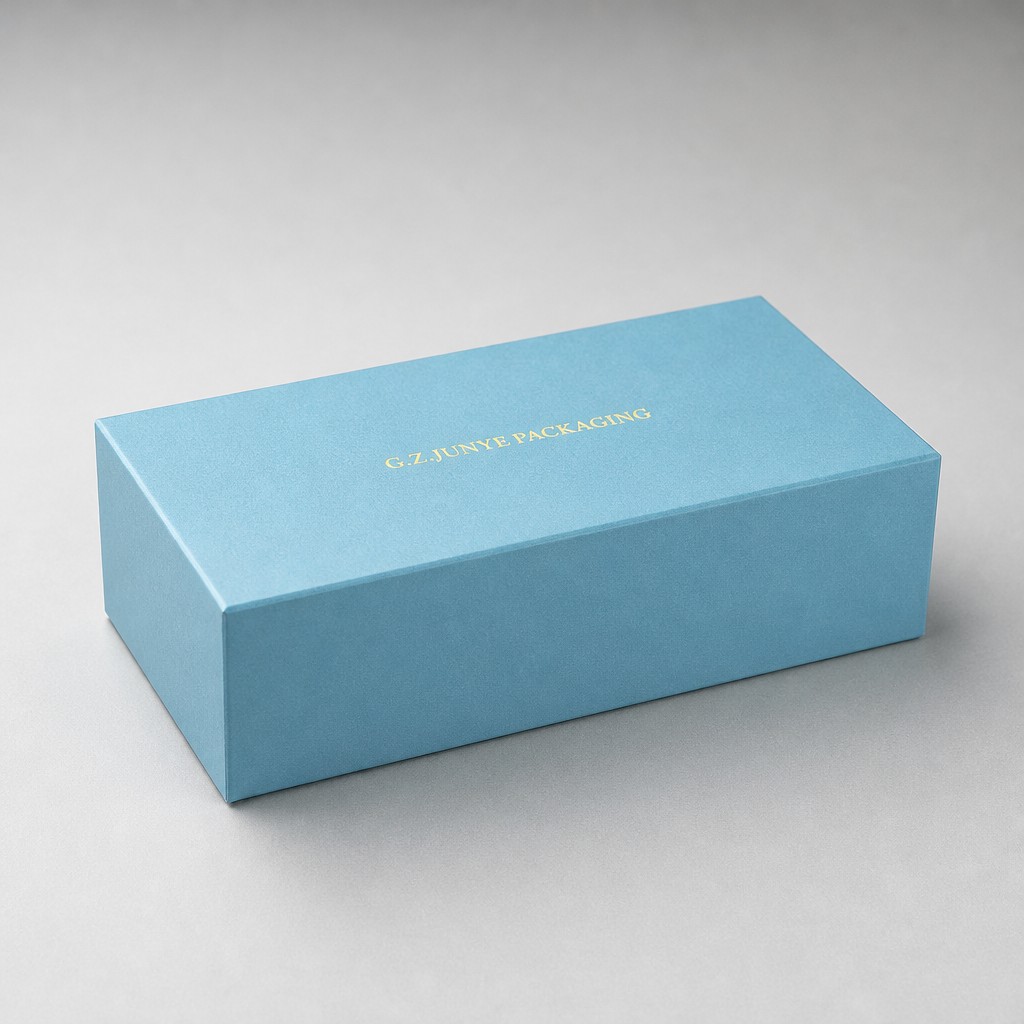
Look from below and you will find it: the base edge is flush with the cover edge, both are wrapped in paper from the same lot, and the join is no thicker than the wrap itself. That is the whole trick, and it is a matter of cutting the cover walls long rather than adding anything to the box.
Four Walls, Two Shells, One Blue Surface
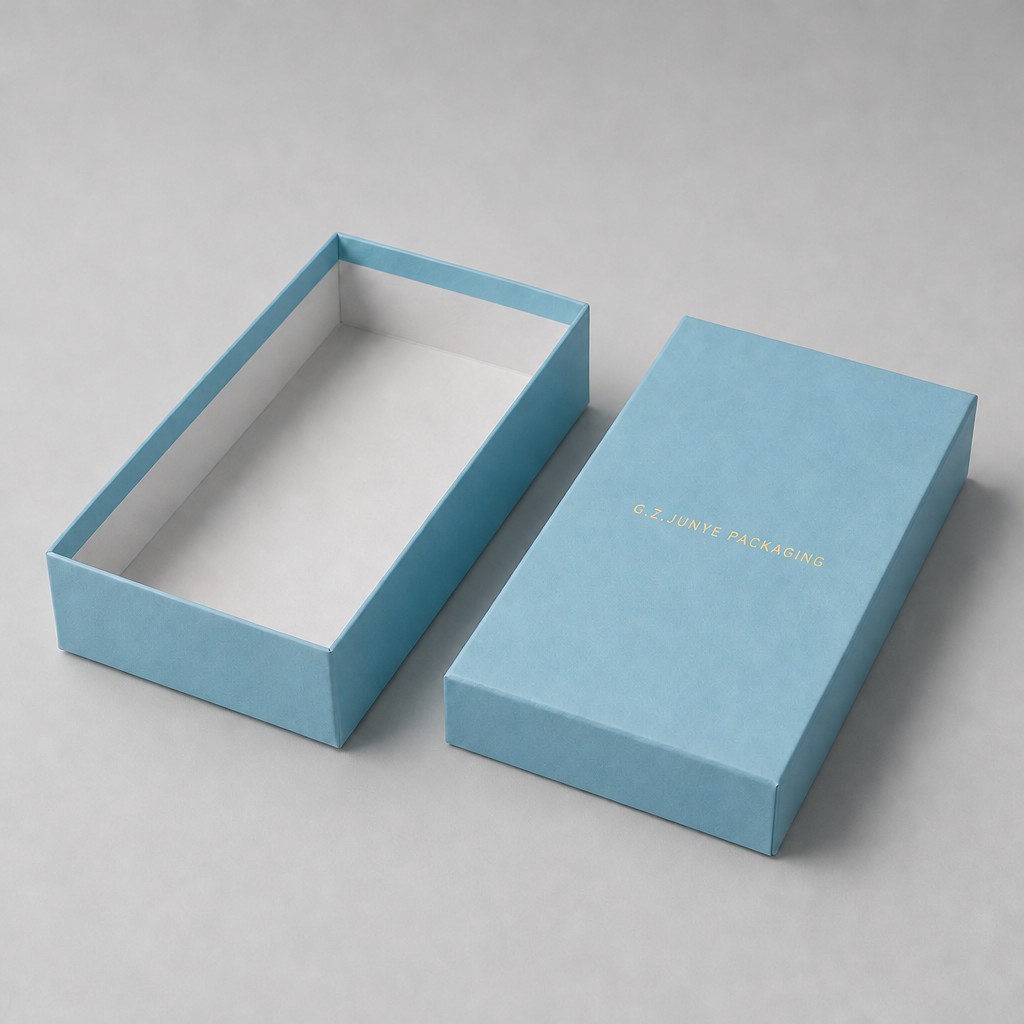
Both halves are built the same way: greyboard cut square, corners joined with paper tape, then wrapped and turned in. Because the paper comes from one lot, the blue reads as a single continuous face rather than two panels that happen to be close in colour.
Two shells, one paper
| Part | What it is | Note |
|---|---|---|
| Cover | Top panel plus four walls, wrapped outside, paper turned in at the mouth | Walls run the full height |
| Base | Floor plus four walls of equal height, lined inside | Drops into the cover |
| Wrap | Matte blue paper, glued and folded round each shell | No embossing, no pattern |
The construction is the same one behind every lid and base box we run; what changes between products is the proportion, the paper and what sits inside the tray.
Fifteen by Eight by Five, Measured Outside
All three figures are outside dimensions: 15 cm along the long side, 8 cm along the short side, 5 cm deep. Nothing is quoted from the inside, because the board and the wrap sit between the two.
Outside size, 15 x 8 x 5 cm
| Dimension | Value | What it decides |
|---|---|---|
| Length | 15 cm | Room at both ends for a folded frame and a soft pouch |
| Width | 8 cm | Side clearance so the frame does not press the walls |
| Depth | 5 cm | Space above the frame instead of contact with the cover |
For eyewear the useful check is not the frame alone but the frame plus whatever it travels in. A pouch adds a few millimetres on every side, and that allowance is what the 15 cm length is there to absorb.
Matte Blue Paper Over Two Millimetre Board
The shell is greyboard of roughly 2 mm, stiff enough that the walls stay flat across an 8 cm span. The wrap is a matte blue paper with no embossing and no printed pattern, so the surface stays even and light falls on it without a highlight running down the side.
A matte face also photographs cleanly in a light tent and does not show fingerprints the way a gloss film does, which matters for a pack that is often shot on a white sweep.
The Blue Edge Turning Over the Mouth
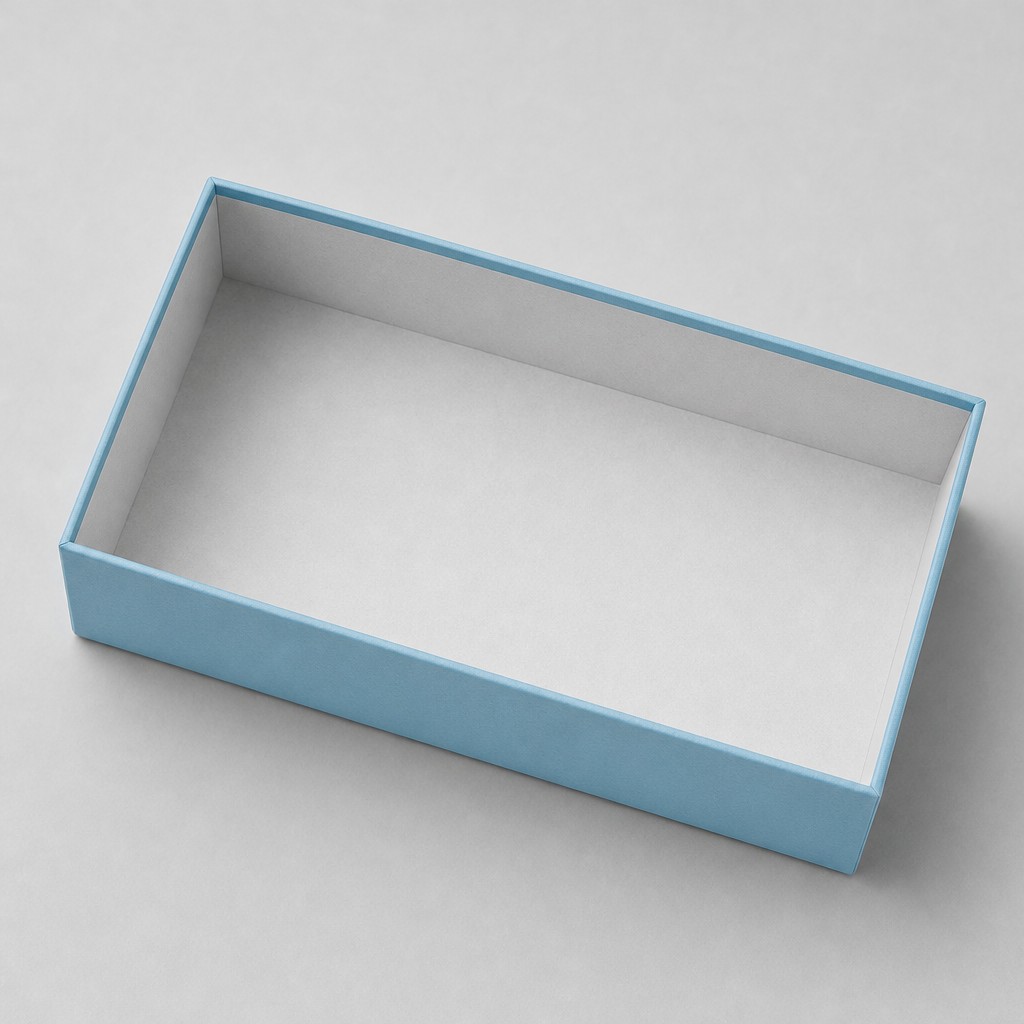
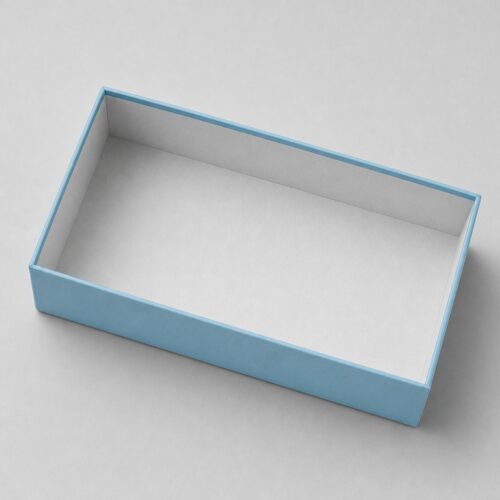
At the top of the base the paper is not cut off where the wall ends. It runs over the mouth and is glued down the inside wall, so a narrow blue band follows the opening the whole way round.
That band does two jobs: it covers the cut edge of the board, and it gives the lining a clean line to stop against. Without it the lining would have to fold over the edge itself, which is thicker and less even.
Light Grey Lining, Flat From Floor to Edge
The tray is lined in a light grey-white paper that covers the floor and runs up all four walls to the mouth. There are no slots, no dividers and no cut-outs in the standard build, and the lining sits flush rather than padded.
A flat lining suits a pouch or a soft bag, and it keeps the box usable for a second frame: nothing in the tray dictates what shape may go in.
Inside the Tray: Flat Liner, Foam Bed or Pouch
Three routes, and they are not exclusive. The standard build is the flat lining; the other two are additions quoted against a drawing.
Insert routes
| Insert | Suits | What it adds |
|---|---|---|
| Flat lining (standard) | A pouch or a soft bag | No tooling, shortest lead time |
| Foam bed in EVA | A frame held in a shaped recess | Tooling cut to the frame outline |
| Flocked tray with cut-outs | Counter display and unboxing | Tooling plus a second material |
Because the tray is a plain rectangle, an insert can be added later without changing the box: the board, the paper and the size stay as they are.
The Velvet Pouch as a Separate Accessory
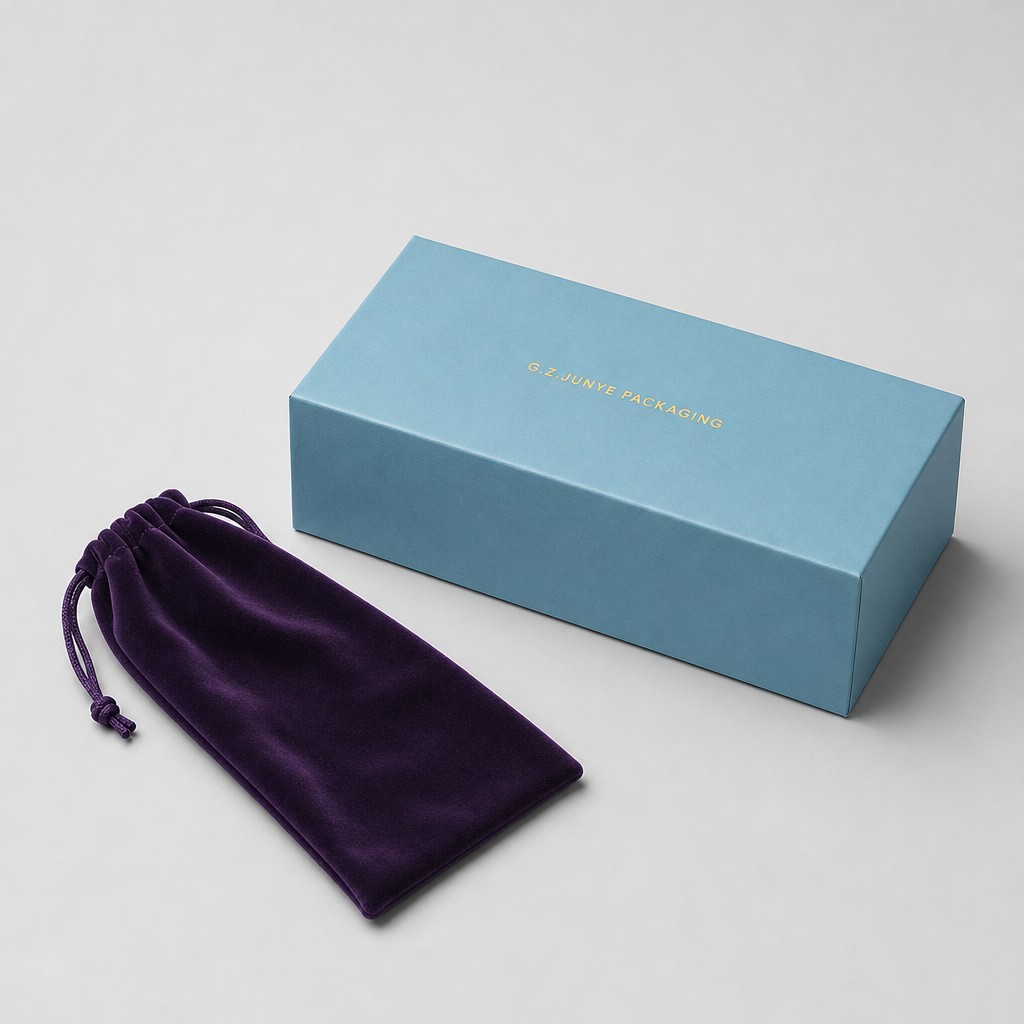
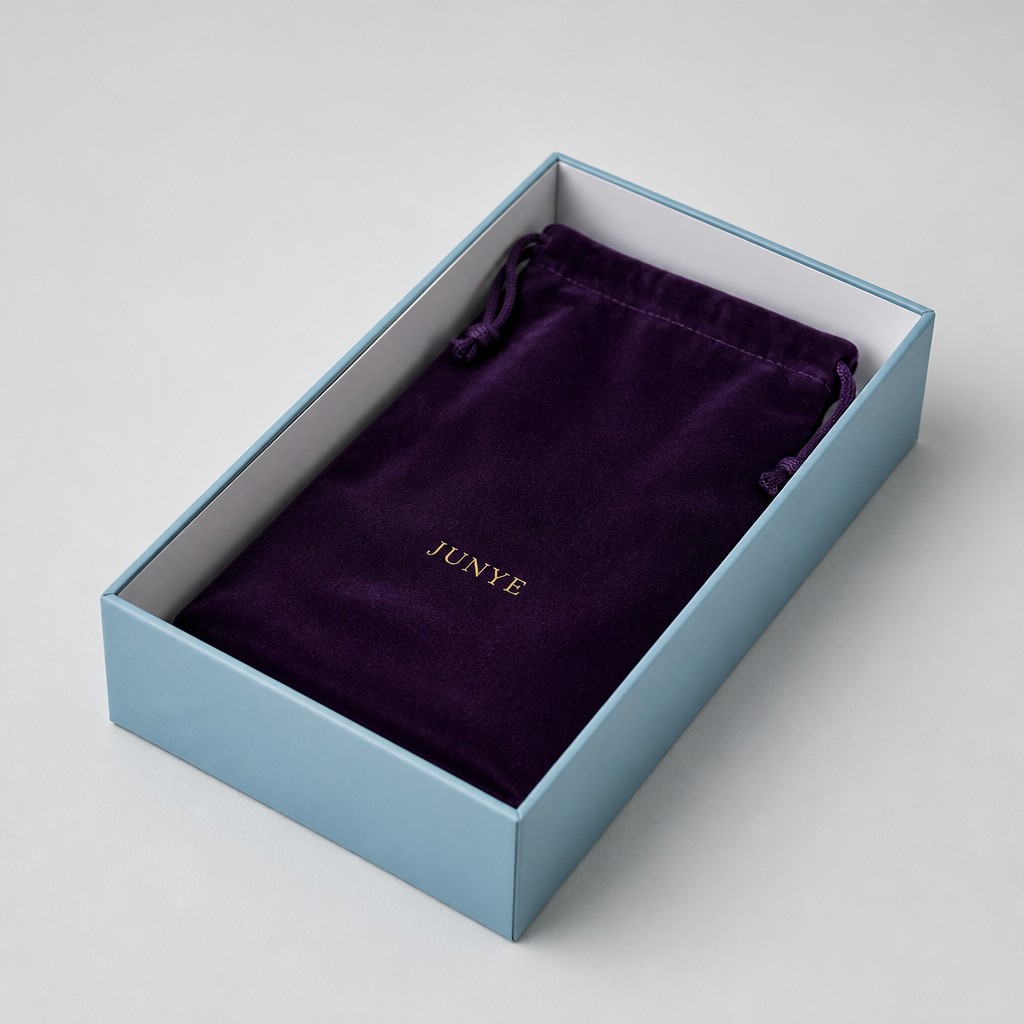
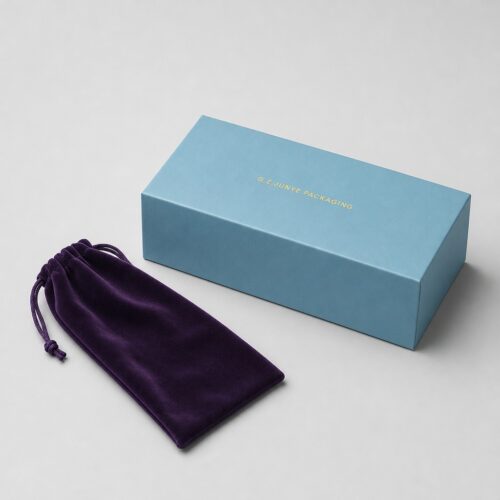
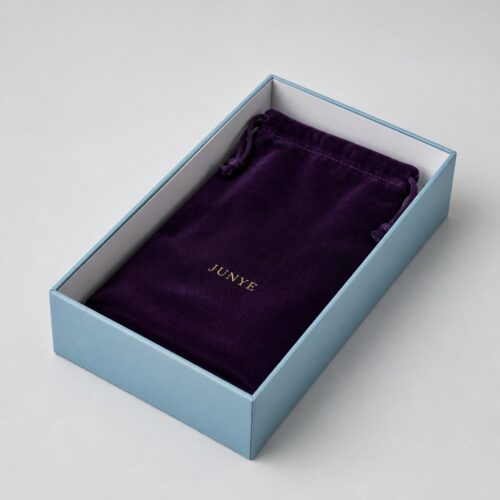
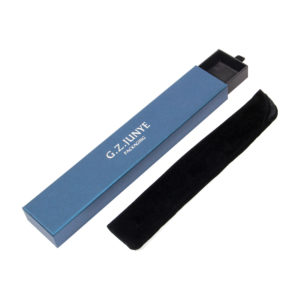
The pouch is not part of the box. It is a drawstring bag in a purple-red velvet, packed inside the tray, and it is ordered alongside the box rather than as a change to it.
Keeping the two separate has a practical side: a repeat order can add or drop the pouch without re-cutting the board or re-approving the wrap.
Hot Stamping a Logo on the Pouch Face
The face of the pouch takes a hot stamped logo. Foil colour, block size and position are fixed on a proof before the run, because velvet pile shifts a fine detail more than paper does.
Bold letterforms and simple marks hold up best. Hairlines and small type tend to fill in where the pile is deep, so a block that works on the box face may need opening up for the pouch.
What Holds the Cover On: Fit, Not Hardware
The cover is held by the fit of the two shells. There is no magnet, no hinge and no ribbon on this box, so there is nothing to line up, nothing to fail and nothing to re-glue later.
Opening is two hands and a straight lift. That is the whole action, and it is the reason the pack feels solid rather than mechanical.
Printing onto a Matte Blue Wrap
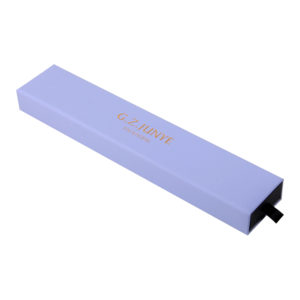
The box as photographed carries one gold logo on the top panel, and the side walls are left plain. When more print is wanted, the matte face takes four routes, and the choice usually follows the artwork rather than the budget.
Print routes on matte paper
| Method | Result | Best for |
|---|---|---|
| Hot foil stamping | Metal or pigment with a sharp edge | A logo on a plain face |
| Screen print | Opaque colour that sits on dark paper | One or two flat colours |
| Offset label | Fine detail and many colours | Artwork with small type |
| Spot UV | Gloss mark on a matte ground | A quiet, tone-on-tone brand mark |
Size, Colour and Lining Set by Drawing
15 x 8 x 5 cm is the size we build for eyewear, and other sizes follow the same rules: outside dimensions given, cover depth chosen, paper and lining named. A rigid paper box of this kind is drawn, not folded from a template.
Colour is matched to a paper swatch or a Pantone reference. Sizes move in millimetres, so a change of 2 mm in length is a new drawing rather than an adjustment on the day.
Packing, Cartons and the Run-Up to Delivery
Boxes travel nested, cover over base, with the pouches bagged separately so the velvet does not pick up board dust. Carton quantity is set per order once the pouch is in or out.
Production starts from the approved sample. The workshop has run since 2004, covers 5,000 square metres, employs more than 50 people and ships to over 30 countries; quality management follows ISO 9001:2015 under certificate ZYC24Q00141R1S, valid to 28 November 2027.
What We Need Before Cutting the Board
Four decisions close the drawing: the outside size, the paper colour, the lining route and the artwork with its colour count. With those fixed the die can be cut and a first sample made.
Holding a sample is the quickest way to judge cover depth, so a sample request is usually the first step. The FAQ covers the rest, and the workshop will quote straight from a drawing. For a different eyewear pack, see black glasses packaging.






Reviews
There are no reviews yet.