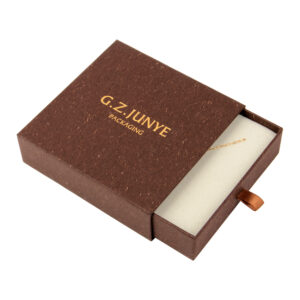
Three Centimetres Is the Whole Point
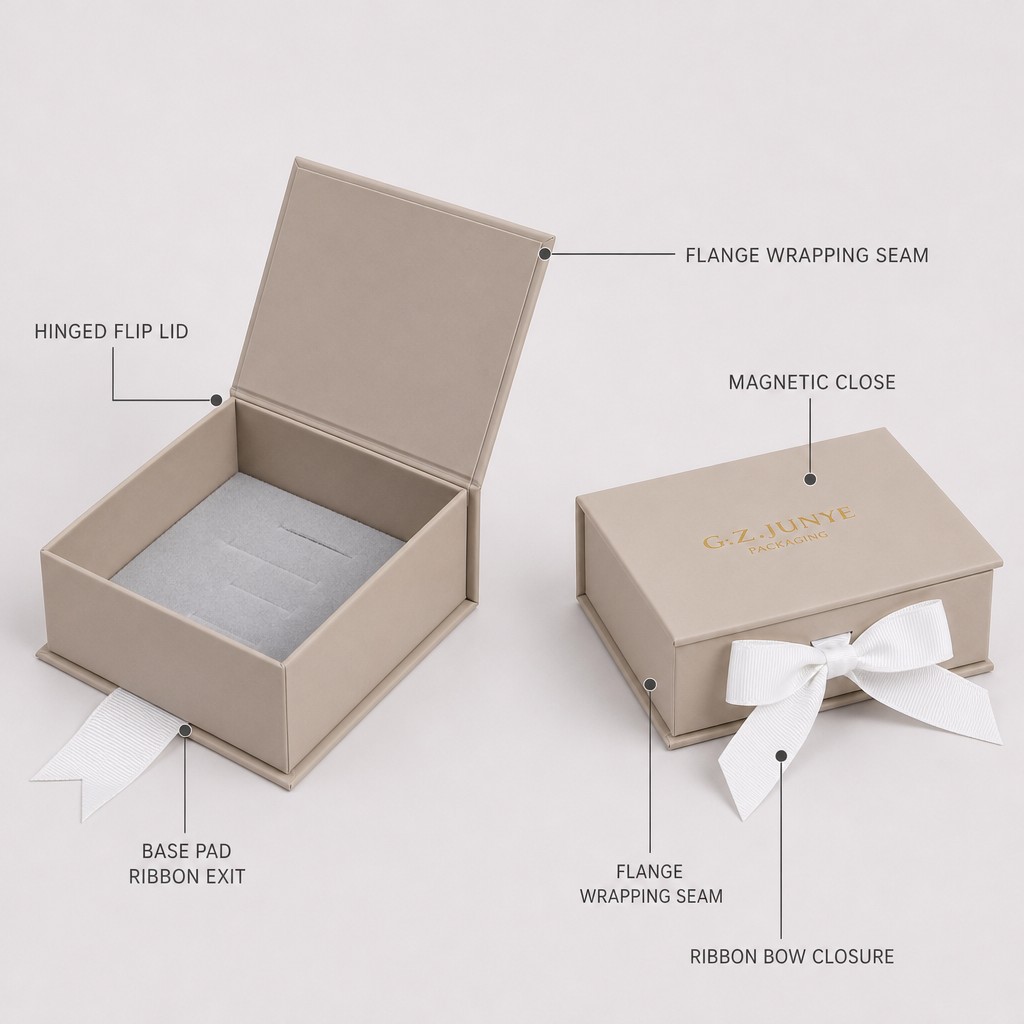
Take a jewelry box at nine by eight centimetres and make it three deep and the piece ends up close to the lid. That single ratio changes how the box is opened, how the piece is seen and what the insert has to do. A deep box hides a ring at the bottom of a well; a flat one presents it.
The construction is one shallow tray and one flat lid panel, hinged along the back long edge so it swings up about a hundred and ten degrees, closed by two hidden magnets. The ribbon around the box is decoration — the box shuts with or without it.
What a Flat Tray Does to a Set of Jewelry
Depth is the budget the insert spends. In a 3 cm box there is very little of it, so the tray cannot hold a cushion stack; it has to hold the piece by its outline instead.
| Flat box, 3 cm | The piece sits near the lid; slots and recesses cut to the outline |
| Deep box, 6 cm+ | Room for a raised cushion and a piece that stands up |
| What a flat box suits | Rings, earrings, pendants, bracelets that lay flat |
| What it does not | Wide bangles, watches, anything that must stand upright |
This is the decision most buyers make last and it should be made first: measure the piece standing up and compare it with the internal depth — the same choice we set out for ring box trays.
Slots, Recesses and Faces: Reading an Insert Layout
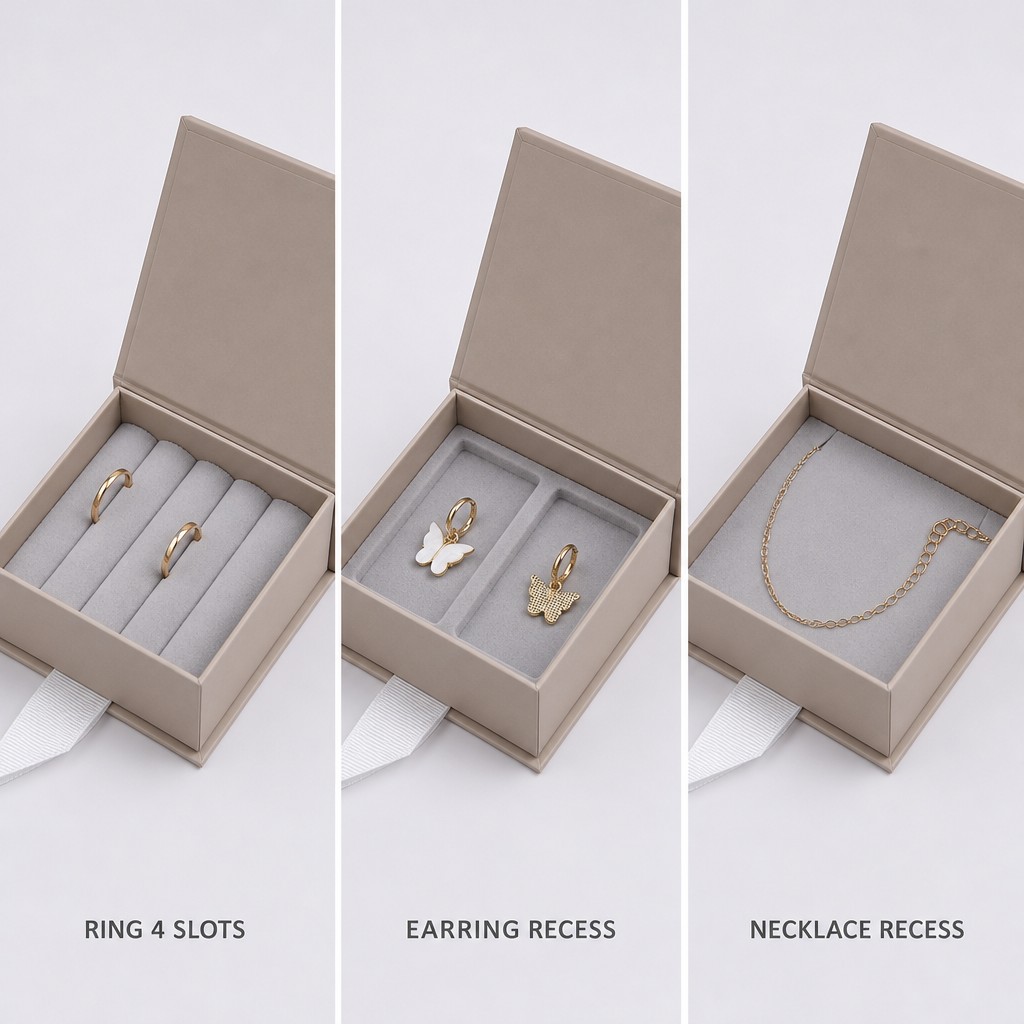
Three cuts cover most jewelry, and they can share one tray.
| Slots | Narrow parallel cuts, typically four, so a row of rings stands in line |
| Recess | A wide shallow well for a pair of earrings |
| Face | A broad flat area where a chain can be laid out without kinking |
| Mixed | Half the tray slotted, half recessed, for a set |
A slot holds by its walls; a recess holds by its depth; a face holds by nothing at all, which is why a face only works when the piece is looped or a lid keeps it in place. The box that carries it is the one shown on the ribbon jewelry box page.
When a Deep Box Is the Wrong Answer
A deep box is not the premium choice by default. If the piece is flat, a deep box means empty air above it, a heavier carton and a smaller stack per pallet — and a ring that looks lost when the lid comes up.
| Empty air | A deep tray with a flat piece leaves several centimetres of nothing |
| Carton cost | Volume drives freight; 3 cm per box adds up over a run |
| Presentation | Flat boxes show the piece at the rim as the lid clears |
The exception is a piece that has to stand, or a box meant to hold several layers — those need the depth, and a different insert with it.
The Lid, the Magnets and the Ribbon
Because the lid is a single panel joined on one edge, there is nothing to set down and no second part to mislay. The three free edges carry a narrow turn-down lip, which is what keeps a flat lid looking square after a hundred openings.
| Lid | One flat panel, hinged on the back long edge |
| Lip | Turn-down lip on the three free edges |
| Magnets | Two, hidden in the tray rim; the box closes on its own |
| Ribbon | White ribbed grosgrain, out under the base, tied at the front |
Specify the ribbon as decoration and the packing line can skip it; specify it as the closure and every unit has to be tied. A flip box with a ribbon works the same way.
Measuring a Piece for a Slot
An insert cut is only as good as the numbers behind it. Four measurements decide the layout.
| Outline | The footprint of the piece at its widest |
| Depth below the rim | How much of the piece sits inside the tray |
| Height above the rim | What the lid has to clear when the magnets pull shut |
| Quantity per box | One piece, a pair, or a set with its own layout |
Send a tracing or the piece itself and we set the slot width, the wall thickness and the sitting height from it. Where the piece is soft — a chain, a silk cord — the cut follows the way it will be coiled rather than its loose length.
Sampling a Flat Box: Five to Seven Days
The sample carries the whole decision: the insert cut, the sitting height, the wrap tone and the ribbon.
| Sample time | 5-7 days |
| Included | Flocked insert cut to your outline, mark, ribbon and a template |
| What to test | Piece in the slot, lid shut, box shaken lightly |
| After approval | 18-25 days for a standard run; 10-15 for a small batch |
Start with the sample request if you would rather handle the insert before committing to a run; the template we cut is the one production uses.
Questions We Get About Flat Flip Boxes
Will a flat box feel cheap?
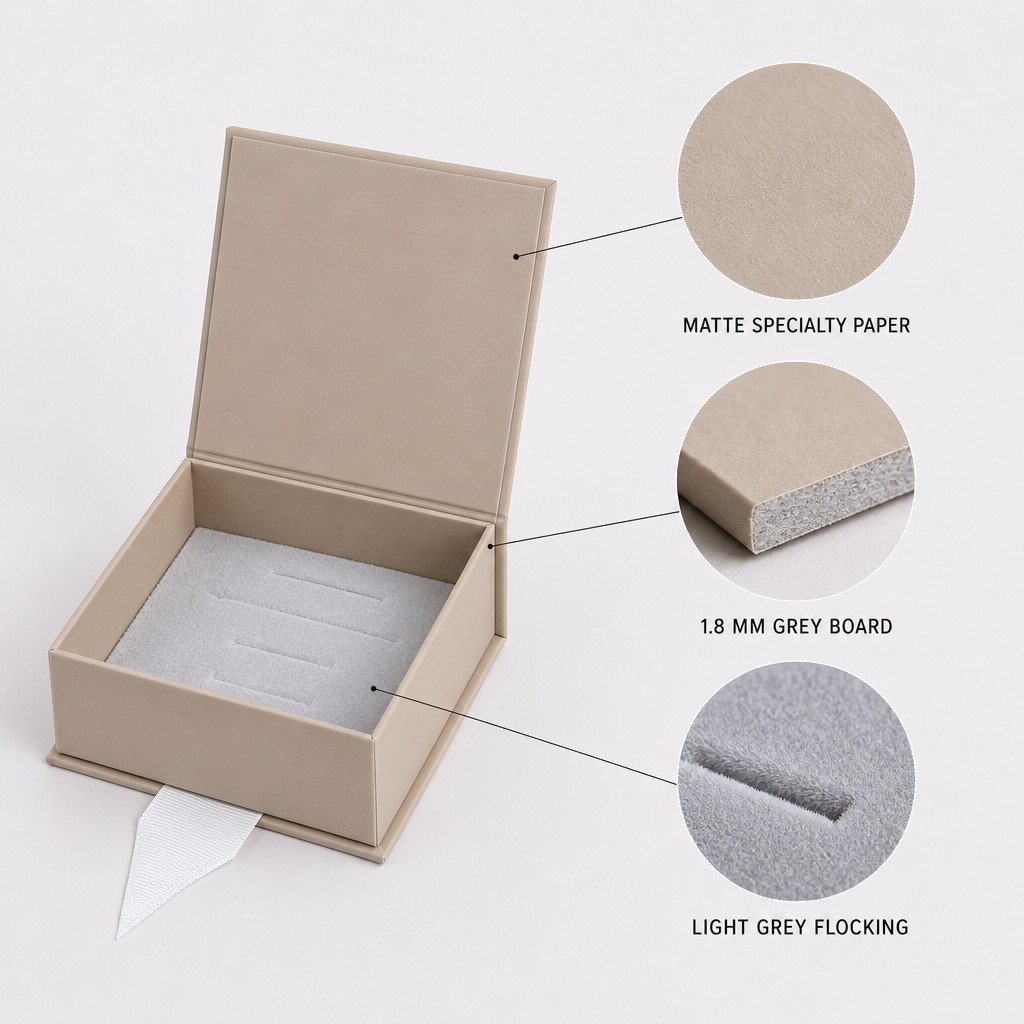
Rigidity comes from the board, not the depth. This one is 1.8 mm grey board wrapped in beige specialty paper, and the lid carries a turn-down lip, so it holds its shape.
Can the insert be changed later?
Yes. The outer box is one construction; the tray is a separate part, so a later run can use a new layout in the same shell.
Does the ribbon mark the paper?
It exits under the base at a corner and sits across the lid, so it does not cut into the wrap; on a pale box we check the tie on the sample.
How many units for a custom cut?
300 pcs for this construction. Below that the die cost is spread over too few boxes, which is covered in the FAQ, and the drawer box range shows the deeper alternative.