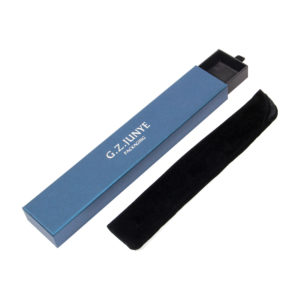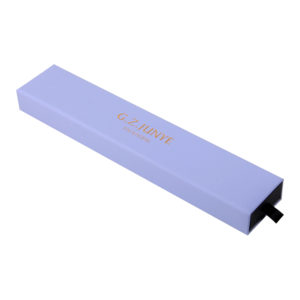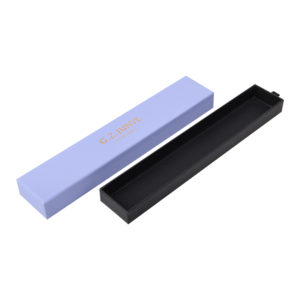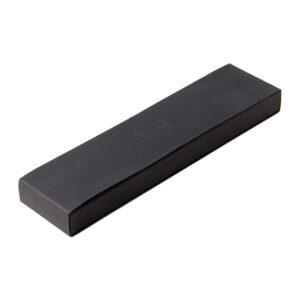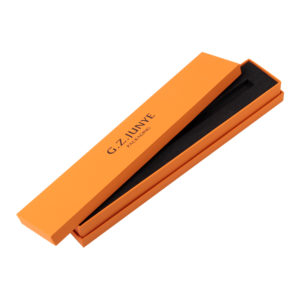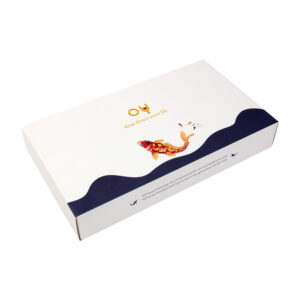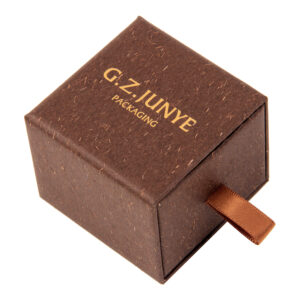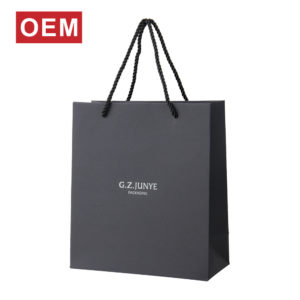
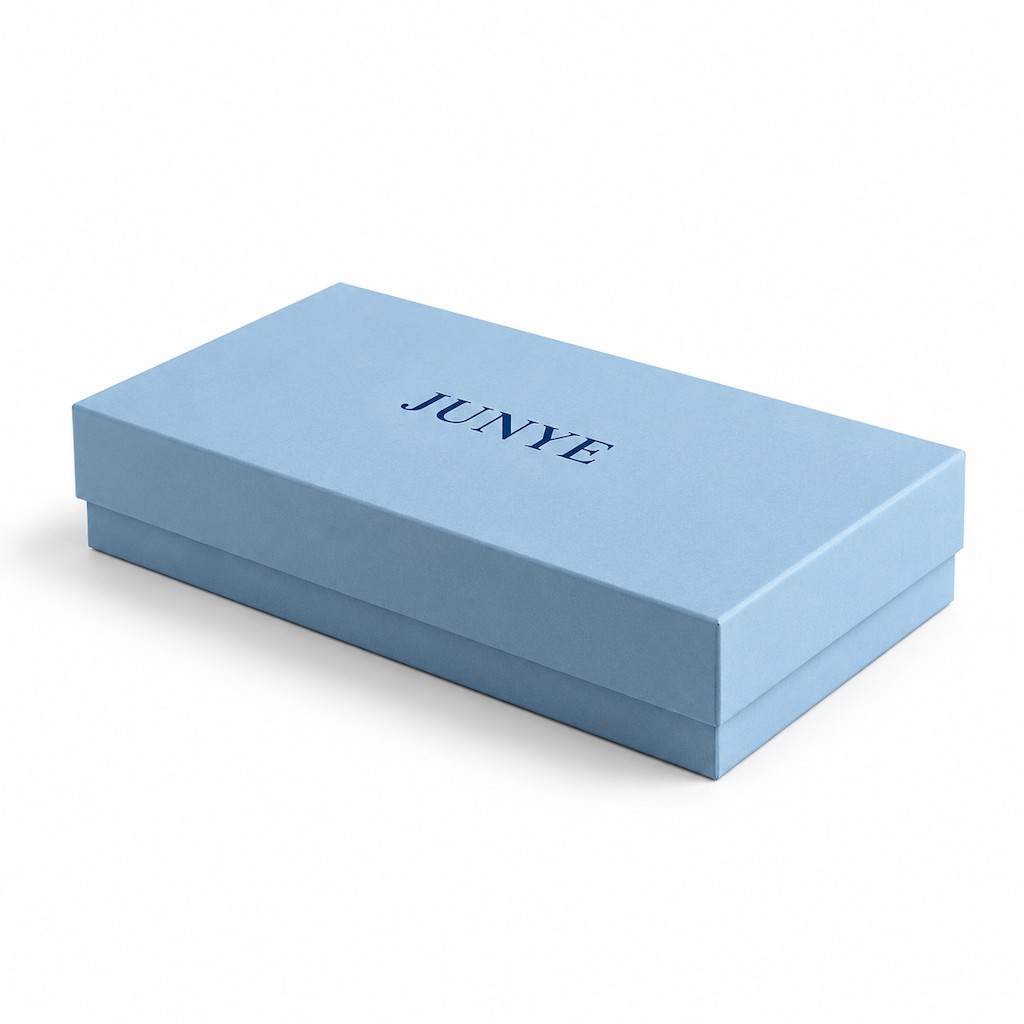
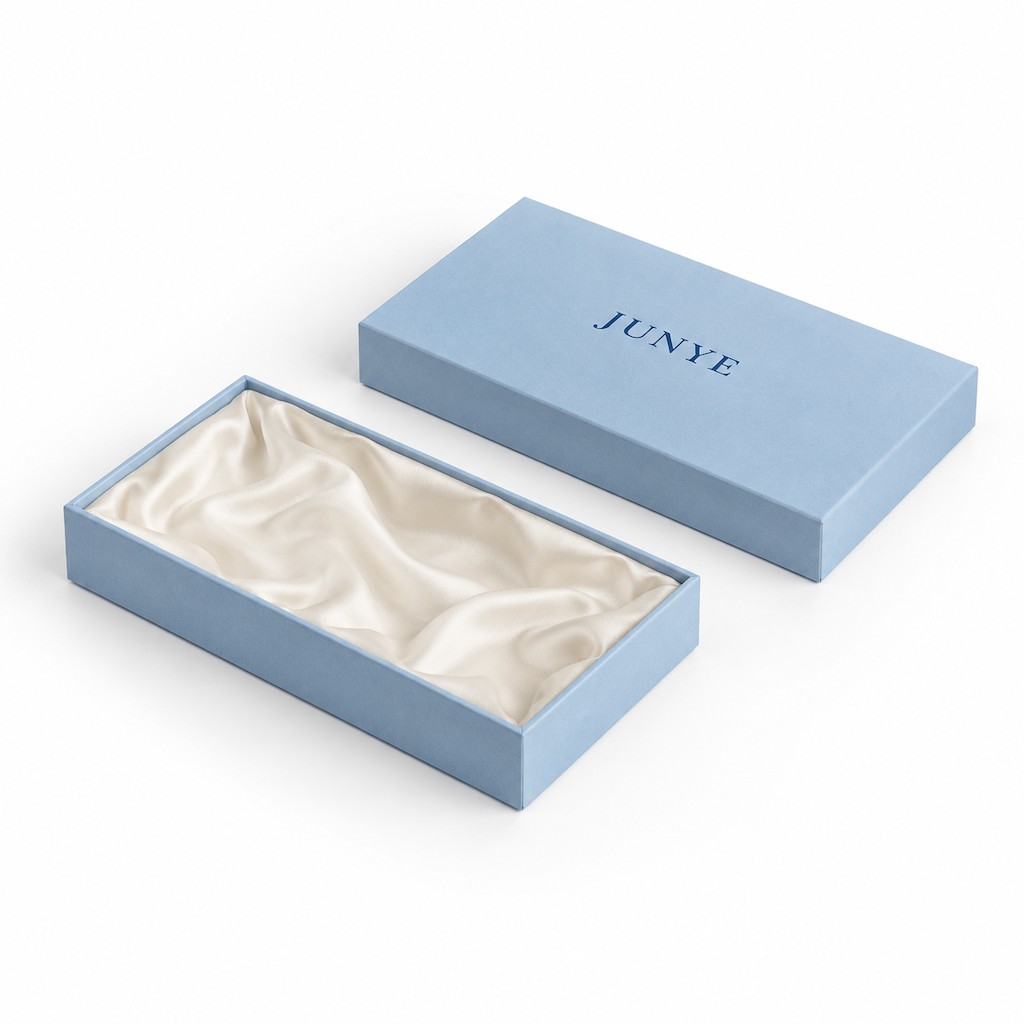
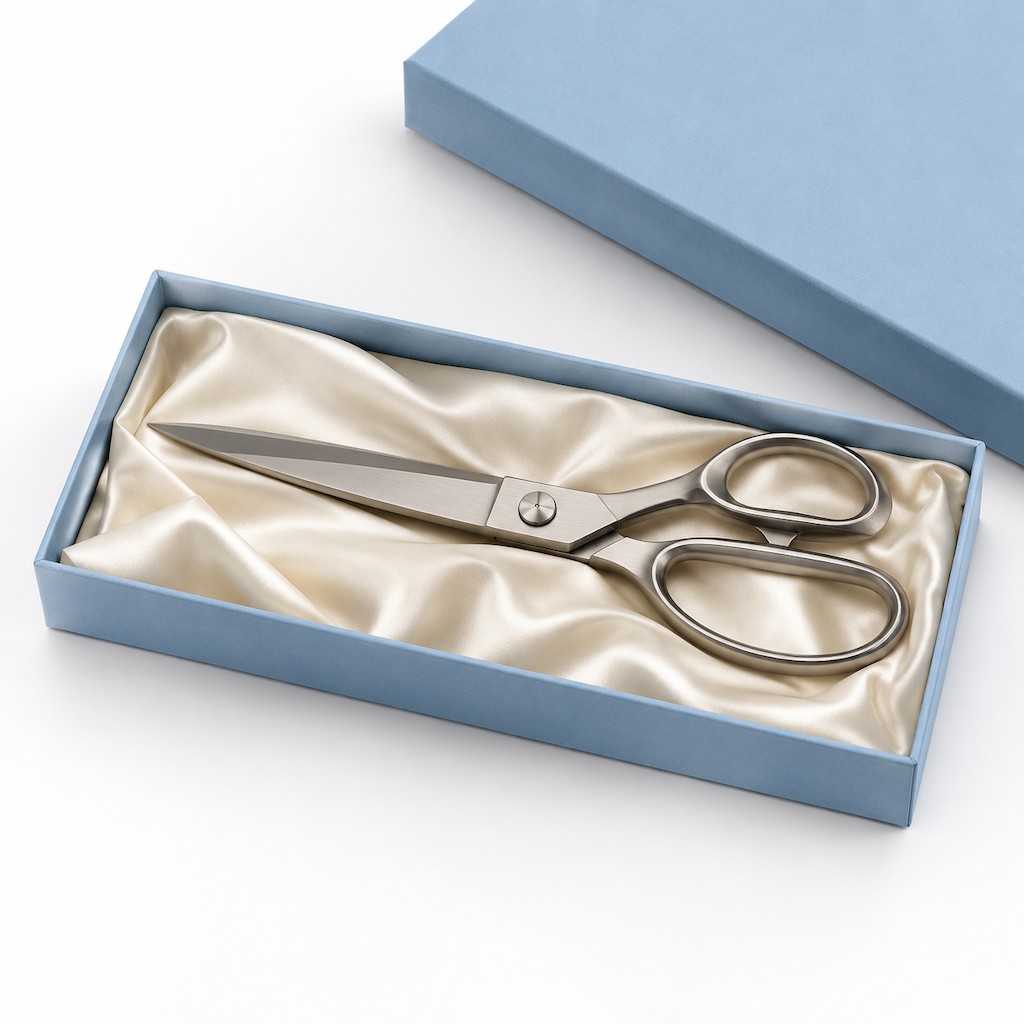
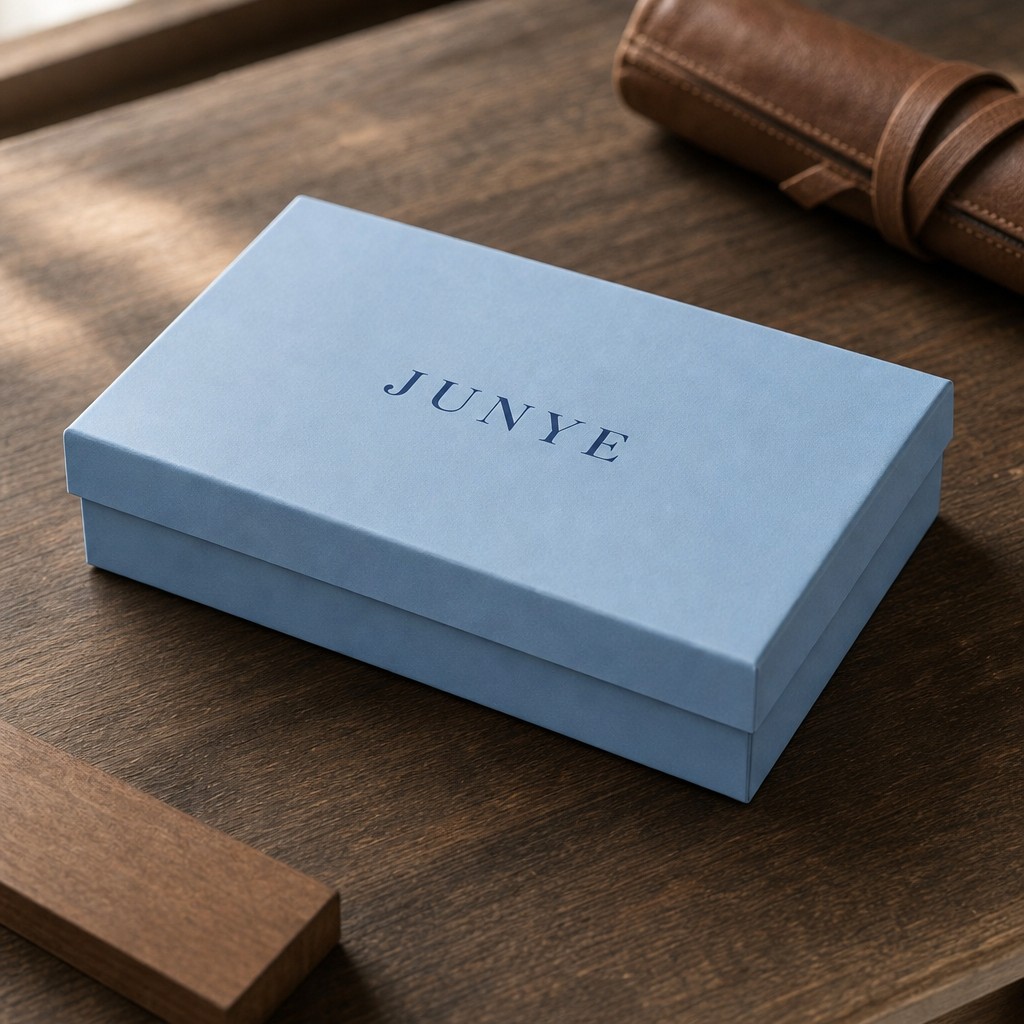
A scissors packaging box built as two pieces: an open tray lined in ivory satin, and a lid that drops over the outside. The lid skirt runs 2 cm down, so 1.5 cm of the tray stays visible when the box is shut. On the closed side that reads as three bands with one step between them.
Two Pieces, One Step
- Tray: an open-top tray, one board for the floor and four walls from the same sheet, wrapped outside. No hard insert.
- Lid: a shell with a top panel and no bottom panel, sized to drop over the outside of the tray.
- Inside the tray: one continuous piece of ivory satin, draped rather than slotted.
What it is not. It is not a full-depth lid, where the skirt runs to the bottom and the tray disappears. It is not a rimmed box either, where a second band of paper stands inside the mouth. Here the mouth is one board thick, and the side shows one step.
Close Geometry
| Reference | Value |
|---|---|
| Footprint | 16 x 8 cm (2:1, rectangle) |
| Overall height | 3.5 cm |
| Lid skirt | 2.0 cm |
| Tray left exposed | 1.5 cm |
| Lid overhang | about 2.5 mm per side |
Every figure above is read on the closed box. Length, width and height are all made to order, and the structure does not change when they are.
How The Step Is Made
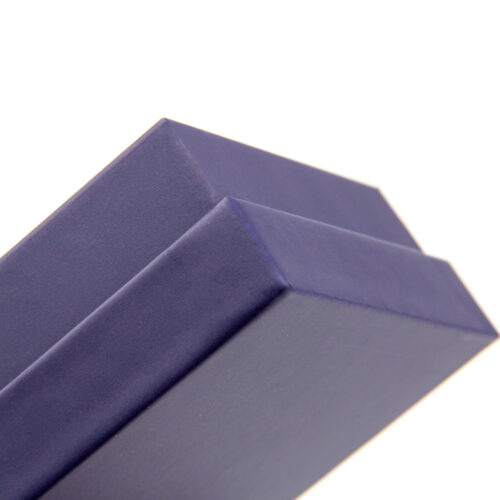
Grey board is V-grooved along the fold lines and turned through 90 degrees, so the corner is a sharp edge rather than a rounded bulge. The wrap goes on afterwards as one piece, folded into the mouths and pressed flat.
Two things show up on the finished box because of that order of work:
- a very narrow band of wrap visible inside the lid mouth, where the paper turns in. It is a process mark, not a defect.
- the step under the lid overhang casts a fine shadow line all the way round. On a pale matte wrap that shadow is the clearest read of the structure.
What The Exposed Strip Is, And Is Not
People see a band of tray below the lid and ask whether the box is shut. It is.
The tray mouth sits at the top, and the lid covers it. The strip you see belongs to the bottom of the tray, the part the skirt does not reach. Nothing is open, and nothing is missing. What you get is a two-tone side: lid and skirt above, tray below, divided by one step.
The strip does three jobs: it makes the lid easy to grip, it breaks the silhouette so the box does not read as a solid block, and it lets the tray carry a second colour if you want one.
On A Counter, Not In A Drawer
This box is built to be opened in front of someone. The lid lifts off cleanly with two hands, the satin catches the light as it comes away, and the tool is already presented when the lid is set down. Nothing has to be unpacked, unwrapped or unclipped.
That matters for a salon or a cutlery counter, and less for a warehouse shelf. If the box is going straight into a courier’s van, see the limits below and spec an insert.
Surface And Lining
The wrap is a matte specialty paper in a pale powder blue with a fine grain and a low sheen. It is not laminated and not a soft-touch film, so the paper stays visible under the light rather than reflecting it back.
The lining is one piece of ivory satin laid across the floor and up the inner walls, left to fold where it wants. It is a presentation surface, not a holding one: the fabric settles around the tool and throws light back onto it, but it does not grip. Anything that must not move needs a moulded insert.
What Fits Inside
The 2:1 footprint lets a long tool lie along the length of the box instead of being stacked or angled:
- barber shears and thinning shears
- nail kits, cuticle tools, razors
- utility knives and small kitchen knives
- commemorative cards, award cards, certificate holders
- single-piece gift sets where the tool is the whole story
Where A Scissors Packaging Box Stops Working
Being straight about the limits saves a sample round:
- Items over about 1 kg need a thicker board and a hard insert, not satin.
- Multi-piece sets that must not touch each other need a compartmented insert in EVA, sponge, EPE or moulded paper.
- Liquids need their own sealed container; the box is not a barrier.
- A tool longer than the 16 cm side is a resize, not a fit. The same structure scales.
Printing And Branding
Hot foil, emboss, deboss, spot UV, screen print, CMYK or a Pantone match. The lid panel is the natural place for a mark: centred, or set high on one side. Our own sample carries JUNYE printed into the paper, with the paper grain reading through the ink.
Ordering And Sampling
MOQ is 300 pcs for the standard size, 500 pcs when the size changes, and 1000 pcs for a new logo, a Pantone colour or a new cutting die. A physical sample is produced and approved before the run starts. Price, freight and lead time are confirmed on the quotation.
What To Send Us For A Quote
Four things, and the quote comes back specific instead of ranged:
- Tool length and thickness, taken with the tool closed. Thickness at the handle, not the blade.
- Whether it travels or only sits on a counter. It decides satin or an insert.
- Your mark, as vector, plus whether it prints one colour or foil.
- Colour target, as a Pantone number if you have one. Otherwise describe it and we match on paper.
A photo helps with shape and finish. It does not replace the three measurements.
Quality
Guangzhou Junye Packaging Industry Co., Ltd. has run its own rigid box factory in Guangzhou since 2004. ISO 9001:2015 certificate ZYC24Q00141R1S is on file. Grey board is V-grooved and folded to a sharp 90 degree corner, then wrapped; the wrap on our sample is a matte specialty paper in pale powder blue with a fine grain.
Related Reading
- Half lid packaging box: the same structure at a square footprint.
- Two piece lid box: what separates a two-piece box from a drawer.
- Flat scarf box: a 2:1 box used for something soft instead of something sharp.