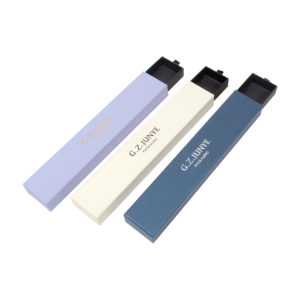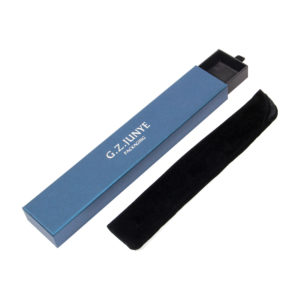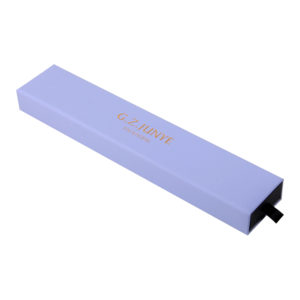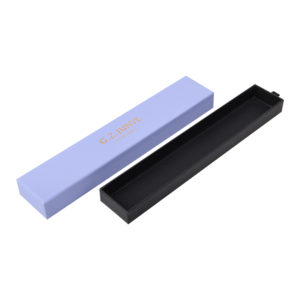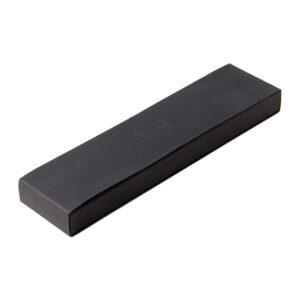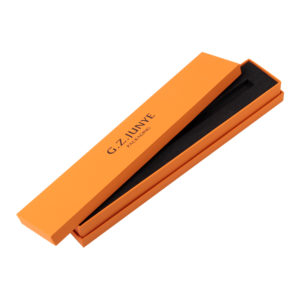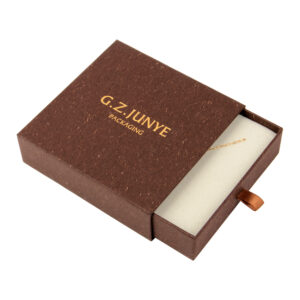
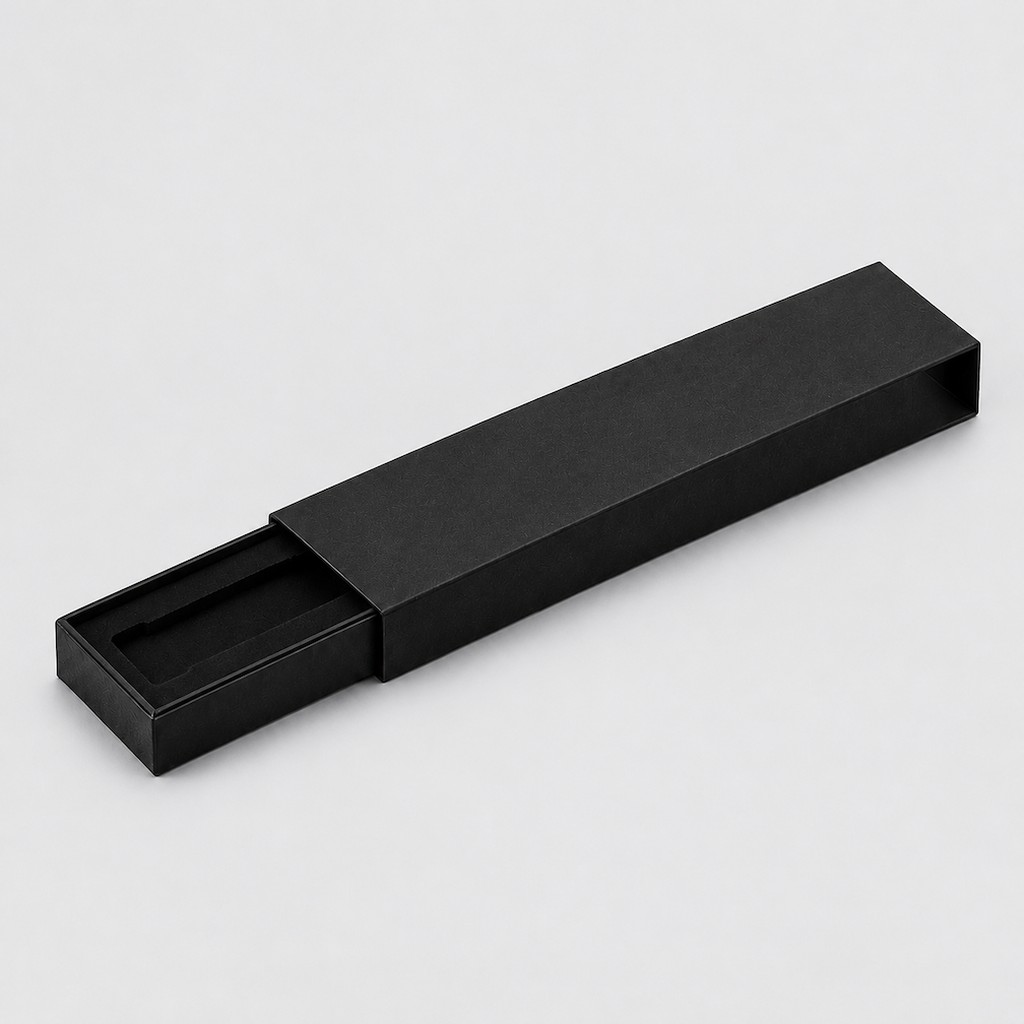
A watch box does not have to open from the top. In a drawer box the sleeve is a tube open at both ends, the tray slides out along the long axis, and the closed box shows no lid line at all — because there is no lid. What holds the watch is not the box but the insert: a flocked cushion with a channel cut for the strap.
The Assumption: A Watch Box Needs A Lid
Most buyers picture a watch box as a body with a lid that lifts. That picture comes from the rigid gift box, where the lid is the ceremony: it comes off, the product is revealed, the box is set aside.
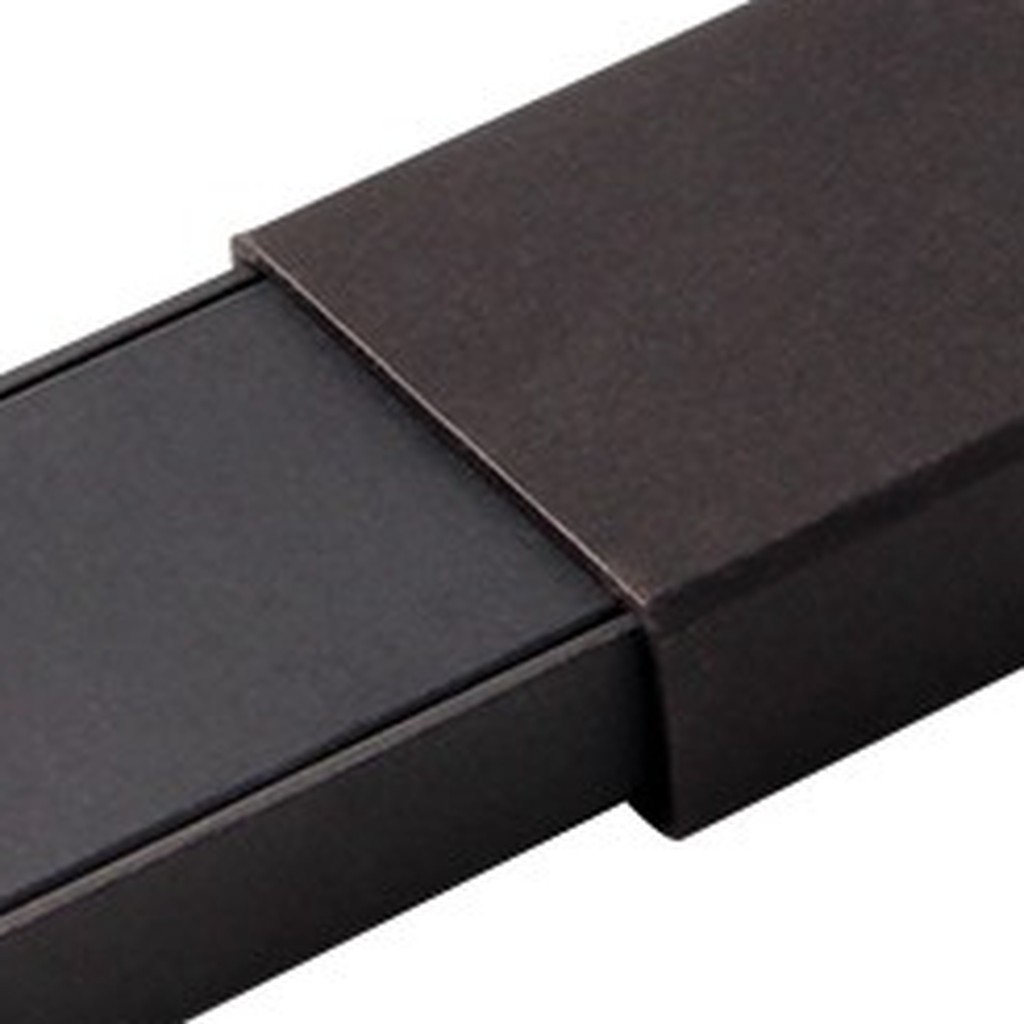
A drawer box breaks that picture in a way that reads as a defect if you are not expecting it. There is no lid line on the long side, no gap at the top, no hinge — so the first reaction is often “this is a sleeve around a box” or “this does not open properly”. Both are wrong, and both are worth answering before a sample is approved.
Two Ways To Open A Box
The difference is not decorative. It decides how the box is packed, how it is opened in a shop, and how the insert has to be built.
| Lid box | A body, a lid, and a lid line on the side; the product is reached from above; the insert can be a flat pad because nothing slides. |
|---|---|
| Drawer box | A sleeve and a tray; the tray moves along the long axis; the insert must hold the product against the slide, not just against gravity. |
Once you read it that way, the missing lid line stops being a fault and becomes the point: the box is opened sideways, so the side has to stay uninterrupted.
Why The Sleeve Is Open At Both Ends
Open-ended construction has three practical consequences, and all three are about the buyer rather than the box.
First, there is no fixed front and back, so the tray can be pushed out from whichever side the buyer is holding. A box that was packed one way round does not have to be turned before it opens.
Second, the same box works for two retail facings: a counter where the customer stands on one side, and a display where they stand on the other.
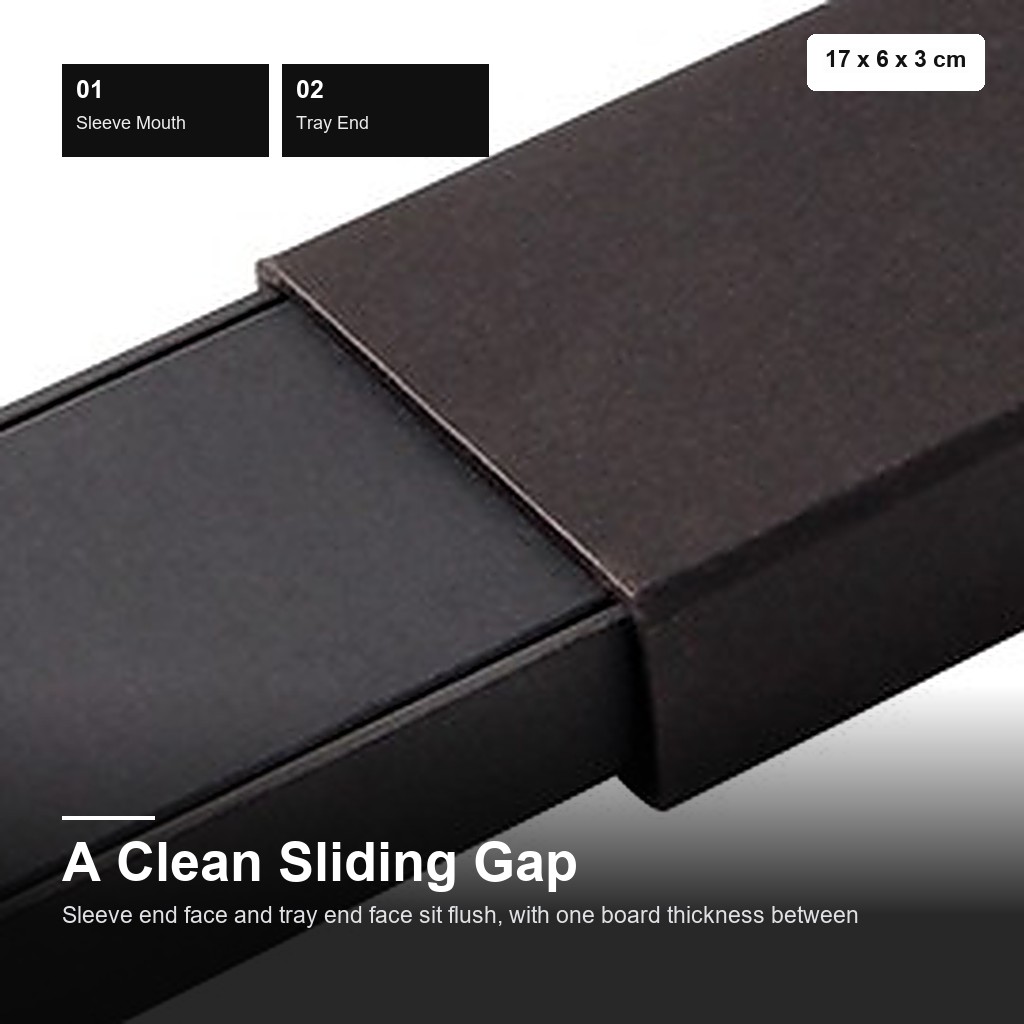
Third, it removes a failure mode. A sleeve with one closed end has to be oriented during packing; a tube open at both ends cannot be packed the wrong way round, and the end faces stay flush because both are the same.
The trade-off is tolerance: the tray has to clear the sleeve along its whole length, from either end, so the die and the wrapping have to be consistent batch to batch.
What The Strap Channel Actually Does
A watch on a flat pad rolls. A watch in a channel cannot. That is the whole reason the insert is cut rather than pressed flat.
The case cannot rotate
The channel runs across the insert, and the case sits in the cut-out with its sides against the walls. Movement along the slide direction is stopped by the cavity itself, so the watch arrives with the dial square to the viewer instead of at an angle.
The band goes under, not over
The strap passes beneath the cushion through the channel, so the buckle tucks out of sight and the band does not wrap across the face. On a mechanical watch this matters: a band lying over the dial can mark the crystal in transit.
Width is cut to the case
Channel width follows the case, not the strap. Too wide and the case rocks in the cavity; too narrow and the strap will not seat without forcing. That is why the insert is tooled from a drawing rather than chosen from a stock list — two watches of the same dial size can differ at the lugs.
Soft-Touch Black Changes The Photography
Matte soft-touch paper over grey board is the default finish here, and it is chosen for a photographic reason as much as a tactile one: it does not mirror the shop lighting. A glossy black box under a ceiling spot becomes a white streak across the lid, and the product behind it disappears.
The cost is handling. Soft-touch paper scuffs against the next box more easily than a coated surface, which is why every unit is sleeved in a transparent PP bag before it goes into the export carton.
When A Drawer Box Is The Wrong Choice
Drawers are not universally better. A drawer box gives up the moment of ceremony: there is no lid to lift, so the reveal is a slide rather than an opening. For a high-jewellery piece sold on theatre, a lid box does that job better.
It is also the wrong call when the product is tall relative to its footprint. A drawer needs length to slide; a box that is nearly square ends up with a short travel and a tray that comes out abruptly. Cardboard watch box covers the shorter formats in the same family.
Specifying It: Size, Insert, Print
Give the internal dimensions you need and let the outside be worked back from them. The stock reference is 17 x 6 x 3 cm, lying flat: long enough for a watch on its cushion, low enough that the drawer reads as a drawer.
Print options on soft-touch black are hot foil, blind emboss, deboss and screen printing. Foil and blind emboss hold a crisp edge on the matte surface; light colours are more reliable as screen print or foil than as offset. Double open drawer watch box shows the finished construction, and watch paper box covers the rest of the range.
Minimum order is 300 pieces per design. A new size or a new insert cavity means a new die, so it is quoted as its own project rather than as a variant of the stock box.
Questions Buyers Ask
Does the tray fall out when the box is tipped?
No. The tray is held by fit along its whole length, and the top board travels with it. The clearance is set so the slide is smooth without being loose.
Can the insert hold a smart watch with a charging puck?
Yes. The tray depth and the cavity are set from your drawing; a puck pocket sits beside the cushion.
Is there a magnet or a catch?
No. There is no magnet, no hinge and no flap. The box closes by pushing the tray home.
Can it carry a necklace instead of a watch?
Yes. The flocked cushion is replaced by a long-profile channel cut to the chain width.
How is it printed on all faces?
The sleeve carries four walls plus top and bottom; the top board is printed separately and travels with the tray. Hot foil, blind emboss, deboss and screen printing are available on the soft-touch surface.