Most two piece boxes hide their join. On a rimmed lid and base gift box it shows on purpose, and the showing is the point: a band wrapped round the base wall gives the lid a place to land and gives the fingers a place to hold. Everything else about the box follows from that one decision.
What a Rimmed Lid and Base Box Means
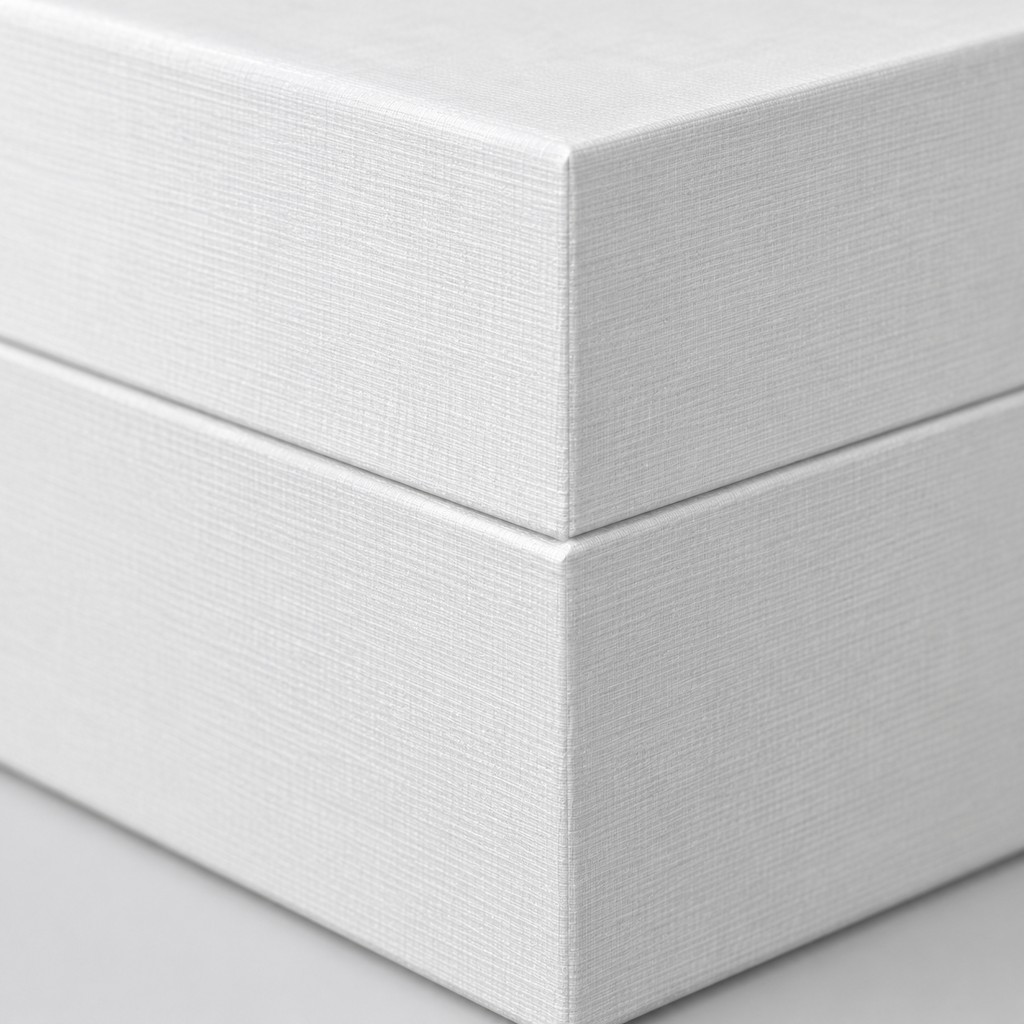
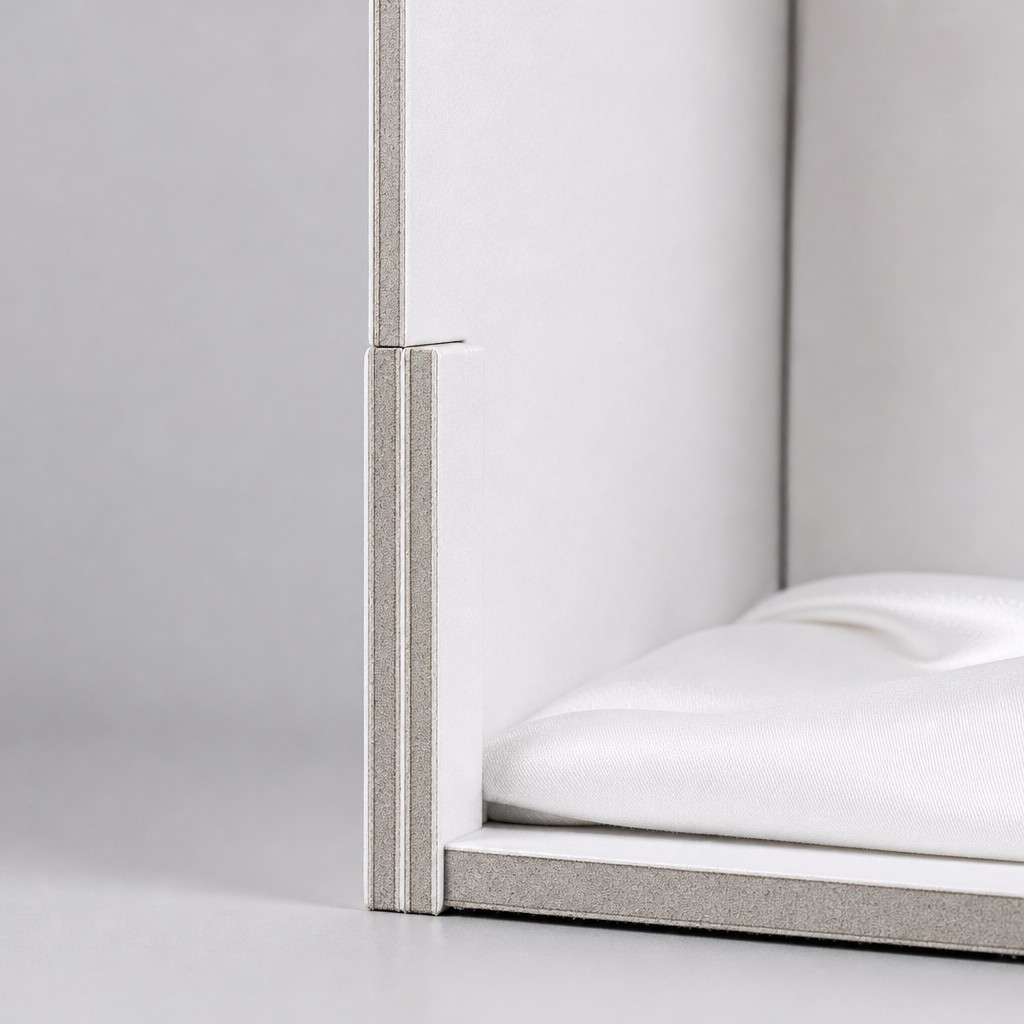
Take a tray and a lid that lifts off, then bond a strip of board round the lower part of the tray wall. That strip is the rim, and once it is on, the box is rimmed. The lid no longer closes over the tray wall; it closes onto the top edge of the strip.
Why the Band Belongs to the Base
Put the band on the lid instead and the geometry inverts: the wide part travels with the lid, the narrow part stays with the product, and the box looks top heavy from every angle. Fixed to the base, the band becomes a foot, a shoulder and a stop all at once.
It also solves a handling problem. A plain lid on a plain tray has nothing to grip except the paper itself, which is why so many boxes end up with a tab or a cord. A band that stands proud creates the grip in the geometry.
Two Millimetres of Grip
The projection is about two millimetres beyond the lid wall. That is enough to catch a fingertip and not enough to read as a second box. On a 13 x 13 x 7 cm pack it is a line you notice when your hand finds it and barely notice when you look at the box from a metre away.
Reading the Step When the Lid Is On
Closed, the lid edge sits on the band edge and the two are cut to the same footprint line, so what shows is a horizontal step of even width on all four sides. It looks deliberate because it is: a maker who cuts the lid deeper gets a seam halfway up the wall, and a maker who cuts it shallower gets a step that wanders.
Two things are worth checking on a sample. First, the step should be the same width on every face, including the two short returns. Second, the shadow line between lid and band should be one line, not a dark band, which would mean the lid is not seated.
Where a Band Helps, and Where It Does Not
It helps when the box is picked up often, when the product is heavy enough that a lid alone feels insecure, and when the pack has to look the same closed as it does in a photograph taken from any side. It is less useful on very shallow boxes, where the band would take up most of the wall and leave the lid looking like a cap.
Satin as a Working Surface
A larger cavity is not just a bigger version of a small one. More surface means more fabric, and fabric that is pulled flat across a wide span reads as plastic. Laid in by hand it keeps folds, and those folds take up slack when a heavy object settles.
For a lacquered speaker or a glass ornament, that soft bed is doing real work before any insert is added: it spreads contact, so a corner does not take the whole load.
Insert Choices for Larger Objects
Larger products usually need a shaped block rather than a flat pad, because the object has to be held against sliding as well as protected from impact. Cut the block to the outline, wrap it in the same lining, and the cavity looks continuous.
Heavier pieces want a paperboard platform under the block, so the weight lands on board and not on fabric. Stacked pieces, such as a tea set, want levels rather than one deep well.
What to Send Before the Dieline Is Cut
Four things settle the drawing: the outside size, the depth split between lid and band, the lining colour, and the product outline or 3D file. With those, a dieline and a 3D mockup come back in 1 to 3 days, a sample in 5 to 7 days, and a bulk run in 18 to 25 days. A sample request is the usual way to check the step, the FAQ covers the rest, and the workshop can quote from a drawing.
Questions Buyers Ask
Is the band structural or decorative?
Structural. It carries the lid, sets the closed height and provides the grip; decoration is a side effect of how it looks.
Does the band go all the way round?
Yes, without a break. The only interruption is the lap seam where the wrap closes, and that sits along the bottom edge.
Can the box stand without feet?
Yes. The band finishes flush with the base, so the box stands on a flat face.
Can the lining be changed later?
Lining colour and material are set at the sample stage; changing them afterwards means a new sample, because the fabric is laid in by hand to the cavity.