What “Flush” Actually Means Here
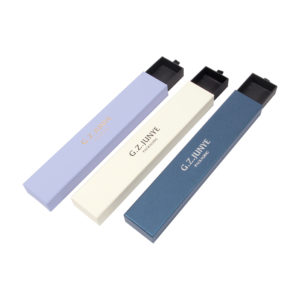
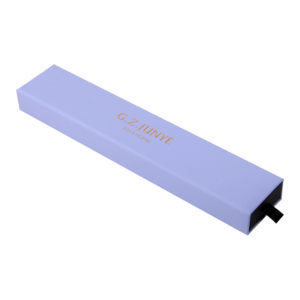
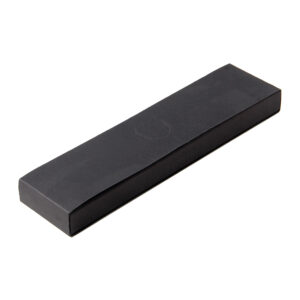
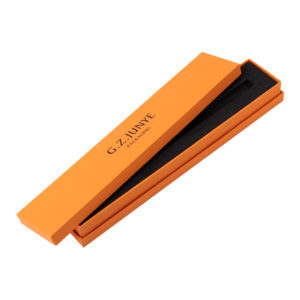
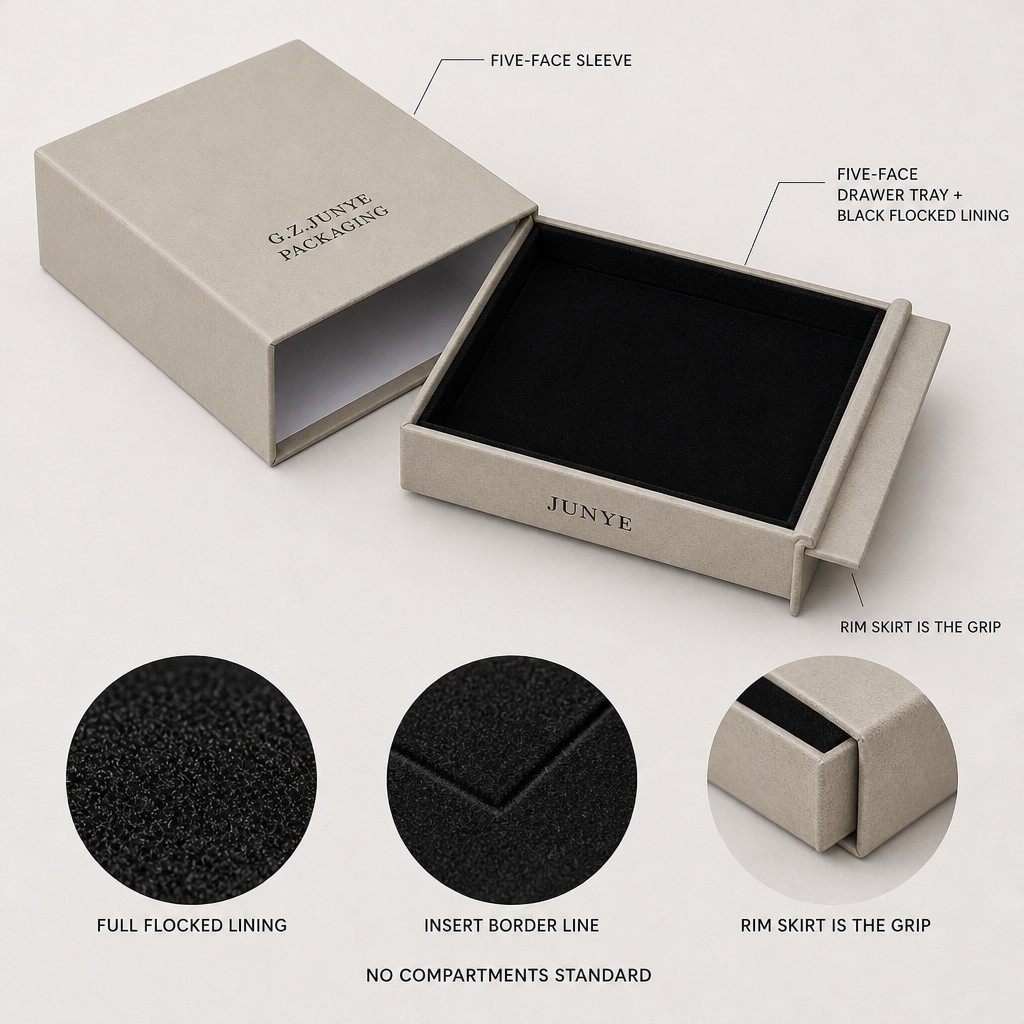
Flush is a measurement, not a mood. On a flush rim jewelry case the band around the tray end is cut to the sleeve’s own outer size, so the band face and the sleeve wall sit on the same plane. Nothing steps out and nothing is recessed.
That single decision gives the case its look when shut and its grip when opened. Get the band size wrong and both fail at once: the box reads as two parts, and the pinch point is either thin or proud.
Why a Rim Skirt Replaces a Ribbon Pull
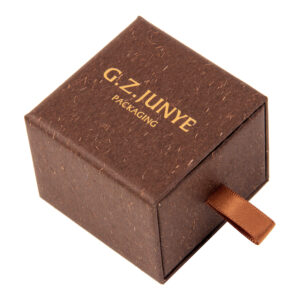
A pull has one job: give a finger something to hold. A ribbon does that job well, and it also brings a part that has to be cut, attached and inspected, and a loose end that hangs outside the box line when it closes.
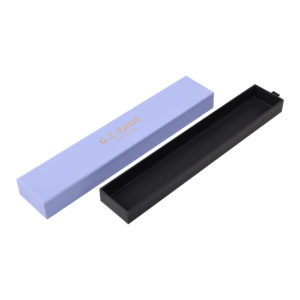
A skirt does the same job with board that is already on the tray. Cut to the sleeve outer size, it becomes the outer face as well as the handle, so one part does two jobs and there is nothing to attach.
Where a ribbon pull draws its length
A ribbon has to leave the box to be grabbed, which means the case either gaps slightly when closed or the ribbon sits flat and has to be picked up. On a shallow case both are noticeable, because there is so little wall for the eye to read.
Pinch Width: How Much Skirt a Thumb Needs
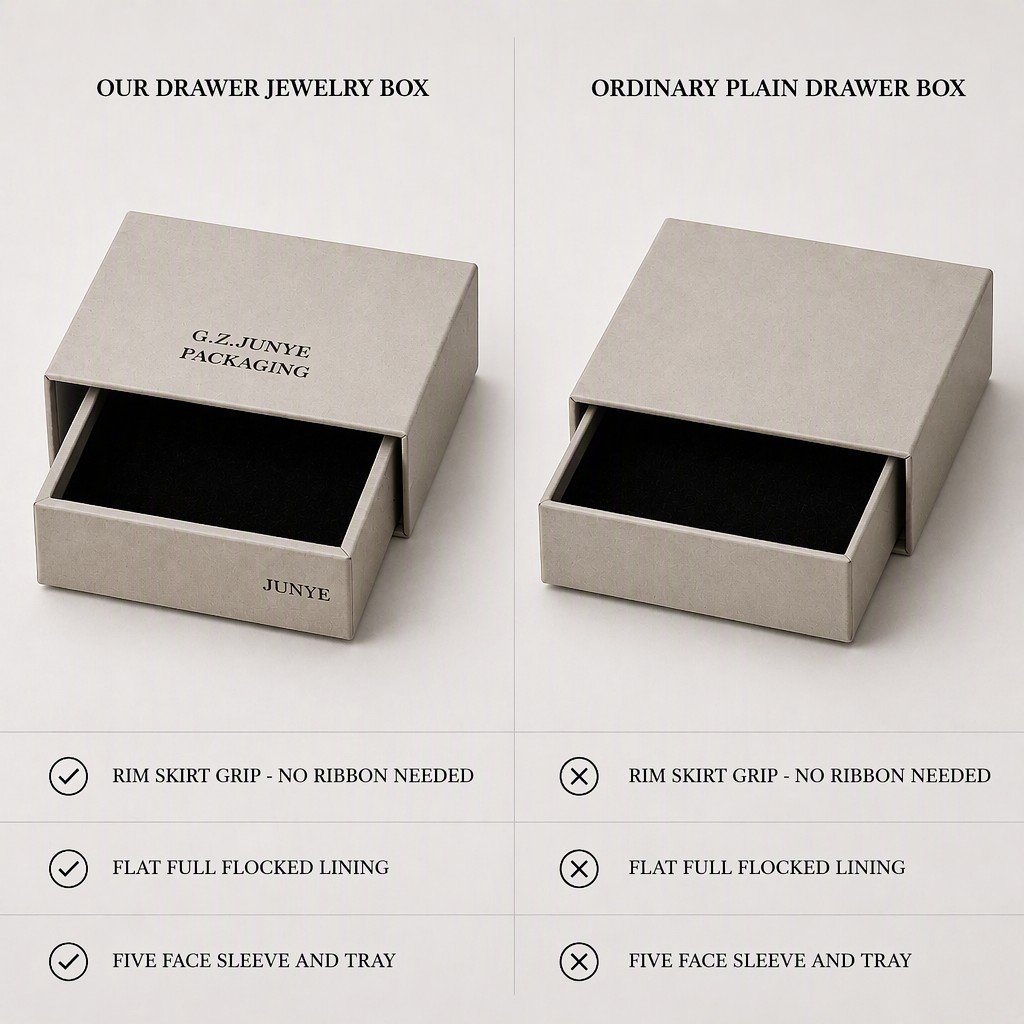
Pinch width is the one number that decides whether the grip feels deliberate. Too little and the tray is fiddly; too much and the closed box starts to look like a step rather than a single block.
On a plain drawer box the tray end is a bare wall, and that wall is also what a finger has to find. A skirt replaces that guesswork with a band the hand can close on without looking.
| Case width | Skirt pinch width | Share of the face |
|---|---|---|
| 10 cm | 2.2 cm | 22% |
| 13 cm | 2.9 cm | 22% |
| 16 cm | 3.5 cm | 22% |
The Seam That Gives the Box Away
Closed, the seam is the only evidence the case opens. A seam of even thickness all the way round reads as a machined line; a seam that widens at one corner reads as a fitting error.
| What you see | What it usually means |
|---|---|
| Seam is even all the way round | Skirt was cut to the sleeve outer size |
| Seam opens at one corner | Skirt is slightly oversized on one wall |
| Seam disappears on the long sides | Tray is a touch narrower than the skirt sits for |
| Step appears before the tray moves | Ledge depth is larger than the piece needs |
What the Outer Ledge Step Does on Opening
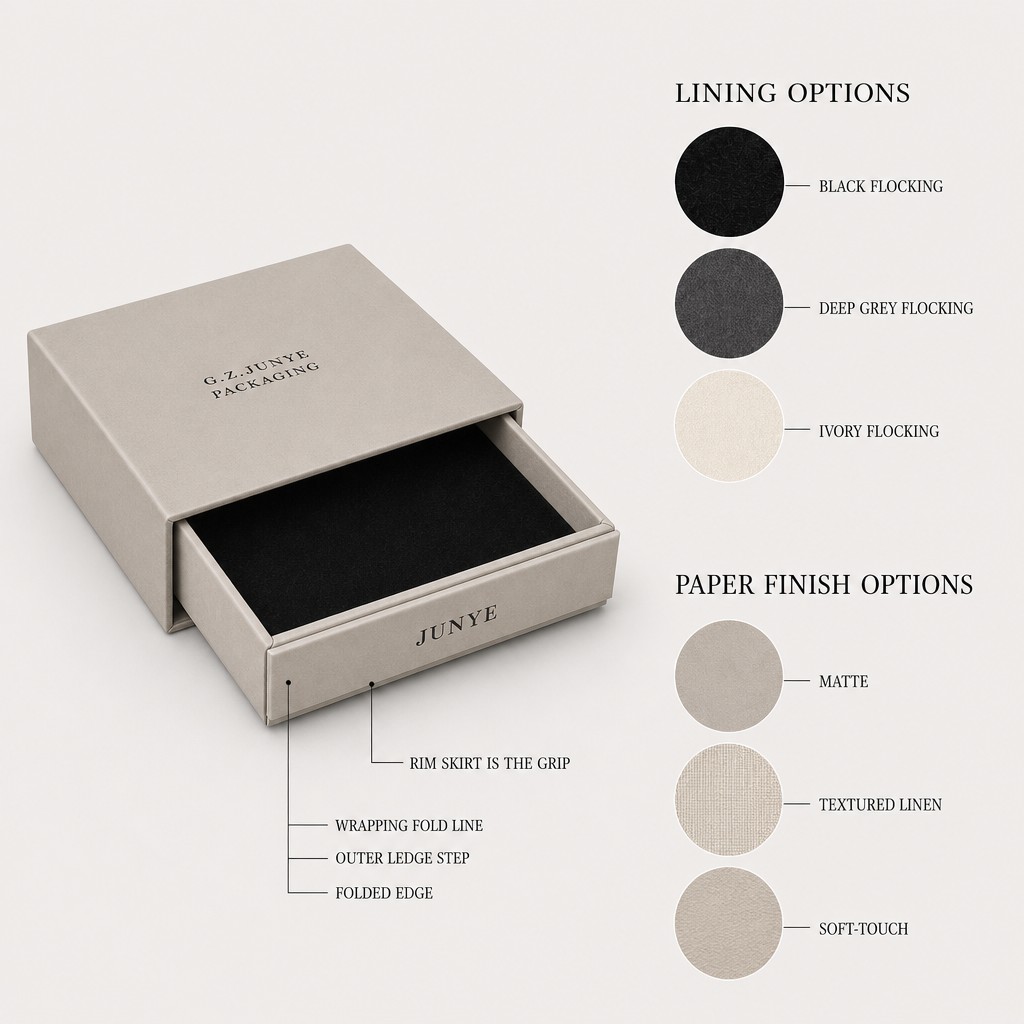
Pull the tray and the overhang appears. That ledge is the part of the skirt that sat outside the tray wall, and it is why the closed face could be continuous. Its depth trades pull comfort against the gap you see when the case is part open.
Liner Depth Under a Flat Flocked Pad
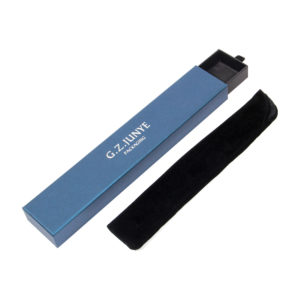
The standard lining is flat black flocking with one slim inlay line, and no compartments. On a shallow case the pad depth does most of the work: it decides whether a piece sits on the surface or sinks below the wall.
| Piece sat on the pad | Pad depth that works | What goes wrong otherwise |
|---|---|---|
| Bracelet, chain | Flat pad, 3 to 5 mm | A deeper pad hides the piece below the wall line |
| Row of rings | Flat pad with slots | Rings roll into each other without a cut |
| Pendant on a card | Flat pad, wider recess | A card edge lifts the piece unevenly |
| Studs | Shallow paired wells | Loose pairs meet in the middle of the tray |
Two Ways Buyers Get the Skirt Wrong
Most revision rounds come back to the same two misreadings, and both are cheap to avoid at the sample stage.
Mistake one: reading the skirt as decoration
The skirt is the opening mechanism, so it is measured first and styled second. Treating it as trim usually ends with a band that looks right and pinches badly.
Mistake two: sizing the skirt to the tray
A skirt cut to the tray wall, rather than to the sleeve outer size, leaves a step at the closed face. The seam then runs unevenly and the flush look is gone.
When a Ribbon Still Wins
There are cases where the accessory is the point. A deep presentation box with a lot of wall to read often wants a ribbon jewelry box treatment, because the ribbon fills space the board cannot. On a shallow case of two or three centimetres, a skirt usually carries the look better.
The same test applies to the inside. A slotted insert tray earns its keep when every piece must hold its position; a flat pad wins when the range changes from order to order. Both are decided by flat box proportions long before artwork.